
Direct answer summary
The beautiful demoiselle (Calopteryx virgo) is a freshwater damselfly species recognized by the metallic blue coloration of adult males. It perches on riparian vegetation to groom head sensory organs, thermoregulate, scan for flying insect prey, and defend riverine territories using its broad, dark wings.
Key Field Takeaways
- Taxonomic Classification: Order Odonata, Suborder Zygoptera, Family Calopterygidae, Calopteryx virgo.
- Primary Behavioral Adaptation: Micro-grooming of compound eyes using specialized tarsal brushes on forelegs to maintain maximum visual acuity.
- Ecological Niche & Range: Oxygen-rich streams and rivers across Europe and Western Asia requiring clean substrate and floating vegetation.
- Conservation & Field Status: Listed as Least Concern by the IUCN, but highly sensitive to agricultural runoff and water pollution.
| Biological Feature | Observed Specification |
|---|---|
| Binomial Nomenclature | Calopteryx virgo |
| Common Name | Beautiful demoiselle |
| IUCN Conservation Status | Least Concern |
| Primary Diet | Small flying insects (midges, mosquitoes, mayflies) |
| Natural Habitat | Fast-flowing, highly oxygenated streams and small rivers |
| Key Adaptation | Structural iridescence and wide-field compound vision |
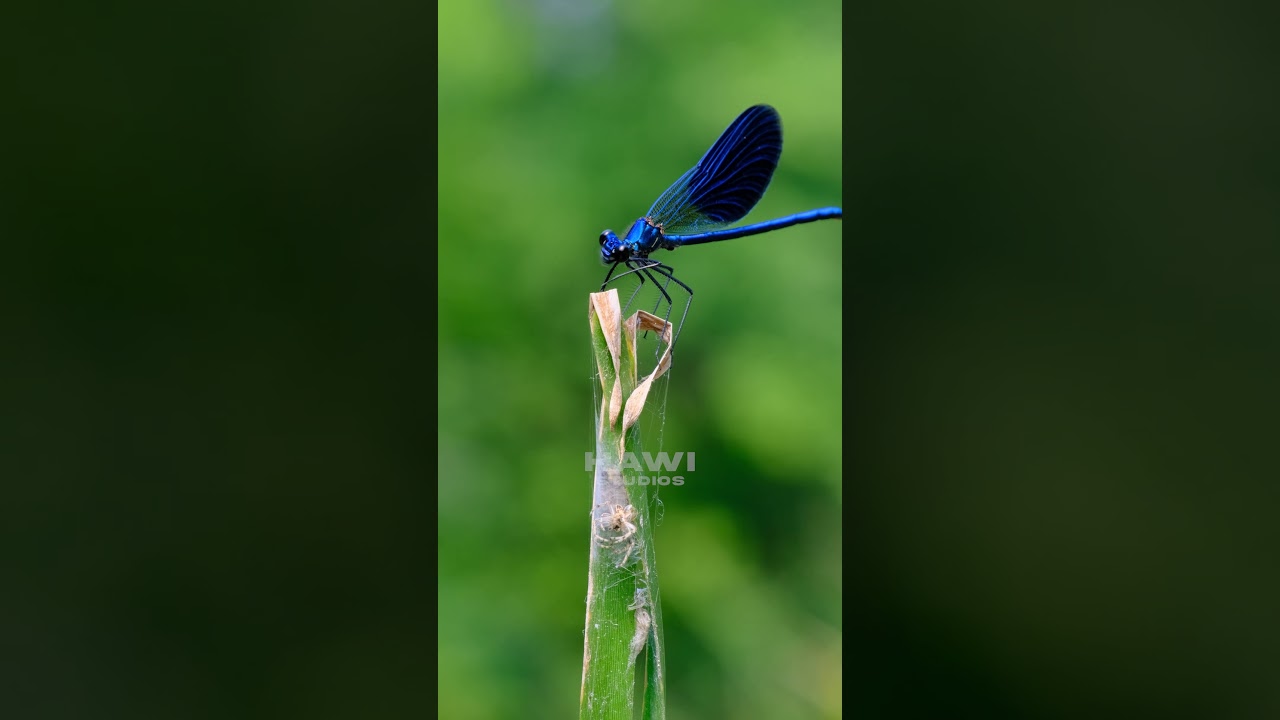
Perching mechanics and substrate grip in Calopteryx virgo
The beautiful demoiselle (Calopteryx virgo) demonstrates typical perching posture characteristic of the damselfly suborder Zygoptera. Unlike true dragonflies in the suborder Anisoptera, which rest with wings extended laterally at 90 degrees, this insect holds its four broad wings folded back vertically over the long abdominal segments.
Perching on the elevated tip of a reed or leaf blade allows the individual to maximize its field of view over surrounding water. The six thoracic legs extend forward and downward, grasping the plant fibers with sharp dual tarsal claws. This mechanical grip secures the insect against wind gusts while keeping the body elevated above the substrate.
Thoracic leg arrangement and stability
The legs of Calopteryx virgo are positioned forward on the pterothorax, angled toward the head. This orientation is specialized for perching and prey capture rather than walking on flat surfaces. Rows of fine stiff spines along the tibia and femur increase contact friction against narrow vegetation stems.
Grooming routines and optical sensory maintenance
In the observed footage, the adult male engages in precise grooming movements targeting the head capsule. The front legs bend at the trochanter joint to sweep over the labrum, mandibles, and the lower margins of the compound eyes. Stiff brushes of microscopic setae located on the front tarsi act as comb structures to scrape away airborne dust, moisture drops, and pollen.
Visual clarity remains fundamental to survival in Odonata. The large compound eyes consist of up to 10,000 individual visual units called ommatidia, providing a nearly 360-degree field of vision. Even minor dust buildup reduces contrast detection, impairing the damselfly’s ability to track small aerial prey or recognize territorial competitors.
Mandibular and antennal cleaning mechanics
During the cleaning sequence, the front legs pass the collected debris directly to the biting mouthparts. The labrum and maxillae process the tarsal tips to clear accumulated waste particles from the leg brushes. The short, bristle-like antennae are pulled through the tarsal joints to clean tactile sensors that monitor air velocity during flight.
Structural coloration and wing morphology
The striking metallic blue hue across the body and dark wings of the male beautiful demoiselle is not produced by chemical pigments. Instead, it relies entirely on nanoscale structural coloration. Multi-layered chitin structures in the cuticle reflect light at precise blue light wavelengths around 450 nanometers.
The broad wings feature dense wing venation that provides structural integrity during rapid flight maneuvers. Unlike females, which possess clear or brownish wings with distinct pale spots called pseudopterostigmata, mature males display dark blue wings across the entire surface. This structural coloration plays an essential role in visual species recognition and territorial signaling.
Riparian ecology and aquatic habitat requirements
The beautiful demoiselle is tied to cold, running freshwater ecosystems across Europe and Western Asia. The species inhabits small to medium-sized streams characterized by high dissolved oxygen levels, shaded bankside vegetation, and coarse gravel bed substrates. Males establish strict territories along sunny patches of riverbanks, defending sections of floating water plants.
Territorial defense involves direct aerial combat and visual wing-flashing displays. Males hover over the water surface, beating their four wings out of phase to produce a flutter display that highlights their dark blue wing surfaces to rival males and approaching females. Female oviposition occurs within submerged plant stems, where eggs hatch into aquatic nymphs.
Predatory strategy and comparative arthropod adaptations
Both adult damselflies and aquatic nymphs function as specialized predators within their micro-habitats. Adults operate as hawking predators, perching on exposed leaves before launching short, rapid intercept flights to catch small midges, blackflies, and mosquitoes mid-air. Their legs form a basket shape during flight to snatch prey from the air.
This predatory reliance on speed and compound vision contrasts with the stationary ambush tactics seen in land insects like the praying mantis feeding mechanics. Furthermore, while terrestrial insects such as the giant prickly stick insect biology rely on camouflage to avoid detection, Calopteryx virgo relies on rapid movement, optical acuity, and agility to survive.
Conservation status and bioindicator significance
The IUCN Red List classifies Calopteryx virgo as Least Concern due to its wide distribution across Europe and Asia. However, localized populations frequently face declines caused by stream modification, channelization, riverbank deforestation, and chemical pollution from agricultural runoff. Aquatic nymphs require clean water to extract oxygen through their three leaf-like caudal gills.
Because the aquatic larvae cannot survive low oxygen conditions or heavy silt sedimentation, entomologists treat the presence of Calopteryx virgo as a direct indicator of high water quality and healthy riparian habitat. Protecting intact river margins with native plant cover ensures stable breeding grounds for this species.