
Direct answer summary
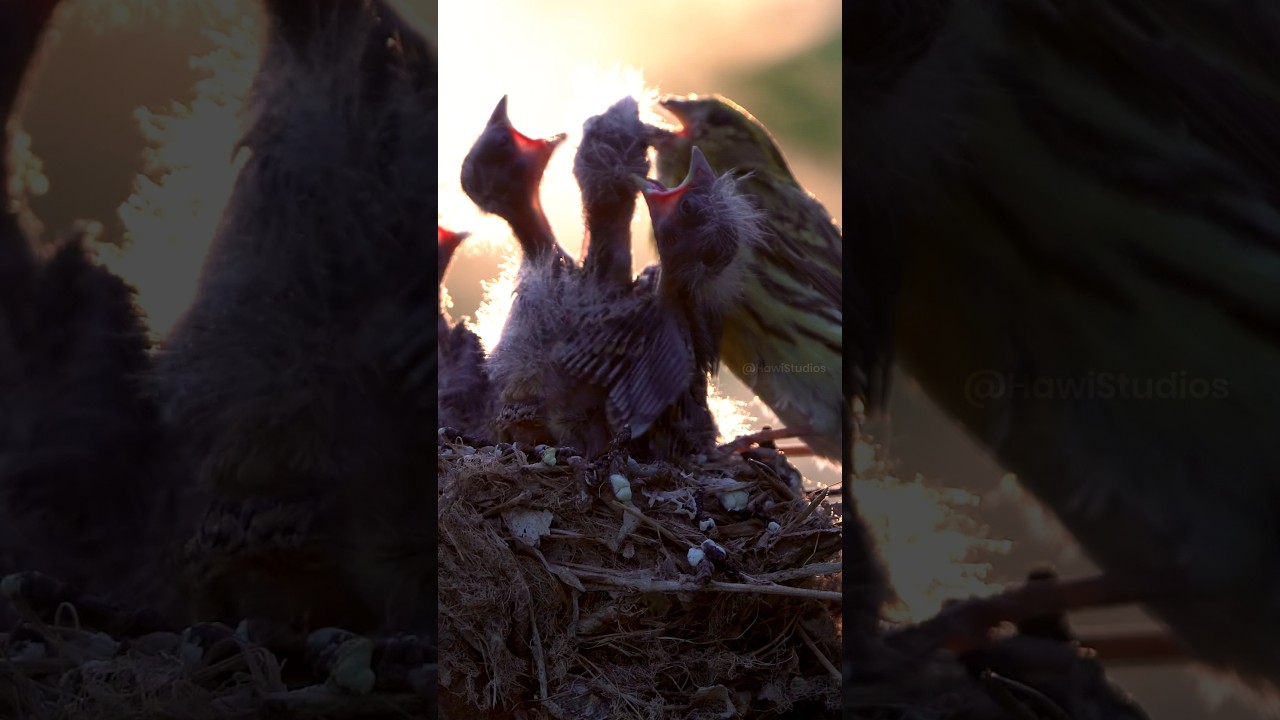
European serin nestling feeding relies on parental crop regurgitation, where adult birds feed nestlings a soft paste of partially digested seeds and plant matter. Parent birds deliver this high-protein slurry directly into the vivid red open gapes of four to five offspring simultaneously throughout the 14 day brooding period.
Key field takeaways
- Taxonomic Classification: European serin (Serinus serinus), Family Fringillidae, Order Passeriformes.
- Regurgitation Feeding Mechanism: Adults process seeds in their crop, regurgitating a soft plant slurry every 15 to 30 minutes during peak nestling growth.
- Gape Signaling Adaptation: Nestlings exhibit bright orange-red mouth linings that function as target points under low light canopy conditions.
- Clutch Size & Nest Architecture: Females lay 3 to 5 eggs in a tight cup nest built from fine twigs, rootlets, moss, and down fibers.
| Biological Parameter | Field Specification |
|---|---|
| Binomial Name | Serinus serinus |
| Common Name | European serin |
| Family | Fringillidae |
| IUCN Red List Status | Least Concern (Population Stable) |
| Primary Nestling Diet | Regurgitated seed paste, weed seeds, plant buds |
| Gape Coloration | Vivid magenta-red with pale yellow rictal flanges |
| Average Adult Weight | 11 to 14 grams |
Field observation of parental regurgitation in European serins
In the primary footage, an adult European serin (Serinus serinus) stands on the outer rim of a cup-shaped nest constructed from twigs and lichens. Four featherless nestlings raise their necks in unison, stretching their wide gapes vertically. The adult bird positions its conical beak over each open mouth in rapid succession, transferring crop contents directly into each chick throat.
Unlike insectivorous passerines that insert whole caterpillars or soft flies into nestling mouths, seed-eating finches utilize internal crop softening. The parent bird rhythmically pump its throat muscles to push softened seed pulp upward from its digestive tract. Each nestling receives a precise portion before the parent shifts its posture to target the adjacent chick.
Morphological adaptations for granivorous nestling care
European serins possess specialized anatomical adaptations suited for seed harvesting and nestling provisioning. Adult serins feature a short, thick conical bill measuring approximately 8 to 9 millimeters in length. This bill design allows adults to crush tough seed coats of wild grasses, chickweed, and dandelion before storing the seeds internally.
Nestlings exhibit a striking visual trigger mechanism known as gape color red-shift. The interior of the mouth cavity displays intense pinkish-red tissue bordered by yellow rictal flanges at the corners of the bill. These high-contrast markers guide parental food placement inside shaded tree canopies, maximizing feeding efficiency during brief adult nest visits.
Nest architecture and brood management mechanics
The nest shown in the visual record is a thick, compact cup positioned on a sturdy branch fork. Female serins weave outer walls using fine plant fibers, small twigs, mosses, and spider silk to bind structural elements together. The interior cup lining consists of soft animal wool, feathers, and seed down to retain body heat during early development stages.
Nest sanitation is a vital component of passerine brood management. Following regurgitation rounds, adult serins inspect the nest bowl to collect fecal sacs produced by the chicks. By swallowing or carrying away these gelatinous waste membranes, the parent keeps the nest clean and reduces olfactory cues that attract arboreal predators.
Interspecies comparisons and seed eating adaptations
Seed-dominated nestling diets are relatively uncommon among passerines, as most songbirds collect high-protein insects to sustain fast nestling growth rates. Finches in the family Fringillidae have evolved specialized digestive enzymes inside their crop that break down seed lipids early, converting plant fats into digestible proteins for young chicks.
This specialized granivorous feeding strategy contrasts with birds like the Himalayan flameback woodpecker, which relies on insect larvae extracted from bark. Similarly, while fruit-eating birds like the Rose-ringed Parakeet foraging routines involve harvesting cultivated crops, European serins concentrate almost exclusively on small wild seed heads in grassland clearings.
Conservation status and environmental distribution
The European serin maintains an extensive breeding range across southern and central Europe, North Africa, and Asia Minor. The International Union for Conservation of Nature (IUCN) categorizes the species as Least Concern, supported by stable regional populations. Serins thrive in agricultural edges, orchards, urban parks, and open pine woodlands where herbaceous plants remain abundant.
Changes in intensive weed management and heavy herbicide application pose local threats by reducing wild seed availability during spring nesting months. Preserved seed-rich margins and pesticide-free fields provide critical foraging areas, allowing parent serins to sustain multi-brood nesting seasons from April through August.