
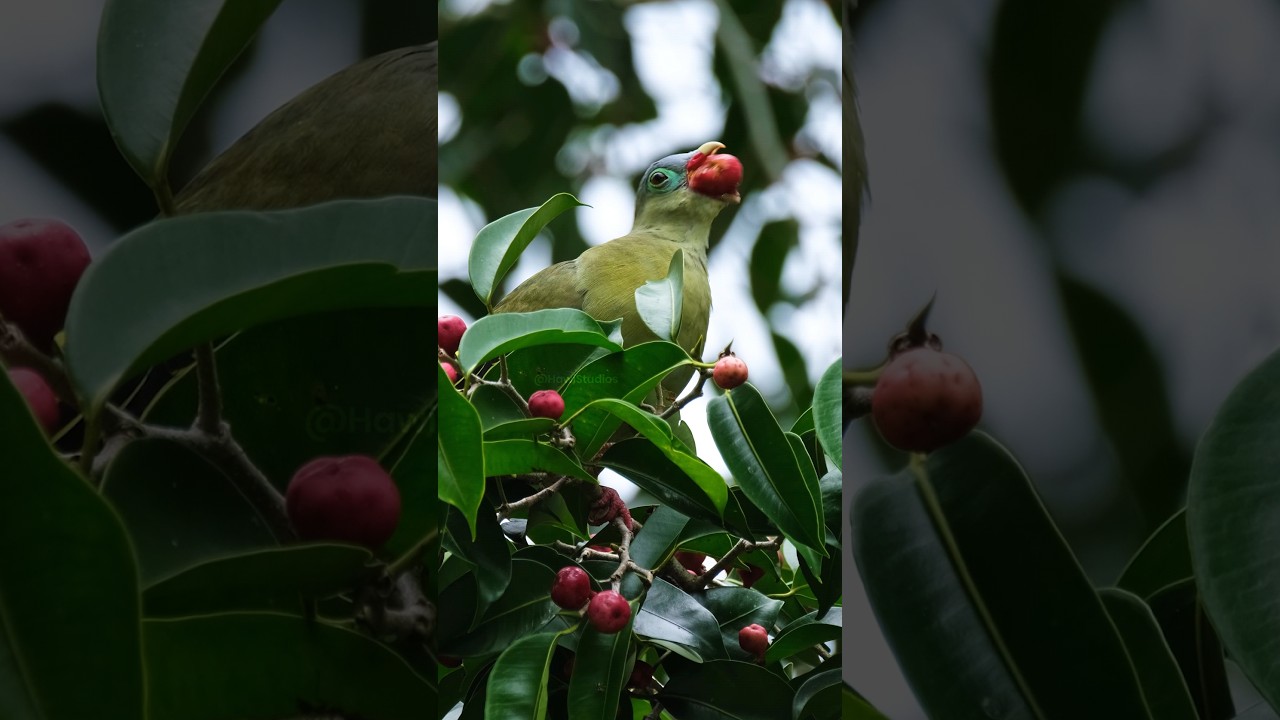
Direct answer summary
Thick-billed Green-Pigeon feeding relies on rapid whole-fruit ingestion, where the bird swallows spherical fruits up to 20 millimeters in diameter intact using a wide cranial gape and stout hooked bill. The bird uses gravity and esophageal peristalsis to move fruit directly into its crop without mastication.
Key Field Takeaways
- Taxonomic Classification: Class Aves, Order Columbiformes, Family Columbidae, Treron curvirostra.
- Primary Feeding Mechanism: Whole-fruit ingestion (frugivory) facilitated by a flexible rictus and wide lower jaw articulation.
- Ecological Distribution: Native to Southeast Asian tropical evergreen forests and lowland mangrove ecosystems.
- Conservation Status: Classified as Least Concern on the IUCN Red List of Threatened Species.
| Taxonomic Parameter | Biological Specification |
|---|---|
| Scientific Name | Treron curvirostra |
| Common Name | Thick-billed Green-Pigeon |
| IUCN Status | Least Concern |
| Primary Diet | Frugivorous (figs, berries, wild tree fruits) |
| Habitat Range | Lowland rainforests and mangrove swamps of Southeast Asia |
| Key Adaptation | Stout hooked bill and expansive gape for whole-fruit consumption |
Immediate physical observation and feeding mechanics
In the observed footage, a female or juvenile Thick-billed Green-Pigeon (Treron curvirostra) perches within dense upper-canopy leaves. The bird holds a fully ripe, bright red fig measuring approximately 15 to 20 millimeters in diameter within the distal tip of its beak. The red fruit contrasts against the olive-green plumage and turquoise orbital facial patch surrounding the eye.
At timestamp 00:03, the bird executes a precise swallowing sequence. It raises its head roughly 45 degrees relative to its body horizontal line and expands its gape. The heavy bill releases its pinching grip, allowing the round fruit to roll directly toward the pharynx. Rather than tearing the flesh or crushing the skin, the bird relies on gravity and rapid tongue movements to position the item into the esophagus.
Between 00:04 and 00:06, esophageal peristalsis transports the bulky fruit down the neck. A distinct swelling moves along the throat column as the fruit travels toward the crop. Once the fruit passes the upper neck region, the bird drops its head and resumes a scanning posture, displaying typical post-ingestion stabilization behavior seen in canopy-dwelling Columbidae species. Similar whole-prey swallowing dynamics occur across other bird families, such as observed in Black-crowned Night Heron foraging mechanics.
Morphological adaptations of the bill and digestive system
The head and bill structure of Treron curvirostra reflect specialized adaptational trends for an obligate frugivorous lifestyle. Unlike granivorous pigeons that possess slender beaks for seed pick-up, this species possesses a high, heavy, and laterally compressed bill. The base of the bill features a prominent bright red soft cere, while the bill tip transitions to a hard, pale greenish-yellow tone with a soft downward curve.
Cranial gape and jaw flexibility
The jaw articulation in Treron curvirostra allows a wider gape relative to head volume than seen in typical urban pigeons. Flexible quadratic joint attachments permit lateral expansion of the lower mandible branches when swallowing firm, spherical objects. This structural mobility enables the bird to exploit large fruit crops that other smaller avian frugivores cannot consume whole.
Digestive tract specialization
The digestive morphology of frugivorous tree pigeons features a wide, stretchable esophagus leading to an expandable crop storage pouch. Inside the stomach system, soft pericarp pulps digest quickly. Depending on food availability, seeds either pass intact through the intestinal tract or undergo grinding inside a muscular gizzard wall lined with specialized keratinoid layers.
Habitat requirements and canopy distribution
The Thick-billed Green-Pigeon occurs widely across Southeast Asia, including parts of India, Myanmar, Thailand, Malaysia, Indonesia, and the Philippines. The species relies heavily on primary and secondary tropical rainforests, freshwater swamp forests, and coastal mangrove zones. It stays predominantly within the mid-canopy and upper crown layers of fruiting trees.
These birds are nomadic in response to localized fruit ripening cycles. Large flocks travel several kilometers daily between roosting sites and fruiting trees, such as mature Ficus canopy trees. Their cryptic green plumage provides camouflage against canopy predators, blending with light reflection on leaf surfaces.
Canopy foraging requires efficient branch locomotion. The feet of Treron curvirostra possess broad plantar pads and strong zygodactyl-like gripping capability, allowing the bird to hang upside down or reach outward along thin distal twigs to pluck ripe fruits, mirroring specialized tree-foraging habits seen in Black-and-white Warbler foraging biology.
Ecological role in forest seed dispersal
As a specialized frugivore, Treron curvirostra plays a key role in tropical forest dynamics through seed dispersal. By consuming figs and forest fruits whole, the bird acts as a primary transport vector for canopy tree seeds. Fruits ingested in one section of the forest pass through the digestive system and deposit far from the parent tree.
Seeds excreted by fruit-eating birds retain high germination viability. The removal of fruit pulp during digestion reduces fungal contamination risks on the seed coat. Consequently, the movement of Treron curvirostra across forest patches supports forest regeneration and plant gene flow across fragmented tropical landscapes.
This ecological interaction mirrors seed and nutrient transport systems maintained by specialized birds in other ecosystems, such as feeding interactions documented in Yellow-billed Oxpecker feeding biology.
Conservation status and threats to tropical frugivores
The International Union for Conservation of Nature (IUCN) classifies the Thick-billed Green-Pigeon as Least Concern due to its wide geographic distribution and large global population size. However, regional populations face localized pressures from commercial deforestation and habitat fragmentation across its Southeast Asian range.
Loss of mature fig trees directly impacts local carrying capacities, as frugivorous species depend on continuous fruit production across overlapping tree species. Conservation of continuous tropical forest corridors remains essential to support the nomadic movements of Treron curvirostra and maintain its seed dispersal services.
What does the Thick-billed Green-Pigeon eat in the wild?
The Thick-billed Green-Pigeon relies primarily on wild figs (Ficus species) and small forest fruits. It consumes fruits whole without biting or peeling them.
How does the bill structure of Treron curvirostra aid in feeding?
The species features a stout, laterally compressed bill with a thick hooked tip and a red basal cere. This heavy bill shape provides a secure grip on slippery fruits before swallowing.
Where is the Thick-billed Green-Pigeon naturally found?
This bird inhabits tropical moist lowland forests, mangrove swamps, and forest edges across Southeast Asia, ranging from Eastern India through Indochina, Malaysia, and Indonesia.
Do green pigeons digest fruit seeds or disperse them?
Green pigeons act as significant seed dispersers for many canopy trees. Seeds pass through their digestive tract intact or are regurgitated, facilitating rainforest regeneration.