
Direct answer summary
The Yellow-billed Oxpecker (Buphagus africanus) is a specialized passerine bird that forages for ectoparasites on the skin of large African mammals. It employs a uniquely flattened, robust bill to glean ticks and larvae, often consuming blood to supplement its nutritional intake.
Key Field Takeaways
- Taxonomic Classification: Family Buphagidae, Genus Buphagus, Species Buphagus africanus.
- Primary Foraging Adaptation: A laterally compressed, chisel-like bill designed for precise extraction of embedded ticks.
- Ecological Niche: Obligate associate of large savanna ungulates, requiring hosts for both sustenance and foraging substrate.
- Conservation Status: Classified as Least Concern, though populations are fragmented by habitat loss and pesticide use on livestock.
| Feature | Specification |
|---|---|
| Scientific Name | Buphagus africanus |
| Common Name | Yellow-billed Oxpecker |
| IUCN Status | Least Concern |
| Diet | Ticks, mites, lice, and mammal blood |
| Habitat | Open savanna and woodland |
| Key Adaptation | Stiff tail for vertical stabilization |
Foraging mechanics on the host
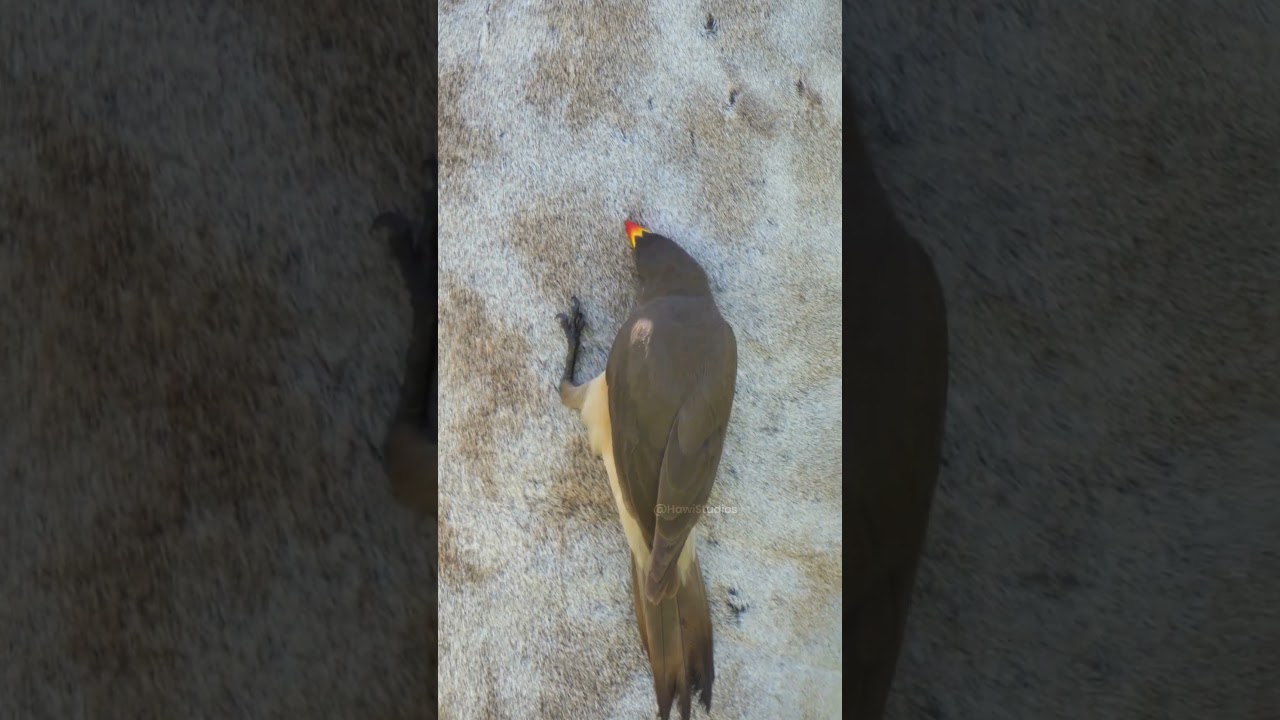
The Yellow-billed Oxpecker exhibits highly specialized foraging behaviors that allow it to exploit the skin of large mammals such as the impala or buffalo. In the footage, the bird moves with agility across the host’s hide, utilizing its sharp claws to maintain a secure grip. This mobility is essential for navigating the complex contours of a moving animal while searching for prey.
The bird’s bill is a precision instrument. It is laterally compressed and features a distinct yellow base with a red tip, allowing the bird to probe deeply into the fur to locate engorged ticks. Once a tick is detected, the bird uses a rapid plucking motion to extract the parasite. This behavior provides a significant service to the host by reducing the parasite load, although the bird may also feed on host tissues or blood from existing wounds.
Morphological adaptations for life on the host
The anatomy of the Yellow-billed Oxpecker is finely tuned to its lifestyle as a permanent associate of large mammals. Its feet are equipped with exceptionally sharp, curved claws that provide superior traction on tough, thick hides. These claws allow the bird to remain anchored even when the host is running or shaking its body.
Another vital morphological feature is the stiff, pointed tail. Similar to the adaptations seen in woodpeckers, the tail of the Yellow-billed Oxpecker acts as a third point of contact, or prop, when the bird is working on vertical surfaces. This structural support is crucial for maintaining posture while the bird uses its beak to manipulate its environment. The combination of these traits ensures that the bird remains stable while performing the delicate task of extracting parasites.
Interspecies relationships and ecological role
The interaction between the Yellow-billed Oxpecker and its host is a complex example of symbiosis. While the removal of ticks is a clear benefit to the host, the birds also exhibit behaviors that can be detrimental. By pecking at open wounds to access blood, they can prevent injuries from healing, occasionally turning the relationship into a parasitic one.
This behavior necessitates a delicate balance in the field. Large mammals often tolerate the presence of these birds, likely due to the net reduction in parasite-borne diseases. The Yellow-billed Oxpecker is a sentinel, often providing alarm calls when potential predators approach, which further integrates the bird into the defensive dynamics of the savanna ecosystem. Understanding these interactions is vital for assessing the health of grassland environments.
Conservation status and environmental factors
The Yellow-billed Oxpecker maintains a stable population across much of sub-Saharan Africa. However, the species is sensitive to environmental changes, particularly the widespread use of acaricides on domestic livestock. These chemical treatments reduce the availability of ticks, which are the primary food source for the birds.
Habitat fragmentation also poses a threat to the species, as it requires large, healthy populations of wild ungulates to thrive. Conservation efforts focus on maintaining natural grazing lands and minimizing the impact of agricultural chemicals on wildlife. By protecting the host species, conservationists indirectly support the survival of these specialized avian parasites-controllers, ensuring their continued presence in the African landscape.