
Direct answer summary
Large-billed crow (Corvus macrorhynchos) ocular mechanics rely on a translucent nictitating membrane that sweeps horizontally across the cornea to clean, moisten, and protect the eye without obstructing visual perception. This third eyelid engages during perching, gape-tracking, and canopy navigation to maintain continuous spatial awareness.
Key Field Takeaways
- Taxonomic Classification: Class Aves, Order Passeriformes, Family Corvidae, Genus Corvus, Species Corvus macrorhynchos.
- Primary Ocular Adaptation: Rapid, horizontal sweep of a translucent nictitating membrane driven by the pyramidalis and quadratus muscles.
- Sweep Velocity &, Duration: Nictitating membrane movement completes in under 100 milliseconds, sweeping from the anterior nasal angle to the posterior temporal corner.
- Ecological Function: Cleans corneal debris, maintains tear film distribution, and shields against wind abrasion during canopy perching and foraging.
| Parameter | Biological Field Specification |
|---|---|
| Binomial Nomenclature | Corvus macrorhynchos |
| Common Name | Large-billed crow |
| IUCN Conservation Status | Least Concern |
| Primary Diet | Omnivorous (invertebrates, seeds, fruit, small vertebrates, carrion) |
| Natural Habitat | Forest edges, woodlands, agricultural land, urban and canopy foliage |
| Key Adaptation | Translucent nictitating membrane for corneal protection and uninterrupted vision |
Frame-by-frame analysis of nictitating membrane movement
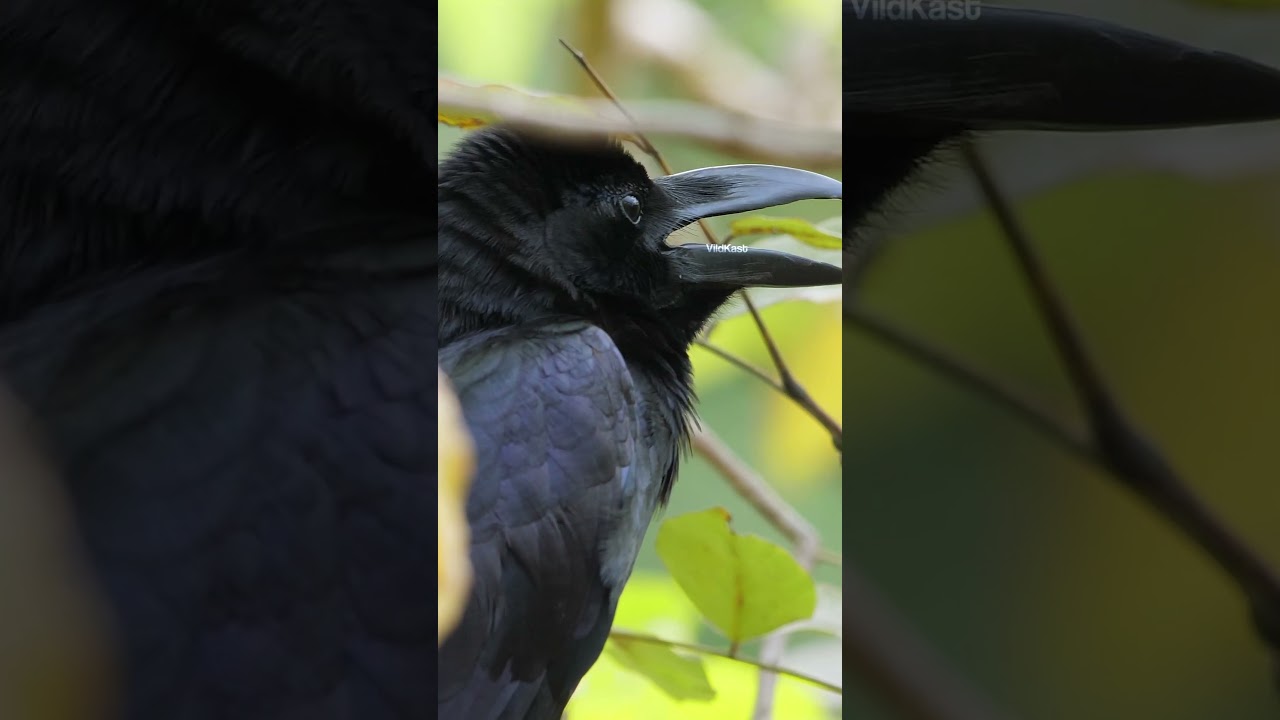
The observational footage provides primary visual evidence of large-billed crow ocular mechanics during routine canopy perching. At timestamp 00:00, the crow presents a lateral head alignment, revealing a milky white, translucent membrane fully extended across the globe of the eye. This structure, known as the nictitating membrane or third eyelid, moves horizontally across the corneal surface rather than closing vertically like outer eyelids.
By timestamp 00:01, the membrane retracts smoothly toward the anterior inner canthus near the base of the beak. This complete retraction exposes the deep black iris and pupil, restored to full optical clarity. Throughout this 6-second interaction, the large-billed crow (Corvus macrorhynchos) maintains a slightly open gape, a posture associated with heat dissipation and environmental vigilance while perching amidst green tree branches.
The physical motion observed in the footage demonstrates high-speed corneal lubrication. The sweep takes less than 100 milliseconds, allowing the eye to sweep away airborne particulate matter without causing prolonged sensory blackout. Because the tissue is semi-transparent, the crow continues to process environmental motion vectors even at the midpoint of the membrane sweep.
Morphology and sensory function of the corvid eye
The ocular anatomy of Corvus macrorhynchos is specialized for high visual acuity, depth perception, and rapid motion detection. Like most members of the family Corvidae, the large-billed crow possesses large, globoid eyes housed securely within sclerotic rings inside the skull. The high density of photoreceptor cells and retinal ganglion cells enables sharp central and peripheral vision, essential for identifying food items and monitoring potential predators.
The nictitating membrane consists of a thin sheet of elastic connective tissue covered by non-keratinized stratified squamous epithelium. Positioned beneath the outer upper and lower eyelids, it is anchored at the inner angle of the eye. The movement of this structure is governed by two specialized muscles situated on the posterior sclera: the musculus quadratus and the musculus pyramidalis.
When these muscles contract, they pull a delicate tendon that wraps around the optic nerve, drawing the membrane horizontally from the nasal margin across the cornea to the temporal corner. As it glides across the globe, the membrane acts like a windshield wiper. It distributes tear fluid secreted by the Harderian gland and removes dust particles, maintaining corneal transparency in dusty or windy conditions.
Perching mechanics and canopy vigilance
In the video, the large-billed crow displays precise perching stability on a thin, woody branch surrounded by broadleaf foliage. Avian perching is facilitated by an automatic foot-locking mechanism involving the flexor tendons of the lower leg. When the crow flexes its intertarsal joint upon perching, the flexor digitorum longus and flexor hallucis longus tendons tighten, clamping the toes firmly around the substrate without requiring active muscular exertion.
While securely anchored, the crow rotates its head to scan the canopy. Corvids maintain broad visual fields, utilizing monocular vision for lateral spatial scanning and binocular vision along a narrow central overlap zone aligned with the beak axis. This dual visual configuration requires frequent eye lubrication because open-air exposure subjects the broad corneal surface to evaporative water loss.
Similar perching and environmental monitoring patterns are observed across various avian species, such as Indian peafowl perching behavior in terrestrial habitats and perching songbirds like grey butcherbird vocal mechanics in woodland environments. These behavioral mechanisms ensure that the bird remains capable of instantaneous flight or prey targeting while conserving metabolic energy.
Ecological niche and foraging efficiency
The large-billed crow occupies a flexible ecological niche across South, East, and Southeast Asia. As an opportunistic omnivore, its diet includes fruits, invertebrates, small reptiles, nestling birds, seeds, and anthropogenic food waste. This diverse foraging regime exposes the bird to diverse environmental hazards, including dense thorn thickets, leaf litter, dust, and abrasive organic debris.
The nictitating membrane provides essential mechanical protection during active foraging. When probing into decaying wood, soil, or dense foliage, the crow extends the translucent tissue to guard against corneal puncture or scratch injuries. The ability to shield the eye while keeping light transmission intact preserves visual orientation during complex manipulative tasks, such as food handling and cache retrieval.
Ground and canopy vigilance systems, where continuous sensory processing must balance against environmental exposure, are vital for survival. Similar trade-offs between foraging activity and physical protection appear in mammals like Eurasian red squirrel foraging, where sensory vigilance directly impacts foraging success and predator avoidance.
Conservation status and ecosystem dynamics
The IUCN Red List categorizes Corvus macrorhynchos as Least Concern due to its extremely wide geographical range, stable population trends, and high adaptability to human-modified habitats. The species thrives in tropical forests, agricultural zones, suburban parks, and dense urban environments. Its generalized morphology and keen sensory apparatus allow it to exploit novel food resources efficiently.
Ecologically, large-billed crows play important roles as seed dispersers, scavengers, and natural pest control agents. By consuming carrion and biological waste, they accelerate nutrient cycling and assist in sanitation across forest edges and agricultural fields. Their high cognitive capacity and sharp ocular adaptations remain central to their success across diverse Asian landscapes.