
Direct answer summary
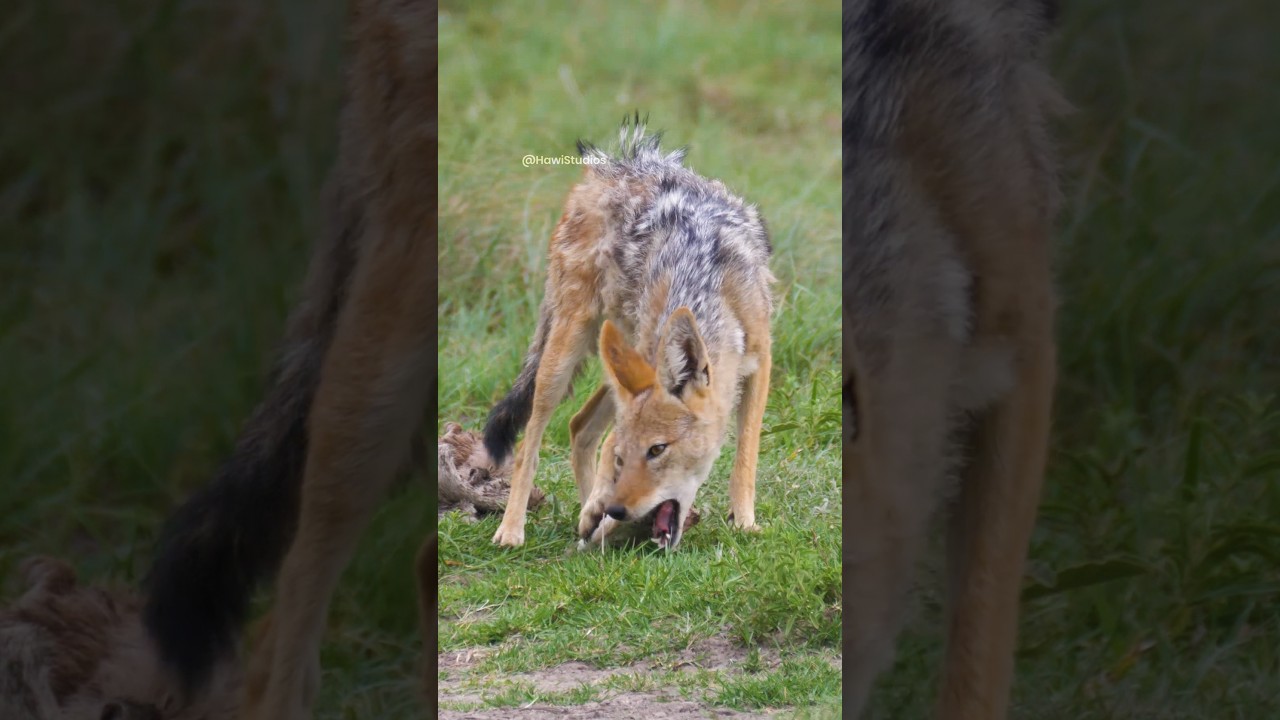
Black-backed jackals (Lupulella mesomelas) use specialized forelimb pinning mechanisms paired with lateral carnassial shearing to consume mammalian tissue and hide. Their bite force combined with sectorial molar movement allows rapid meat ingestion while maintaining periodic head-up scanning for competing predators.
Key Field Takeaways
- Taxonomic Classification: Family Canidae, Order Carnivora, Lupulella mesomelas (formerly Canis mesomelas).
- Mechanical Adaptation: Forelimb carcass pinning paired with fourth upper premolar and first lower molar carnassial shears.
- Sensory Vigilance: High-frequency auditory rotation across broad pinna range during 1.5-second chewing pauses.
- Conservation Status: Classified as Least Concern on the IUCN Red List across East and Southern African savannah habitats.
| Metric / Feature | Field Specification |
|---|---|
| Scientific Name | Lupulella mesomelas |
| Common Name | Black-backed jackal |
| IUCN Status | Least Concern |
| Adult Weight Range | 6.0 to 10.0 kg (13.2 to 22.0 lbs) |
| Primary Diet | Opportunistic omnivore (small mammals, carrion, insects, reptiles) |
| Key Adaptation | Forelimb carcass anchorage and high-shear carnassial dental processing |
Forelimb pinning and dental mechanics during feeding
In open grassland habitats, small carnivores face distinct mechanical challenges when dismembering fibrous animal tissue. The black-backed jackal anchors food items against the substrate using its body mass and limb architecture. By placing a forelimb directly over a carcass fragment, the animal creates static friction against the ground surface. This foot position prevents the prey from shifting forward when jaw force is applied.
As observed in the primary field footage, the jackal places its right forepaw firmly onto the hide. It lowers its skull, aligns its incisors with the edge of the tissue, and bites down securely. Once a firm grip is established, the head retracts upward and backward while the forelimb maintains downward pressure. This opposing double-force vectors tension across the muscle fibers, allowing the teeth to separate smaller bites from the main piece.
This mechanical technique contrasts with species that lack flexible forelimb stabilization. For example, avian foragers rely entirely on cervical wrenching or beak manipulation, as seen in Southern ground hornbill prey handling where items are swallowed whole or crushed against hard surfaces. The canid reliance on limb-anchored pulling provides greater efficiency when dealing with tough hide and elastic ligaments.
Carnassial dental morphology and tissue tearing
The dentition of Lupulella mesomelas features 42 specialized teeth designed for processing both fresh flesh and tough structural tissue. The focal anatomical equipment for meat consumption is the carnassial apparatus. This set consists of the upper fourth premolar (P4) and the lower first molar (m1). These specific teeth blade past one another during jaw closure in a slicing, scissor-like action.
When the jackal grips a tough patch of hide, it shifts the material from its front incisors sideways into the premolar and molar zone. The lateral masticatory muscles contract, bringing the sharp cusps into contact. The mechanical advantage generated at the back of the jaw exerts elevated bite forces exceeding 300 Newtons relative to the body size of the animal. This lateral shearing action cuts collagen strands that straight puncturing incisors cannot break.
The jaw articulation in canids strictly limits side-to-side grinding movement, locking the mandibles into a vertical hinge. This hinge structure concentrates muscular energy directly into vertical and diagonal shearing planes. Consequently, the animal can sever skin, tendon, and skeletal muscle fibers rapidly without risking jaw dislocation.
Sensory vigilance and scanning pauses
Feeding on open terrain exposes mid-sized canids to constant ecological risk. In the field footage, the feeding cycle is regularly interrupted by sudden structural pauses. At second 00:03, the jackal immediately halts mastication, elevates its head roughly 35 centimeters above the grass line, and locks its posture into an upright scan.
This head-up position restores broad visual and acoustic awareness. Large, erect pinnae pivot independently to capture ambient high-frequency sounds across the plain. This heightened sensitivity allows early detection of larger apex species, whose presence would force an immediate retreat. Readers interested in apex predator acoustic output can examine lioness roaring mechanics to understand the heavy sound signals that smaller scavengers monitor.
These scanning micro-pauses last between one and three seconds before feeding resumes. The continuous alteration between head-down processing and head-up environmental scanning maximizes caloric intake while maintaining a low profile against dominant kleptoparasites and predators.
Ecological niche and opportunistic foraging strategy
The black-backed jackal occupies an active dual role within African ecosystems as both a mesopredator and a primary scavenger. Weighing between 6 and 10 kilograms, this canid cannot consistently defend large carcasses against spotted hyenas or lions. Instead, its foraging strategy relies on high mobility, acute olfaction, and dietary flexibility.
Jackals hunt small prey including rodents, scrub hares, ground-nesting birds, and insects. When larger prey is available, they act as opportunistic scavengers, feeding on leftover remnants abandoned by larger carnivores. Their stomach physiology features low gastric pH levels near 1.5, which neutralizes harmful bacteria found in decaying tissue and allows digestion of bone fragments.
Their light body frame and long limb bones support efficient trotting across extended distances. A single jackal can cover over 20 kilometers in a night search, conserving metabolic energy through a light, rhythmic gait until potential food sources are located.
Territoriality and interspecies dynamics in African savannahs
Black-backed jackals form long-term monogamous pairs that defend permanent territories ranging from 2 to 15 square kilometers. Both adult partners scent-mark boundaries using urine and scat deposits on vegetation mounds. Pair bonding increases hunting success and provides joint defense against competing jackal pairs or smaller carnivores.
Within the broader ecological community, jackals interact with sympatric carnivores including side-striped jackals, African wild dogs, and various raptor species. While they yield to larger predators at kills, their agility allows them to dart in and secure small pieces of meat before retreating to safe distance cover.
Habitat loss and human-wildlife conflict remain localized pressure factors across agricultural borders. However, due to their broad dietary range and high reproductive potential, populations of Lupulella mesomelas maintain stable numbers across protected parks and surrounding pastoral zones.