
Direct answer summary
Indian peafowl perching behavior functions as an essential antipredator strategy, elevating birds above ground hazards to scan for predators. By positioning themselves on elevated rock formations or tree branches, Pavo cristatus gains a wide field of view while using specialized anisodactyl feet to secure balance on uneven surfaces.
Key Field Takeaways
- Taxonomic Classification: Class Aves, Order Galliformes, Family Phasianidae, Pavo cristatus.
- Primary Behavioral Adaptation: Elevated perching for early predator detection and spatial orientation.
- Foot Anatomy Metric: Anisodactyl toe arrangement with a hallux gripping angle providing stability on rock edges.
- Conservation Status: Classified as Least Concern on the IUCN Red List with stable native populations.
| Attribute | Specification |
|---|---|
| Binomial Nomenclature | Pavo cristatus |
| Common Name | Indian Peafowl |
| IUCN Status | Least Concern |
| Primary Diet | Omnivorous (seeds, insects, small reptiles, berries) |
| Natural Habitat | Deciduous forests, scrublands, agricultural borders |
| Key Adaptation | Iridescent structural plumage and anisodactyl perching feet |
Frame by frame analysis of elevated perching mechanics
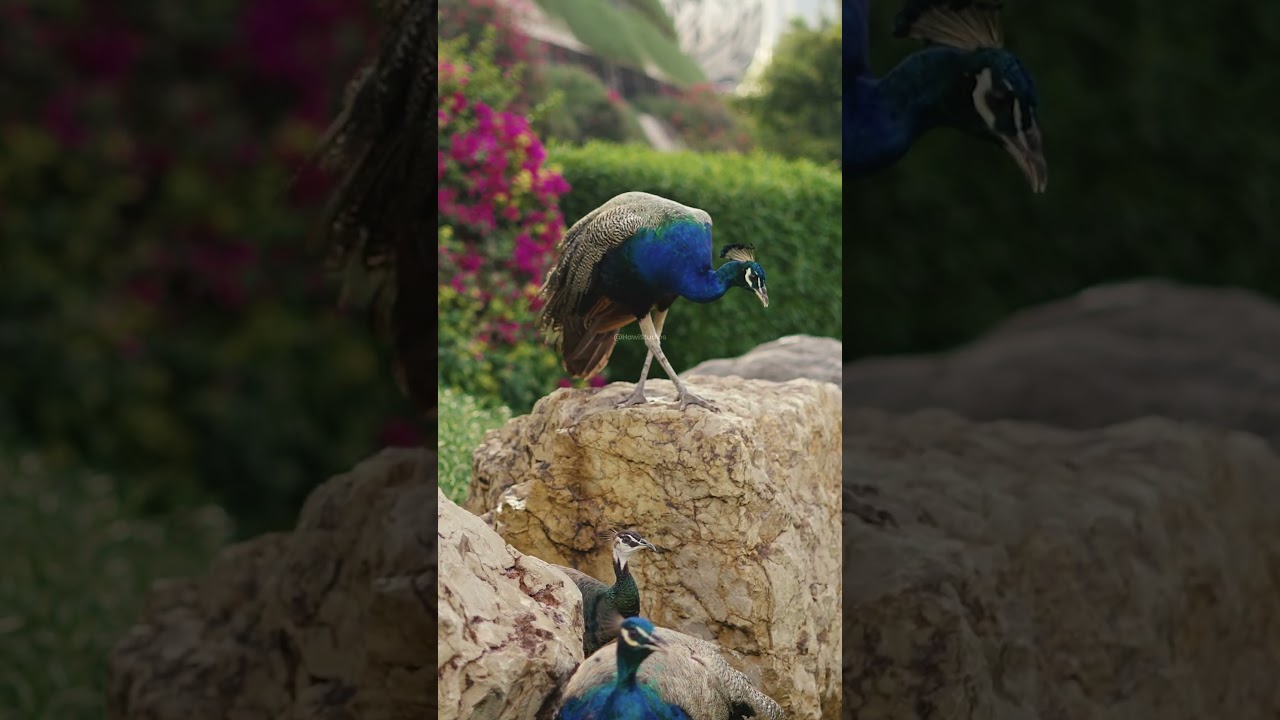
In the footage, a male Indian peafowl (Pavo cristatus) shifts its body weight across a large limestone rock formation. The bird extends its tarsus forward, placing its foot carefully onto an uneven ledge while maintaining an upright chest posture. Each movement reflects precise motor control as the bird evaluates substrate stability before committing its mass.
Positioned in the lower crevice of the rock outcropping, a second individual rests on a shaded ledge. This spatial distribution demonstrates group roosting mechanics, where individual birds select distinct height levels to maintain visual coverage across surrounding vegetation. The higher perching individual gains an unobstructed view of the surrounding terrain.
Weight distribution and foot gripping mechanics
The foot structure of the Indian peafowl features an anisodactyl arrangement, where three toes point forward and the hallux points rearward. This configuration provides a stable base of support when walking on loose soil or balancing on narrow stone ridges. The spread of the forward digits spreads weight evenly across rough rock faces.
As the peacock adjusts its position on the stone, flexor tendons in the lower leg automatically tighten when the intertarsal joint bends. This mechanical flexor mechanism locks the digits around uneven edges, allowing the bird to remain anchored without continuous muscular strain. This adaptation is essential for long perching bouts and nocturnal roosting high above the ground.
Morphological features and structural color in male peafowl
The neck and breast plumage of the male Indian peafowl exhibits an intense blue hue that changes intensity based on lighting angles. This visual effect stems from structural coloration produced by microscopic physical arrangements within the feather barbules rather than chemical pigmentation. Melanin rods and keratin layers reflect blue light while absorbing other spectral wavelengths.
In contrast to the iridescent neck, the wings show a barred black and buff pattern that provides camouflage when the bird is resting among low vegetation. The combination of brilliant signal coloration and cryptic wing patterns allows peacocks to balance visual signaling with predator avoidance depending on body posture.
Train composition and weight management during movement
The elongated train of the male consists of over 200 extended upper tail coverts, rather than true rectrices or tail feathers. These coverts can measure up to 1.5 meters in length and add substantial weight to the posterior half of the bird. Balancing this extended train requires constant adjustments of the neck and torso position when navigating elevated rocks.
When stepping down steep rock surfaces, the male keeps its train tightly folded behind its body. By aligning the feathers close to its center of mass, the peacock reduces wind resistance and prevents the long coverts from catching on jagged rock projections during movement.
Vigilance behavior and predator detection strategies
Indian peafowl possess laterally positioned eyes that grant a broad visual field exceeding 300 degrees. This wide arc enables birds to monitor the horizon for approaching threats while remaining largely stationary. Slight head rotations allow each eye to scan both upper canopy levels and ground vegetation.
Head bobbing sequences observed during perching assist in spatial depth perception. Because birds have limited binocular overlap at the front of their field of view, rapid movements of the head generate motion parallax. This parallax visual processing allows the peafowl to accurately calculate the distance to nearby ledges or potential predators.
When examining avian spatial scanning strategies, peafowl share elevated perching instincts with other ground-nesting species. Studying an Indian peahen perching behavior highlights similar head movement patterns dedicated to scanning environmental borders for concealed threats.
Terrestrial mammals also rely on elevated terrain to assess environmental risks. Similar behavioral mechanics exist in mule deer vigilance mechanics, where animals stop on high ridges to monitor surrounding forest cover.
Terrestrial foraging and habitat utilization
Ground foraging constitutes a major portion of daily activity for Pavo cristatus. Their sturdy tarsometatarsal legs and curved claws allow them to dig through leaf litter to uncover seeds, invertebrates, small reptiles, and plant shoots. After foraging bouts, birds return to elevated perches to digest food in safety.
Similar ground scratching and pecking strategies occur across various large terrestrial bird species. Examining ostrich pecking mechanics shows how heavy ground-dwelling birds utilize specialized beak structures to harvest food efficiently from firm substrates.
Native to South Asia, Indian peafowl inhabit deciduous forests, riverine scrublands, and edges of cultivated land. They require habitats with permanent water sources, open ground for foraging, and tall trees or rocky structures for nighttime roosting.
Conservation status and ecological threats
The International Union for Conservation of Nature (IUCN) classifies Pavo cristatus as Least Concern. Wild populations remain stable across India, Sri Lanka, and Nepal, supported by cultural reverence and strict legal protections under national wildlife acts.
Despite stable overall numbers, local populations face challenges from habitat fragmentation, agricultural pesticide use, and illegal poaching for feathers. Their ability to thrive in human-modified landscapes, including agricultural fields and suburban parks, helps maintain stable population densities across their native range.
Why do Indian peafowl search out elevated perches?
Indian peafowl roost on elevated structures like trees and large rocks to escape ground predators such as jackals, leopards, and feral dogs. Elevated positions expand visual scanning ranges and protect birds during resting periods.
How do peacocks balance on uneven rocks with a heavy train?
Peacocks maintain balance using an anisodactyl foot arrangement combined with automatic tendon locking mechanisms in their legs. They shift their center of gravity over their sturdy tarsometatarsal bones while adjusting toe placement across uneven rock textures.
What gives male Indian peafowl their blue color?
The brilliant blue color of the male Indian peafowl comes from structural coloration rather than chemical pigments. Microscopic two-dimensional photonic crystal structures within the feather barbules reflect blue light wavelengths while absorbing others.
What is the conservation status of Pavo cristatus?
The Indian peafowl is classified as Least Concern on the IUCN Red List. The species benefits from strict national legal protection in India and adapts well to agricultural and suburban habitats.