
Direct answer summary
Mule deer vigilance mechanics depend on independent pinnae rotation, horizontal pupil alignment, and controlled slow-stride locomotion to detect environmental threats in low-visibility fog. By maintaining elevated cervical alignment and extended pause cycles, Odocoileus hemionus compensates for damp atmospheric visual restrictions while navigating open forest floors.
Key Field Takeaways
- Taxonomic Classification: Order Artiodactyla, Family Cervidae, Odocoileus hemionus.
- Primary Sensory Adaptation: Large 23 cm pinnae with 180-degree independent rotational capability for acoustic tracking.
- Visual Field Architecture: Horizontal slit pupils providing a 310-degree panoramic field of view along the horizon.
- Locomotor Strategy: Cautious four-beat walking stride synchronized with elevated cervical scanning pauses.
| Biological Parameter | Field Specification |
|---|---|
| Binomial Nomenclature | Odocoileus hemionus |
| Common Name | Mule deer / Black-tailed deer |
| IUCN Conservation Status | Least Concern |
| Primary Diet | Forbs, woody browse, grasses, lichens |
| Natural Habitat Range | Western North America coastal forests, shrublands, and montane zones |
| Key Adaptation | Large acoustic pinnae and horizontal panoramic vision |
Immediate physical observation and behavioral mechanics
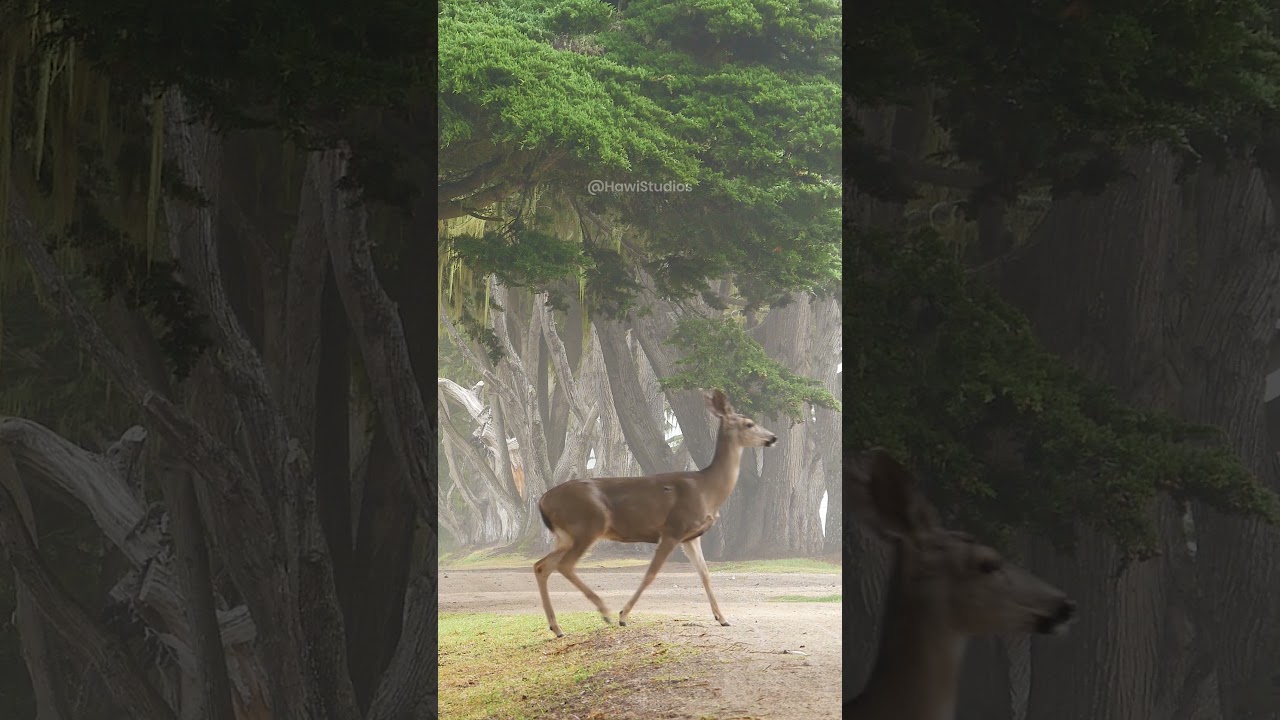
In the observed footage, a female mule deer (Odocoileus hemionus) walks through a damp coastal woodland underneath mature Monterey cypress canopy. The animal exhibits deliberate quadrupedal gait control, pacing across the uneven terrain with slow forelimb extensions. Each step involves precise hoof positioning to minimize substrate noise on dry needles and soil.
The neck remains held at an elevated 45-degree angle, maintaining the head well above shoulder level. This posture positions the eyes clear of low-lying brush, permitting an unhindered visual sweep across the forest path. Throughout the passage, the deer pauses its forward stride, rotating its head laterally toward the tree line to evaluate acoustic and visual signals.
Atmospheric fog reduces background contrast, narrowing visual detection thresholds for distant motion. In response, the ungulate lengthens its stationary scanning intervals between paces. This balanced movement pattern optimizes energy output while ensuring continuous monitoring of potential disturbance vectors in foggy coastal conditions.
Morphological and anatomical sensory adaptations
The prominent ears of Odocoileus hemionus provide superior acoustic localization capabilities. Measuring up to 23 centimeters in length, each pinna operates independently through ten specialized muscles. This anatomy permits a 180-degree rotational arc, capturing sound frequencies up to 30 kilohertz without requiring whole-body repositioning.
Visual structures are equally specialized for open and semi-dense habitats. Mule deer possess horizontally elongated pupils that maintain a wide panoramic view aligned parallel to the ground surface. This configuration delivers a 310-degree field of vision, allowing the animal to monitor the horizon for predators while keeping its head lowered during forage sampling.
Olfactory processing relies on an expansive nasal cavity lined with millions of sensory receptors. Moisture in foggy coastal air traps airborne chemical compounds, enhancing scent molecule collection on the wet rhinarium. This heightened olfactory acuity acts as an early warning system when fog obscures optical sightlines.
Habitat range and coastal forest ecology
Mule deer occupy diverse biomes across western North America, ranging from arid deserts to temperate coastal forests. In coastal ecosystems characterized by heavy morning mist and dense overstory, microclimates produce abundant lichen growth such as Usnea along upper tree branches. Fallen lichen fragments serve as a nutrient-dense dietary supplement during periods when terrestrial herbaceous vegetation is scarce.
The structural complexity of coastal forest edge zones offers both thermal cover and foraging corridors. Large evergreen trees break high wind velocities and intercept rainfall, creating stable ground-level microhabitats. Mule deer navigate these clearings using established game trails, balancing browse availability against exposure to open terrain.
In these coastal microhabitats, vigilance strategies adapt to microclimatic variations. Fog alters sound transmission density and light attenuation, requiring ungulates to coordinate sensory modalities differently than in open grassland habitats. Similar sensory dynamics govern prey vigilance in other ecosystems, such as Indian peahen perching behavior in forested cover.
Interspecies relationships and anti-predator dynamics
As primary consumers, mule deer face predation pressure from cougars, wolves, coyotes, and bears. Their survival depends on early threat identification followed by swift evasive action. When potential danger is detected, Odocoileus hemionus transitions from a walking gait to stotting, a high-bounding leap where all four hooves strike the ground simultaneously.
Stotting elevates the deer above low vegetation, providing an unhindered view of pursuing predators while signaling athletic vigor to the attacker. In dense forest environments, this vertical movement allows the animal to clear obstacles like fallen logs easily. The high visual profile also alerts nearby conspecifics to impending danger.
Under fog-shrouded conditions, vocal communication remains muted to avoid revealing precise locations to stealth predators. Acoustic cues like alarm snorts are reserved for confirmed threats. In contrast to vocal display dynamics seen in species like the red deer mate call during open-rutting conditions, coastal mule deer prioritize silent visual and olfactory monitoring.
Conservation status and ecosystem threats
Mule deer populations are currently categorized as Least Concern by the IUCN, maintaining robust numbers across most historical ranges. However, localized populations face stress from habitat fragmentation, suburban expansion, and altered fire regimes. Fencing and road networks disrupt seasonal migration corridors between high-elevation summer ranges and sheltered winter valleys.
Disease transmission represents another key management concern for wild cervid populations. Chronic Wasting Disease, a fatal neurodegenerative prion condition, spreads through direct animal contact and contaminated soil. Resource managers track herd densities and movement corridors to limit disease spread in high-density overwintering areas.
Predator-prey balance remains critical for maintaining forest understory vegetation structure. Unchecked deer populations can overbrowse native shrubs, reducing seedling regeneration and altering plant community composition. Apex carnivores like cougars assist in regulating herd movements, preserving balance within coastal forest food webs. Understanding carnivore hunting strategies, such as cheetah feeding mechanics in open biomes, highlights the ecological contrast between pursuit tactics and ambush-driven woodland predation.
How do mule deer detect predators in low-visibility foggy environments?
Mule deer rely on their large, independently rotating pinnae to capture subtle acoustic vibrations across a 310-degree field of awareness. Combined with an olfactory epithelium containing over 290 million sensory receptors, they detect predators visually restricted by coastal mist.
Why do mule deer elevate their neck while walking through open clearings?
Elevating the neck positions the lateral eyes higher above ground vegetation, maximizing the horizontal field of view to 310 degrees. This spatial arrangement allows the ungulate to maintain visual vigilance while evaluating potential escape paths.
What distinguishes mule deer morphology from white-tailed deer?
Mule deer (Odocoileus hemionus) feature significantly larger ears relative to head size, a dichotomously branching antler structure in males, and a black-tipped tail. Their bounding stott gait during flight also contrasts with the single-stride galloping motion of white-tailed deer.
How does atmospheric fog affect ungulate foraging and vigilance patterns?
High humidity and atmospheric mist suppress volatile organic compound dispersion while muffling acoustic frequencies. Consequently, ungulates decrease stride velocity and increase head-up scanning durations to compensate for reduced sensory range.