
Direct answer summary
Spotted hyena water play serves dual biological functions: thermal cooling in warm environments and social bond maintenance within large matriarchal clans. By submerging in shallow pools, Crocuta crocuta dissipates excess metabolic heat while engaging in low-intensity mock biting to reinforce group cohesion without physical injury.
Key Field Takeaways
- Taxonomic Classification: Class Mammalia, Order Carnivora, Suborder Feliformia, Family Hyaenidae, species Crocuta crocuta.
- Thermoregulatory Function: Water immersion dissipates core body heat when ambient temperatures exceed 30 degrees Celsius.
- Social Mechanics: Open-mouth gape displays and inhibited bite force allow individuals to test social relationships safely.
- Conservation Status: Classified as Least Concern by the IUCN, with wild populations estimated between 27,000 and 47,000 individuals across Sub-Saharan Africa.
| Field Metric | Biological Specification |
|---|---|
| Binomial Name | Crocuta crocuta |
| Common Name | Spotted Hyena |
| IUCN Status | Least Concern |
| Average Adult Mass | 40 to 86 kg |
| Maximum Bite Force | Up to 4,500 Newtons |
| Primary Habitat | Savanna, grassland, and woodland borders |
| Key Adaptation | Bone-crushing premolars and complex social intelligence |
Frame-by-frame analysis of spotted hyena water interaction
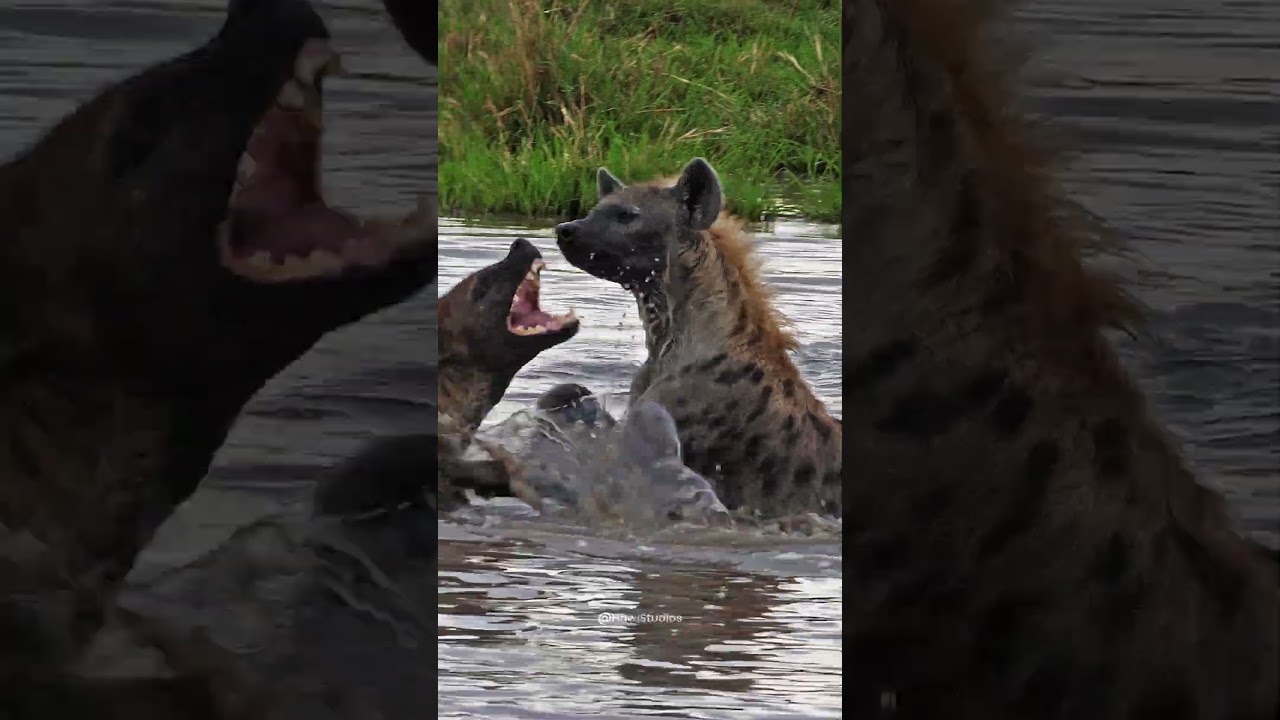
In the opening frames of the footage, four adult spotted hyenas sit partially submerged in a muddy waterhole surrounded by tall grass. Two individuals face each other closely, opening their mouth cavities to show play biting behavior. The animals bob their heads up and down, creating surface ripples and splashing water across their shoulders.
As the clip continues, one hyena turns toward its neighbor and executes a gentle nuzzle against the side of the neck. The audio track captures soft vocal chatter alongside water movement. The ears of both animals remain held in a neutral position, indicating an absence of aggressive territorial defense or competitive conflict.
Thermoregulation and heat dissipation mechanics
Spotted hyenas possess robust bodies ranging from 40 to 86 kilograms in mass, covered by coarse hair. Because large carnivores generate substantial internal metabolic heat during activity, ambient temperatures above 30 degrees Celsius present physiological cooling challenges. Submerging the lower torso in shallow pools allows heat to transfer directly into the water through conduction.
Water immersion cools the subcutaneous blood vessels across the abdomen and inner limbs. This evaporative and conductive cooling process restores thermal balance quickly after intense foraging or movement. Wallowing in muddy substrates also coats the hide with sediment, providing a protective barrier against biting insects and solar radiation.
Social play mechanics and clan hierarchy maintenance
Spotted hyenas live in complex social groups called clans that can include up to 80 individuals led by dominant females. Social play in water provides a controlled environment where individuals negotiate social standing and reinforce bonds. Open-mouth jaw displays allow hyenas to practice bite motor patterns while suppressing their full bite force of nearly 4,500 Newtons.
This inhibited biting behavior builds trust between pack members across different rank levels. Vocal chatter produced during aquatic play communicates peaceful intent across the group. Similar vocal structures appear in other African predators, such as lioness roaring mechanics and black-backed jackal feeding mechanics, where sound signals convey motivation and spatial position.
Anatomical features and semi-aquatic capability
The morphology of Crocuta crocuta includes powerful forequarters, elevated shoulders, and a sloping backline. This muscular arrangement gives the animal strong paddling capability when crossing river channels or deep marshes. Broad paws with blunt, non-retractable claws deliver firm footing on slippery, muddy bottoms.
Their heavy skeletal structure provides negative buoyancy compared to lighter mammals, enabling them to wade securely in flowing currents. Hyenas frequently use water bodies for playing and cooling and to cache uneaten prey parts underwater to hide them from land scavengers.
Ecosystem role and shared waterhole dynamics
Waterholes act as focal points for ecosystem activity across African savannas. Spotted hyenas interact with many sympatric species around these aquatic sites, sharing access with large herbivores and rival carnivores. Their presence around water sources influences how smaller animals navigate the surrounding terrain.
Waterhole social patterns are visible across multiple species, including African elephant drinking mechanics, where large mammals gather to drink, bathe, and socialize. Through their feeding and aquatic caching habits, spotted hyenas contribute to nutrient recycling across the land-water interface.
Why do spotted hyenas enter water holes to play?
Spotted hyenas enter shallow water to cool their core body temperature during hot weather and to engage in social play. Play swimming lowers tension within the clan and helps maintain social bonds.
Can spotted hyenas swim effectively in deep water?
Yes, spotted hyenas are competent swimmers capable of crossing rivers and deep pools. Their powerful shoulder muscles and chest girth provide buoyant movement in open water.
What is the bite force of a spotted hyena?
An adult spotted hyena can exert a bite force of approximately 4,500 Newtons. During social play, individuals strictly control this jaw pressure to avoid injuring clan members.
How do hyenas signal play intent rather than aggression?
Hyenas signal play using relaxed ear postures, open-mouth gape displays without teeth baring, and soft vocal vocalizations. These visual and auditory cues distinguish social play from territorial conflicts.