
Direct answer summary
African bush elephants (Loxodonta africana) utilize their highly muscular, prehensile trunks to facilitate efficient hydration at waterholes. By creating suction, they draw water into the trunk’s nasal passages, holding up to 8 liters before delivering it directly into the oral cavity for ingestion.
Key Field Takeaways
- Taxonomic Classification: Family Elephantidae, Genus Loxodonta, Species Loxodonta africana.
- Primary Behavioral Adaptation: Trunk-based suction feeding allows for water intake without submerging the head.
- Ecological Niche & Range: Inhabits savanna, woodland, and forest regions across Sub-Saharan Africa.
- Conservation & Field Status: Listed as Endangered by the IUCN due to habitat loss and poaching pressures.
| Feature | Specification |
|---|---|
| Scientific Name | Loxodonta africana |
| Common Name | African Bush Elephant |
| IUCN Status | Endangered |
| Primary Diet | Herbivorous (grasses, bark, foliage) |
| Hydration Needs | 150 to 200 liters per day |
| Key Adaptation | Prehensile, muscular trunk |
African elephant drinking mechanics
The drinking behavior observed in Loxodonta africana represents a sophisticated adaptation for megaherbivore survival. The trunk, which contains over 40,000 individual muscles, functions as both a straw and a storage vessel. When drinking, the elephant extends the trunk toward the water surface, creating a vacuum through muscular contraction of the nasal passages.
Once the trunk is filled, the elephant curls the tip toward the mouth. The water is then expelled into the oral cavity. This mechanism is essential for minimizing water loss and avoiding the vulnerability associated with lowering the entire head to the water level, which would obstruct the animal’s field of vision and sensory awareness.
Juvenile learning and social mimicry
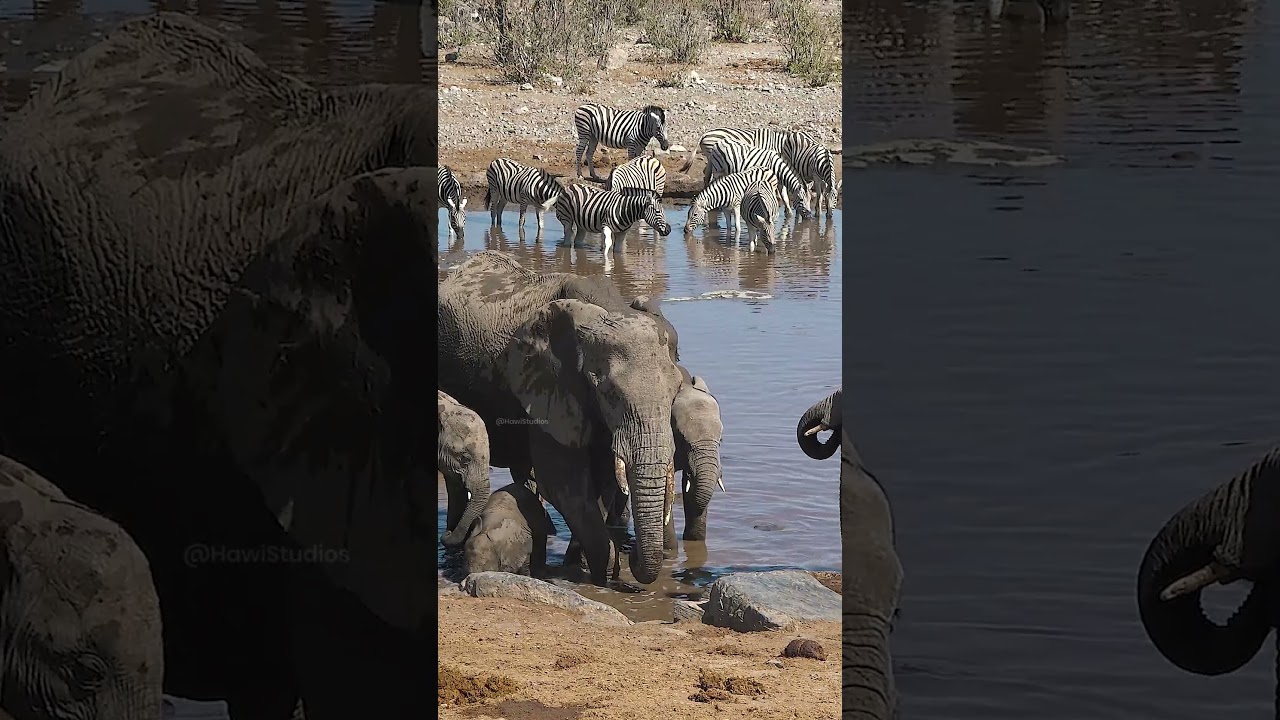
Young elephants, or calves, spend significant time observing adult females to master the coordination required for trunk usage. As seen in the footage, the juvenile remains close to the matriarch, mirroring the adult’s movements. This social learning process is critical for the development of motor skills necessary for independent foraging and hydration.
Interspecies waterhole dynamics
Waterholes function as essential hubs for savanna biodiversity. The coexistence of Loxodonta africana and Equus quagga (plains zebra) highlights the spatial partitioning often seen in these habitats. While elephants can disturb the substrate and alter water quality, their presence rarely prevents other species from accessing the site.
This interspecies interaction is governed by mutual tolerance. Zebras and other ungulates often benefit from the presence of elephants, as the latter can clear debris or deepen water sources through physical activity. For more on how other species navigate foraging environments, see our analysis of black-backed jackal feeding mechanics and southern ground hornbill prey handling.
Morphological adaptations for savanna survival
The African bush elephant possesses a massive skeletal structure designed to support its weight, which can reach up to 6,000 kilograms. Their skin, while appearing thick, is highly sensitive and requires regular hydration and mud-bathing to protect against ultraviolet radiation and ectoparasites. The trunk is a multifunctional tool, used not only for drinking but also for tactile exploration, communication, and social bonding within the herd.