
Direct answer summary
Carabus ullrichii feeding mechanics rely on extraoral digestion coupled with powerful, sickle-shaped mandibles. The predatory beetle regurgitates digestive enzymes onto prey tissue to liquify proteins and carbohydrates, allowing maxillary palps and labial structures to draw in pre-digested liquid nourishment efficiently.
Key Field Takeaways
- Taxonomic Classification: Order Coleoptera, Family Carabidae, Genus Carabus, Species Carabus ullrichii.
- Primary Behavioral Adaptation: Extraoral enzymatic secretion combined with specialized masticatory palps for fluid prey consumption.
- Ecological Niche & Range: Central and Southeastern European temperate broadleaf forests and moist leaf litter zones.
- Conservation & Field Status: Declining locally due to forest fragmentation, protected under regional European biodiversity frameworks.
| Metric / Attribute | Field Data Specification |
|---|---|
| Binomial Nomenclature | Carabus ullrichii |
| Common Name | Ullrich’s ground beetle |
| Adult Body Length | 20 to 28 mm |
| IUCN / Regional Status | Near Threatened (Regional European assessments) |
| Primary Feeding Strategy | Predatory extraoral digestion (liquefaction of soft invertebrates) |
| Main Habitat Layer | 0 to 10 cm topsoil and damp leaf litter layer |
Visual breakdown of Carabus ullrichii feeding mechanics
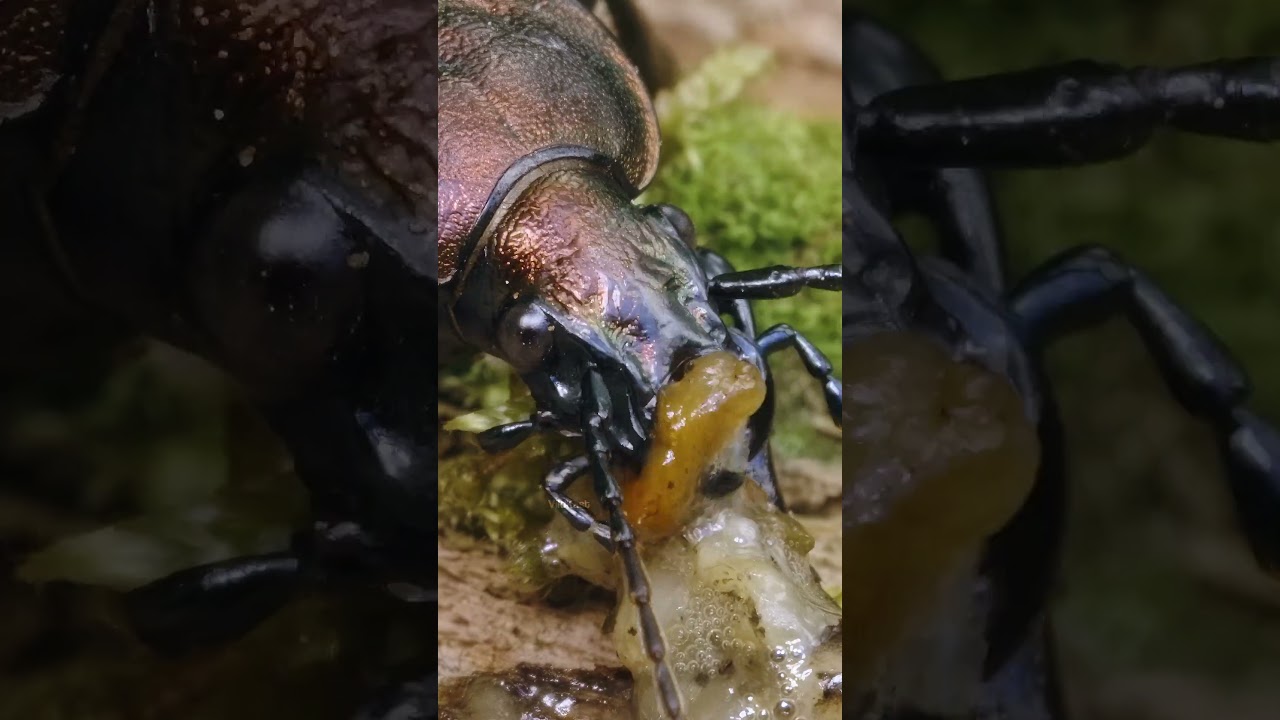
Close-up macro observations of Carabus ullrichii reveal precise movement patterns during prey consumption. The insect positions its head at a downward angle, bringing its oral appendages into direct contact with translucent, soft invertebrate tissue. The metallic coppery sheen on the pronotum and head capsule contrasts sharply with the moist substrate environment.
During feeding, the powerful paired mandibles open and close sideways, puncturing prey membranes. Enzymatic regurgitation is visible as a glistening liquid film surrounding the mouthparts. Maxillary and labial palps vibrate continuously, tasting and directing fluid nutrients directly into the preoral cavity.
Mandibular structure and extraoral digestive processes
The mouthparts of Carabus ullrichii are specialized for holding and tearing soft prey bodies. Sickle-shaped mandibles feature sharp retinacular teeth on their inner edges, allowing the beetle to pierce tough outer integuments. These sclerotized structures provide mechanical leverage needed to grip slippery prey like terrestrial slugs and earthworms.
Rather than swallowing solid food particles directly, Carabus ullrichii practices extraoral digestion. The midgut secretes digestive fluids packed with proteases, lipases, and carbohydrases through the oral opening onto the prey tissue. This enzymatic cocktail breaks down complex muscular matrices into a digestible liquid slurry within minutes.
Morphological traits and sensory adaptations of carabid beetles
Carabus ullrichii features prominent morphological adaptations typical of active predatory ground beetles. Adults measure between 20 and 28 millimeters in length, exhibiting a broad pronotum and robust elytra marked by distinctive longitudinal ridges alternating with chain-like tubercles. This metallic bronze or coppery coloration provides camouflage among decaying forest vegetation.
Sensory processing depends on 11-segmented filiform antennae situated near large compound eyes. Antennae continuously sample chemical cues in the leaf litter, detecting prey secretions and pheromones. Long, cursorial legs enable the beetle to traverse rough terrain quickly, reaching sprint speeds up to 0.15 meters per second when hunting.
Habitat distribution and forest floor ecology
Carabus ullrichii inhabits moist temperate deciduous forests across Central and Southeastern Europe. The species prefers undisturbed oak-hornbeam stands and riparian woods where humidity remains elevated near the soil surface. Relative humidity levels between 80% and 90% in the leaf litter layer prevent desiccation of both the beetle and its soft-bodied prey.
Active primarily during crepuscular and nocturnal hours, Carabus ullrichii seeks shelter under fallen logs, loose tree bark, or deep leaf litter during peak daylight hours. Soil temperatures between 12 and 22 degrees Celsius support optimal metabolic function, allowing efficient hunting throughout spring and summer months.
Trophic role and conservation dynamics in temperate ecosystems
As an apex invertebrate predator within the leaf litter ecosystem, Carabus ullrichii regulates populations of gastropods and insect larvae. Its predatory habits contribute to biological pest management on the forest floor. Mechanized hunting techniques in carabids parallel mechanical foraging seen in other specialized animals, such as ghost crab sand excavation or precise striking mechanics in Veiled Chameleon feeding.
Habitat fragmentation poses the primary threat to Carabus ullrichii populations across its European range. Modern forestry practices that remove deadwood and compact soil layers destroy critical microhabitats. Because adults possess reduced hindwings and cannot fly long distances, isolated populations remain vulnerable to local extirpation.
What does Carabus ullrichii eat in its natural habitat?
Carabus ullrichii primarily feeds on soft-bodied forest floor invertebrates including terrestrial slugs, earthworms, and soft insect larvae. The species utilizes extraoral digestion to dissolve prey tissue prior to ingestion.
How does extraoral digestion work in ground beetles?
Ground beetles execute extraoral digestion by regurgitating enzyme-rich midgut fluids onto prey tissues. Proteolytic enzymes rapidly break down muscular cell walls, enabling the insect to drink liquified nutrients.
How can you identify Carabus ullrichii in the field?
Carabus ullrichii displays a metallic bronze or coppery-green exoskeleton with characteristic elytral sculpturing consisting of longitudinal ridges interrupted by chains of tiny tubercles. Adults measure between 20 and 28 millimeters.
Why are Carabus ullrichii populations declining across Europe?
Populations suffer from habitat fragmentation, clear-cutting of deciduous broadleaf forests, and heavy pesticide use in modern forestry. Because adults are primarily flightless, isolated populations struggle to recolonize disturbed areas.