
Direct answer summary
Cheetah feeding mechanics rely on rapid flesh slicing using specialized carnassial teeth, combined with immediate post-chase metabolic recovery. Because extreme sprinting elevates core body temperature up to 40.5 degrees Celsius (104.9 degrees Fahrenheit), cheetahs must pant heavily to dissipate heat while feeding quickly before kleptoparasites arrive.
Key Field Takeaways
- Taxonomic Classification: Class Mammalia, Order Carnivora, Family Felidae, Acinonyx jubatus.
- Post-Chase Respiration: Respiratory rates increase from 16-25 breaths per minute up to 150 breaths per minute after a pursuit sprint.
- Carcass Consumption Rate: Single adult cheetahs can consume 4 to 10 kg of meat in under 40 minutes to prevent resource loss.
- Conservation Status: Classified as Vulnerable on the IUCN Red List with under 7,000 mature individuals remaining in the wild.
| Taxonomic Metric | Biological Specification |
|---|---|
| Binomial Name | Acinonyx jubatus |
| Common Name | Cheetah |
| IUCN Status | Vulnerable |
| Primary Diet | Medium ungulates (Gazelles, Impalas, Duikers) |
| Thermal Tolerance Limit | Critical thermal maximum near 40.5, 41.0 °C |
| Key Adaptation | Enlarged nasal passages, semi-retractable claws, blade-like carnassial teeth |
Cheetah feeding mechanics and post-chase panting
Observational breakdown of carcass consumption
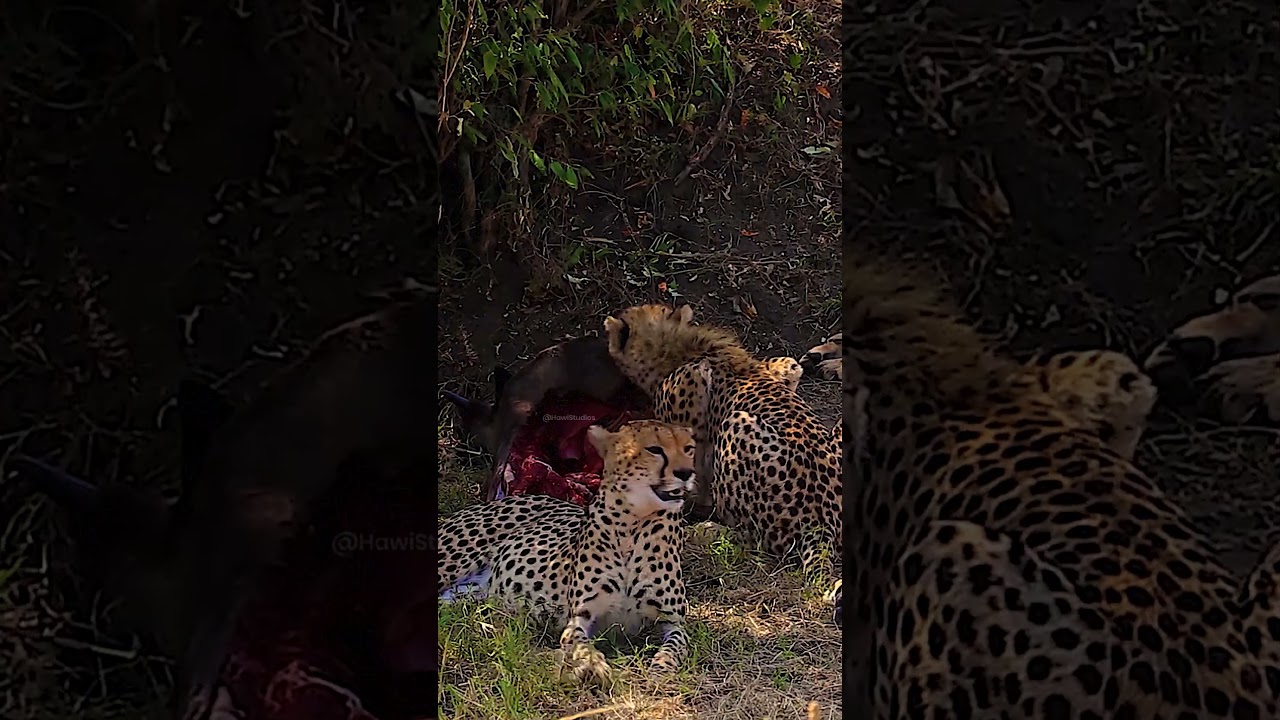
In the observed footage, a pair of cheetahs (Acinonyx jubatus) displays synchronized post-hunt behavior under the shade of savanna foliage. The background individual actively ingests tissue from a freshly dispatched ungulate, utilizing its lateral jaw movement to slice meat. The foreground individual remains prone on the substrate, keeping its throat elevated and mouth open in an intense panting posture.
Cheetahs lack the bone-crushing jaw mass of spotted hyenas or lions. Instead, their feeding mechanics rely on sharp, narrow incisors and specialized blade-like carnassial teeth (upper fourth premolar and lower first molar). These tooth structures shear through skin and muscle fibers cleanly, allowing quick ingestion without prolonged chewing.
Respiratory regulation and thermal cooling post-sprint
High-speed pursuits demand extraordinary muscular output, pushing cheetah sprinting speeds up to 100 to 120 kilometers per hour (62 to 75 miles per hour). This intense muscular exertion generates tremendous metabolic heat, causing core body temperatures to spike. To avoid thermal stroke, the resting cheetah utilizes respiratory evaporation through rapid panting.
During peak post-chase panting, air passes rapidly over humid nasal membranes and the tongue, cooling arterial blood before it enters the brain via the carotid rete. The open-mouth posture seen in the resting animal maximizes airflow across mucous membranes, facilitating thermal stabilization while keeping a visual watch over the surrounding landscape.
Anatomical adaptations for speed and carnivory
Dentition and jaw biomechanics for rapid flesh shearing
The skull anatomy of Acinonyx jubatus represents an evolutionary compromise between aerodynamic efficiency and jaw mechanics. To accommodate larger nasal passages, the roots of the upper canine teeth are shortened. This reduces overall bite force compared to larger felids, preventing cheetahs from easily breaking large limb bones.
Despite reduced bite pressure, the carnassial shear area is highly efficient. The sharp blade edges past each other like scissor blades, severing skeletal muscle into swallowable chunks. This anatomical configuration enables cheetahs to consume soft tissues quickly, targeting the thighs, abdomen, and brisket of ungulate prey.
Nasal passage enlargement and cardiovascular capacity
To support high oxygen consumption during and immediately following a hunt, cheetahs possess expanded nasal apertures and enlarged respiratory passages. The nasal cavity occupies a large portion of the anterior skull, allowing high-volume airflow without restricting the esophagus or pharynx during feeding.
Complementing the upper respiratory tract, the heart, lungs, and bronchi are proportionally oversized relative to total body mass. This physiological investment ensures rapid oxygen delivery to oxygen-starved skeletal muscle and accelerates the clearance of metabolic byproducts post-chase.
Savanna ecology and diurnal hunting strategy
Diurnal temporal niche and thermal tolerance
Cheetahs operate within a diurnal temporal niche, hunting primarily during early morning and late afternoon hours. This activity window reduces direct encounters with larger, nocturnal carnivores such as lions and leopards. However, hunting during daylight hours exposes cheetahs to ambient solar radiation, compounding the thermal burden of the pursuit sprint.
Shade utilization during feeding is a critical behavioral strategy. Resting under canopy cover reduces environmental thermal loading, allowing the animal to lower its core body temperature faster while processing heavy meals of high-protein tissue.
Vigilance behavior and kleptoparasitism risk
Because cheetahs are built for acceleration rather than physical defense, they are highly vulnerable to kleptoparasitism, the theft of hard-won prey by competing carnivores. Lions, spotted hyenas, and aggressive scavengers like the black-backed jackal feeding mechanics frequently displace cheetahs from fresh carcasses.
The foreground cheetah in the footage demonstrates classic alertness, periodically lifting its head and scanning the surrounding field while panting. Maintaining spatial awareness while resting allows cheetahs to detect incoming threats early and abandon carcasses before suffering physical injury.
Interspecies dynamics and food web competition
Competition with dominant apex predators
Within African savanna food webs, cheetahs occupy a mesopredator position relative to dominant felids. Larger predators exert strong interference competition, often killing cheetah cubs or driving adults away from kills. Direct confrontation with apex carnivores displaying powerful lioness roaring mechanics invariably forces cheetahs to retreat.
To mitigate interaction risks, cheetahs consume prey rapidly and rarely return to a carcass once abandoned. They consume high-energy viscera and heavy muscle groups first, leaving skeletal remains for avian and small mammalian scavengers.
Scavenger dynamics and carcass utilization
Once a cheetah pair leaves a feeding site, secondary consumers quickly utilize the remaining biomass. Vultures, jackals, and terrestrial birds like those exhibiting typical Southern ground hornbill prey handling clear peripheral tissues, tendon attachments, and smaller bone fragments, fully recycling nutrients back into the savanna ecosystem.
This rapid energy transfer emphasizes the cheetah’s role as a primary consumer of medium ungulate populations, driving nutrient circulation across open grassland habitats.
Conservation status and habitat fragmentation
Population demographics and genetic bottlenecks
The wild population of Acinonyx jubatus is classified as Vulnerable by the International Union for Conservation of Nature (IUCN). Historical bottleneck events reduced genetic diversity within the species, leading to uniform major histocompatibility complex (MHC) genes and low reproductive variance across wild sub-populations.
Current estimates indicate fewer than 7,000 mature individuals remain across fragmented African reserves and unprotected farmlands. Low genetic variability increases susceptibility to infectious diseases and reduces overall environmental adaptability.
Range contraction across African ecosystems
Habitat loss, land conversion for agriculture, and direct human-wildlife conflict continue to contract the historic range of the cheetah. Range contraction forces cheetahs into closer contact with livestock farmers and protected area boundaries where high predator densities increase competition.
Protecting continuous wildlife corridors and preserving natural prey populations of gazelles and impalas remain essential priorities for ensuring long-term cheetah survival in natural habitats.
Frequently Asked Questions
Why do cheetahs pant heavily after killing prey?
Cheetahs pant rapidly after a chase to lower their elevated core body temperature and repay oxygen debt accrued during high-speed exertion. Their respiratory rate can exceed 150 breaths per minute during post-chase thermal dissipation.
How fast do cheetahs consume their prey?
Cheetahs eat rapidly, often consuming up to 10 kilograms of flesh within 30 to 40 minutes. Swift feeding minimizes the likelihood of losing the carcass to larger scavengers like hyenas and lions.
What dental adaptations allow cheetahs to eat rapidly?
Cheetahs possess enlarged carnassial teeth (premolar 4 and molar 1) that act like biological scissors, slicing cleanly through thick hides and dense skeletal muscle without requiring extensive chewing.
Why do cheetahs feed under tree shade or brush cover?
Shade lowers direct thermal stress on resting cheetahs while dense brush conceals the bright red carcass from airborne vultures and distant terrestrial predators.