
Direct answer summary
North Sulawesi babirusa tusk growth occurs when upper canine tooth sockets rotate vertically within the maxilla bone during early embryological development. This unique anatomical orientation forces the continuously growing teeth to erupt directly upward through the skin of the upper snout, curving backward toward the forehead to form secondary sexual weapons.
Key Field Takeaways
- Taxonomic Classification: Order Artiodactyla, Family Suidae, Babyrousa celebensis (North Sulawesi babirusa).
- Canine Growth Vector: Upper canine sockets are rotated 180 degrees vertically, causing the teeth to penetrate the upper lip skin and reach lengths up to 40 centimeters.
- Ecology & Wallowing: Clay wallowing provides evaporative thermoregulation and forms a hardened dermal shield against biting dipteran insects.
- Conservation Status: Classified as Vulnerable by the IUCN due to rainforest fragmentation and targeted local poaching in endemic Indonesian ranges.
| Field Attribute | Biological Metric / Classification |
|---|---|
| Binomial Nomenclature | Babyrousa celebensis |
| Common Name | North Sulawesi babirusa |
| Family | Suidae |
| IUCN Red List Status | Vulnerable |
| Upper Tusk Arc Length | 25 cm to 40 cm (10 in to 16 in) |
| Primary Diet | Frugivorous and omnivorous (fruits, seeds, leaves, roots) |
| Native Geographic Range | Sulawesi and adjacent northern Indonesian islands |
Observational breakdown of facial mud wallowing and snout morphology
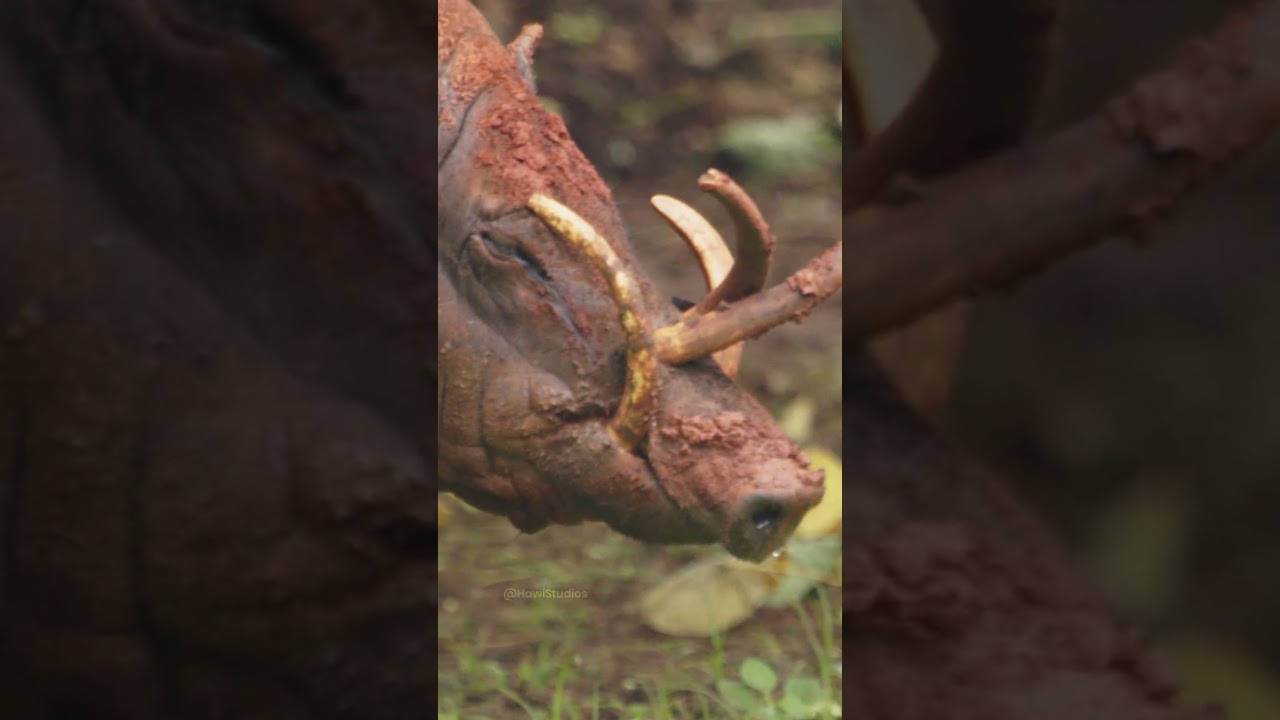
In the close-up field footage, a male North Sulawesi babirusa (Babyrousa celebensis) exhibits classic foraging posture with its head lowered near the forest floor. A thick layer of dried red clay covers the forehead, upper lip, and skin around the orbital cavities. The mud acts as a protective crust over the nearly hairless epidermis, shielding the animal from solar radiation and blood-feeding insects in humid tropical habitats.
The video clearly reveals two pairs of specialized canine teeth. The lower canines project outward and upward from the sides of the mandible. The most striking anatomical feature is the pair of upper canines, which emerge vertically through the skin of the snout maxilla. These tusks curve in a high arc back toward the bridge of the nose and forehead, completely bypassing the mouth cavity.
Anatomical mechanics of babirusa upper canine tusk growth
The unusual orientation of upper canines in Babyrousa celebensis is unique among modern mammals. In standard members of the family Suidae, upper canine teeth grow sideways and outward from the upper lips. In male babirusas, the tooth germs in the premaxilla bone undergo a complete vertical rotation during fetal development. This developmental shift causes the root of the tooth to anchor downward while the tooth shaft points directly upward toward the top of the rostrum.
As the babirusa matures, these rootless, hypsodont teeth grow continuously throughout the life of the animal. Instead of erupting into the mouth cavity, the upper canine forces its way through the dermal layers of the snout. The skin heals around the base of the emerging tusk, forming a sealed junction that prevents bacterial infection as the bone-like structure pushes upward.
Functional role of canine tusks in male combat and defense
For decades, naturalists debated the exact biological purpose of these extraordinary structures. Modern field ethology confirms that the upper tusks serve as protective armor rather than offensive stabbing tools. During the breeding season, rival male babirusas compete for mating access to females by engaging in vertical wrestling matches. Males rear up on their hind legs, pushing against each other with their forelimbs and snouts in an upright position.
During these wrestling matches, the sharp lower canines act as the primary offensive weapons, capable of delivering slashing strikes. The backward-curving upper tusks function as a interlocking face guard, deflecting strikes aimed at the eyes, snout, and skull. The thick layer of dried mud visible on the animal in the footage provides an extra layer of shock absorption during these physical contests, similar to defensive structures observed in hippopotamus river sparring analysis.
Thermoregulation and habitat dynamics in Sulawesi rainforests
The presence of dried mud across the head highlights the vital role of wallowing in babirusa ecology. North Sulawesi babirusas inhabit dense tropical rainforests and swampy river margins where temperatures remain high throughout the year. Like most suids, babirusas possess minimal functional sweat glands, making behavioral thermoregulation essential for maintaining core body temperature.
Babirusas seek out natural clay wallows and riverbanks to submerge their bodies. As the wet mud dries on their skin, water evaporates slowly, cooling the superficial blood vessels. The mineral-rich clay layer also suffocates external parasites such as ticks and fleas. Once dry, the clay crust falls off in flakes, removing attached parasites and dead skin cells in the process.
Conservation status and ecological role in island ecosystems
The North Sulawesi babirusa is classified as Vulnerable on the IUCN Red List of Threatened Species. Native exclusively to the island of Sulawesi and nearby offshore islands in Indonesia, populations face severe threats from habitat loss. Large-scale conversion of lowland tropical forests into agricultural plantations has fragmented the continuous canopy environments required by this species.
As seed dispersers and soil churners, babirusas play an important role in maintaining forest diversity. Their foraging behavior involves digging into soft mud and leaf litter with their strong snouts, turning over organic soil layers and dispersing large rainforest seeds. Understanding their unique morphology, from specialized tusk growth to sensory foraging, provides critical data for establishing protected habitat corridors across Sulawesi.
Why do babirusa upper tusks grow through the skin of their snout?
The upper canine tooth sockets in male babirusas are rotated vertically inside the premaxilla bone during embryological development. This directional rotation forces the continuously growing teeth to erupt upward through the dermal layer of the upper lip rather than into the oral cavity.
Do babirusa tusks ever grow back into their own skulls?
If a male babirusa lives to an advanced age without breaking its upper tusks, the continuous arc growth can occasionally reach the frontal bone of the skull. In rare documented field cases, unchecked growth results in the tip pressing against or penetrating the cranial bone.
What is the primary function of male babirusa tusks?
Upper tusks act primarily as biological shields during male-to-male competitive combat. When males rear up on their hind legs to wrestle, the curved upper tusks deflect incoming slashes from the opponent lower canine teeth, protecting the eyes and upper face.
Why are babirusas frequently covered in dried red mud?
Babirusas wallow in moist clay and mud to regulate their body temperature and repel ectoparasites. Because these artiodactyls possess very few functional sweat glands across their hairless skin, evaporative cooling from wet mud is essential for survival.