
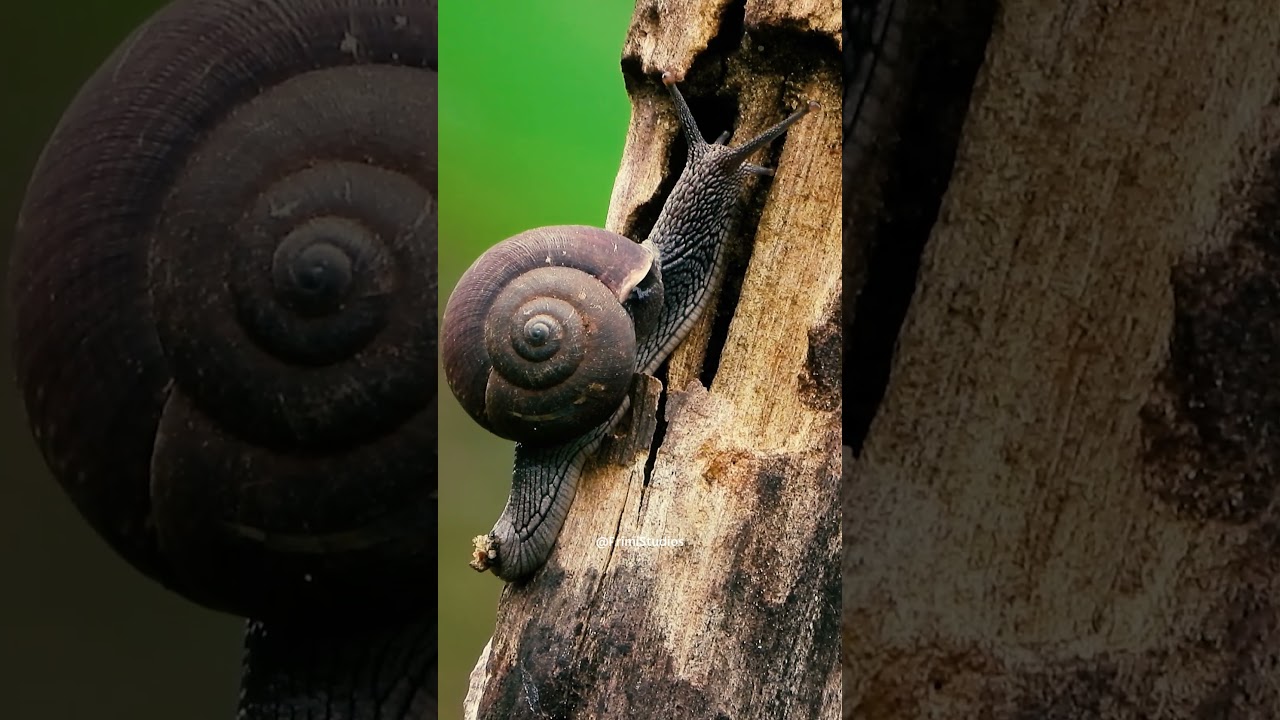
Direct answer summary
The black land snail (Arianta arbustorum) accomplishes vertical locomotion on bark through synchronized pedal wave contractions and thixotropic pedal mucus. This non-Newtonian secretion functions as a liquid lubricant under muscular compression and transitions to a firm adhesive when stationary, enabling upside-down and vertical climbing up to 1 millimeter per second.
Key Field Takeaways
- Taxonomic Classification: Class Gastropoda, Order Stylommatophora, Family Helicidae, Arianta arbustorum.
- Locomotion Mechanism: Retrograde pedal contraction waves paired with glycoprotein rich non-Newtonian pedal mucus.
- Sensory Navigation: Retractable ocular ommatophores with apical eye spots for light gradient detection and chemical sensing.
- Dietary Ecology: Herbivorous detritivore utilizing a chitinous radula to rasp organic films and decaying plant tissue.
| Biological Category | Field Parameter Specification |
|---|---|
| Binomial Nomenclature | Arianta arbustorum |
| Common Name | Black land snail / Copse snail |
| IUCN Conservation Status | Least Concern (Population Stable) |
| Primary Locomotion Speed | 0.5 to 1.2 millimeters per second |
| Shell Composition | Calcium carbonate (Aragonite) within a protein matrix |
| Primary Habitat Zone | Moist temperate forests, damp fallen logs, and leaf litter |
Vertical pedal locomotion and mucus adhesion mechanics
Terrestrial gastropods face significant gravitational challenges when traversing vertical substrates like tree trunks and decaying logs. The primary muscle driving this movement is the broad ventral foot, which executes rhythmic muscular contractions known as pedal waves. These contraction waves move in a forward or backward direction along the sole, pushing small segments of the foot forward in sequence while keeping adjacent areas firmly anchored.
To maintain continuous adhesion against gravity, the snail secretes a specialized pedal slime from a gland located at the front edge of the foot. This pedal fluid consists of complex mucopolysaccharides and water, forming a non-Newtonian thixotropic gel. When the snail applies muscular force during a contraction wave, the slime thins and flows like a liquid lubricant. When the force stops, the slime thickens instantly into a high-tack gel, holding the body in place.
Role of pedal wave dynamics in climbing efficiency
Observations of the ventral sole reveal that pedal contraction waves maintain constant contact with uneven bark. Small structural gaps in decaying wood are bridged as the flexible foot conforms directly to the surface topography. This maximizes contact surface area, which allows the animal to distribute its body weight evenly across steep incline angles.
Energy expenditure during pedal wave climbing is high due to the constant production of protein-rich slime. Gastropods often reuse old mucus trails or restrict movement to high-humidity windows to minimize water and nutrient loss. By matching pedal wave frequency to substrate moisture levels, the snail optimizes mechanical energy output during vertical ascents.
Morphological anatomy of tentacles and sensory systems
The head of the land snail contains two pairs of retractable, fluid-filled tentacles that control spatial sensing. The larger upper pair, called ommatophores, elevates the sensory apparatus clear of the body. At the tip of each ommatophore rests a primitive eye spot containing photo-receptor cells and an elementary lens capable of distinguishing light intensity and spatial shadows.
The shorter lower pair of tentacles focuses primarily on tactile and chemical inputs from the immediate path. These lower labial tentacles probe the substrate surface to detect surface texture, moisture levels, and chemical trails left by potential food sources or predators. Chemical receptors along the tentacles can register subtle air currents carrying plant volatiles.
Retraction mechanics and sensory integration
When encountering physical obstacles or sudden visual shadows, the snail rapidly retracts its tentacles using internal retractor muscles. This inverted retraction pulls the eye spot inward like an inverted glove finger, protecting sensitive nerve endings from mechanical damage. Hydraulic pressure from internal body fluid subsequently extends the tentacles back out once safety is established.
Sensory processing occurs in a central ring of ganglia located around the esophagus. Information gathered by ommatophores and labial tentacles is integrated to direct spatial orientation, triggering turns away from bright, dehydrating sunlight toward damp, shaded microenvironments inside rotten wood structures.
Shell structure and calcium biomineralization
The calcareous shell serves as the primary structural defense and osmotic barrier for terrestrial gastropods. Composed primarily of calcium carbonate layered over an organic protein matrix, the shell protects soft internal organs against desiccation, physical crushing, and predator attacks. The visible spiraled whorls represent continuous radial growth added along the outer mantle edge over the animal’s lifetime.
The outer protein layer, known as the periostracum, provides weather protection and gives the shell its dark brown or black coloration. Beneath this layer lie dense, crystalline aragonite layers deposited by mantle cells. The snail regulates shell repair by extracting calcium ions from ingested mineral substrate, leaf litter, and limestone deposits within its foraging territory.
Desiccation prevention and thermal regulation
Water retention is essential for terrestrial gastropod survival, as evaporative loss across soft tissues can be lethal. During extended periods of dry heat, the snail withdraws fully into its shell and secretes a temporary barrier of hardened mucus called an epiphragm. This seals the shell aperture against the atmosphere, dropping metabolic rates and conserving internal fluids.
Microclimate choice plays a key role in thermal management. Snails seek shaded microhabitats provided by damp logs and thick vegetation. Similar thermal management adaptations are seen in other moisture-dependent terrestrial animals, such as those monitored during oriental garden lizard thermoregulation studies in forest canopy zones.
Radula foraging mechanics and forest ecological niche
Land snails are essential primary decomposers within forest floor ecosystems. Feeding relies on a unique organ called the radula, a tough chitinous ribbon covered in rows of microscopic teeth. Driven by internal muscles, the radula functions like a rasping file, scraping micro-particles of algae, fungal hyphae, lichens, and decaying wood directly into the mouth cavity.
As the radula rasps food, salivary glands release enzymes that begin digesting complex carbohydrates like cellulose. The worn front teeth of the radula are continuously replaced as new rows of chitinous denticles form at the posterior end of the radular sac. This ensures a sharp feeding surface throughout the snail’s life.
Microhabitat dynamics and nutrient cycling
By consuming dead plant matter and fungal growth, gastropods accelerate the physical breakdown of organic debris on the forest floor. Their nitrogen-rich waste secretions enrich topsoil and stimulate microbial activity necessary for nutrient recycling. They frequently share these damp leaf litter layers with other key decomposers, such as those working within a red wood ant colony environment.
Furthermore, terrestrial gastropods play an understated role in spore dispersal. Fungal spores and plant seeds pass through the digestive tract intact and are deposited across new sub-habitats along the trail. This micro-dispersal mechanism helps maintain plant and fungal diversity in temperate floor ecosystems, alongside organisms highlighted in Nine-spotted moth biology research.
Conservation status and ecosystem threats
While many common species like Arianta arbustorum retain healthy, stable wild populations, terrestrial gastropods are sensitive to environmental shifts. Habitat fragmentation, deforestation, and aerial pesticide applications alter moisture availability and destroy decaying log microhabitats. Acidic precipitation can leach calcium from soil, leaving snails unable to build or repair structural shells.
Preserving deadwood structures in managed forests provides critical refuges for gastropods, amphibians, and subterranean invertebrates. Maintaining contiguous, unpolluted leaf litter zones ensures stable moisture corridors that support gastropod biodiversity and nutrient recycling networks worldwide.
How do land snails crawl vertically without falling off tree bark?
Land snails secrete pedal mucus containing specialized glycoproteins that exhibit thixotropic properties. Under mechanical stress from pedal muscular contractions, the slime acts as a liquid lubricant, but solidifies into an adhesive gel when stationary to secure the snail to vertical wood.
What is the function of the upper tentacles on a land snail?
The upper tentacles, known as ommatophores, carry primitive eye spots at their tips that detect light intensity and movement. These tentacles also harbor chemoreceptors that detect airborne chemical signals from distance food sources.
How do terrestrial snails synthesize their protective shells?
Terrestrial snails extract calcium ions from their diet and surrounding soil, using their mantle tissue to deposit calcium carbonate crystals embedded in a protein matrix. This continuous secretion builds concentric growth rings along the shell whorls.
What do black land snails eat in forest environments?
Black land snails are primary detritivores and herbivores that consume decaying plant matter, fallen leaves, lichen, and fungi. They process food using a specialized rasping tongue called a radula equipped with thousands of chitinous teeth.