
Direct answer summary
Leaf-cutter ants (Atta cephalotes) transport leaf fragments not for direct consumption, but to cultivate a specialized fungus within their subterranean colonies. This fungus, which breaks down plant cellulose, serves as the ants’ primary food source.
Key Field Takeaways
- Taxonomic Classification: Leaf-cutter ants belong to the genus Atta or Acromyrmex, within the family Formicidae, order Hymenoptera.
- Primary Behavioral Adaptation: These ants engage in obligate mutualism, cultivating a specific fungus as their sole food source using plant material.
- Ecological Niche & Range: They are dominant herbivores in tropical and subtropical Americas, constructing vast underground nests that can extend up to 6 meters deep.
- Carrying Capacity: Individual ants can carry leaf fragments weighing up to 20 times their own body weight, demonstrating exceptional strength for biomass transport.
| Characteristic | Detail |
|---|---|
| Binomial Nomenclature | Atta cephalotes |
| Common Names | Leaf-cutter ant, Parasol ant |
| IUCN Conservation Status | Least Concern (for widespread species) |
| Primary Diet & Foraging Apparatus | Symbiotic fungus cultivated on masticated plant material, powerful mandibles for cutting. |
| Natural Habitat & Depth/Elevation Range | Tropical and subtropical rainforests, savannas, and dry forests, nests typically 2-6 meters deep. |
| Key Anatomical/Physiological Adaptation | Exceptional mandibular strength for cutting leaves and carrying heavy loads. |
Physical observation and foraging mechanics
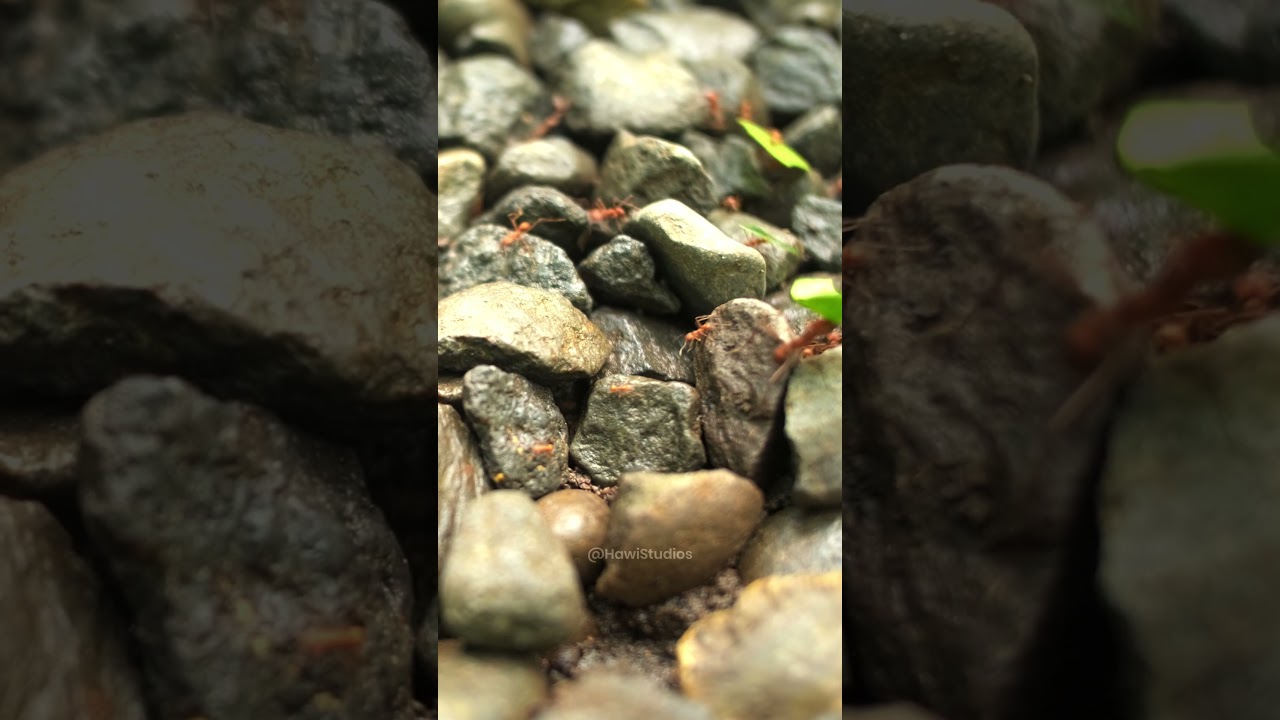
The video footage reveals a meticulous procession of leaf-cutter ants (Atta cephalotes) navigating an uneven terrain composed of small rocks and soil. Each individual ant is observed carrying a green leaf fragment held vertically above its head, an iconic behavior that earned them the common name ‘parasol ants’. The leaf pieces are notably large, often exceeding the ant’s body length and width, indicating significant strength and precise cutting. This visual evidence highlights the ants’ ability to transport substantial biomass.
As the ants traverse the rocky substrate, their six legs demonstrate coordinated movement, allowing them to maintain balance while carrying their heavy loads. They carefully step over and around obstacles, showcasing remarkable navigational skills within their micro-environment. The continuous flow of ants suggests a well-established foraging trail, likely marked by pheromones, guiding them between the vegetation source and their subterranean nest. This organized transport system is vital for the efficient provisioning of their fungus gardens.
Morphological and anatomical adaptations
The leaf-cutter ants exhibit several key morphological adaptations enabling their specialized foraging strategy. Their robust mandibles are equipped with serrated edges, functioning as highly effective cutting tools capable of shearing through tough plant fibers. These mandibles are powered by strong adductor muscles, allowing them to exert considerable force relative to their body size. This strength is crucial for both cutting and carrying leaf fragments.
The ants’ six legs provide stability and leverage, essential for navigating complex terrain while burdened with heavy loads. Their tarsi, or feet, possess claws and adhesive pads, enhancing their grip on various surfaces, including the rough textures of rocks and vegetation. Antennae are constantly in motion, detecting chemical cues (pheromones) that guide them along trails and communicate information about food sources and potential dangers. Their hard exoskeleton offers protection and a rigid attachment point for powerful muscles.
Habitat range and terrestrial ecology
Leaf-cutter ants are endemic to the neotropical regions of the Americas, spanning from the southern United States through Central America and into South America. They thrive in diverse terrestrial ecosystems, including tropical rainforests, savannas, and dry scrublands. Their presence is often indicative of a healthy, biodiverse environment, where they play a significant ecological role as primary consumers.
These ants construct elaborate, multi-chambered underground nests that can extend several meters deep and cover vast areas. These subterranean complexes provide stable temperature and humidity conditions for their fungus gardens. The extensive tunneling activity of leaf-cutter ants significantly aerates the soil, influencing soil structure and nutrient cycling in their habitats. Their foraging can reduce local plant biomass, impacting forest regeneration patterns.
Interspecies relationships and evolutionary significance
The most defining interspecies relationship for leaf-cutter ants is their obligate mutualism with a specific type of basidiomycete fungus (Leucoagaricus or Attamyces). The ants cannot digest cellulose directly, instead, they cultivate this fungus on the masticated leaf material, and the fungus breaks down the plant matter into digestible sugars and proteins, which the ants then consume. This symbiotic relationship has evolved over millions of years, leading to a highly specialized and interdependent system.
As dominant herbivores, leaf-cutter ants exert significant selective pressure on plant communities. Plants have evolved various defenses, such as chemical deterrents or tougher leaves, in response to ant herbivory. Their foraging activities also create clearings, influencing plant succession and biodiversity. The ants’ ability to carry large loads over uneven terrain, similar to the challenges faced by hermit crabs hauling shells, underscores a common evolutionary pressure for efficient transport in challenging environments. The complex social structure and division of labor within a colony, with different castes performing specific tasks like cutting, carrying, and gardening, further highlight their evolutionary success.
Conservation status and ecosystem threats
Many widespread species of leaf-cutter ants, such as Atta cephalotes, are currently classified as Least Concern by the IUCN Red List. Their broad distribution and adaptability to various tropical and subtropical habitats contribute to their stable populations. However, specific localized populations or less common species may face greater threats.
The primary threats to leaf-cutter ant populations are habitat destruction and fragmentation, largely due to deforestation for agriculture, urbanization, and logging. While resilient, extensive loss of their forest and grassland habitats can impact their ability to establish new colonies and maintain their complex foraging networks. Pesticide use in agricultural areas adjacent to their habitats can also pose a risk to ant colonies. Understanding the detailed foraging biology of such species is crucial for effective conservation strategies.
What do leaf-cutter ants do with the leaves they collect?
Leaf-cutter ants do not eat the leaves directly. They meticulously chew the collected plant material into a pulp, which they then use as a substrate to cultivate a specific symbiotic fungus inside their underground nests. This fungus is the ants’ primary food source, breaking down the cellulose in the leaves into digestible sugars.
How do leaf-cutter ants cut leaves so efficiently?
Leaf-cutter ants possess powerful mandibles with serrated edges, specifically adapted for shearing plant material. They use a precise cutting technique, often working in groups to detach larger pieces, which are then further processed into manageable fragments for transport back to the colony.
How much weight can a leaf-cutter ant carry?
A leaf-cutter ant can carry a leaf fragment weighing up to 20 times its own body weight. This remarkable strength is crucial for their foraging efficiency, allowing them to transport substantial amounts of vegetation over considerable distances back to their subterranean fungus gardens.
Where do leaf-cutter ants typically live?
Leaf-cutter ants are predominantly found in tropical and subtropical regions of the Americas, ranging from the southern United States down to Argentina. They inhabit diverse ecosystems, including rainforests, savannas, and even some arid areas, building extensive underground nest systems that can span several meters in depth and diameter.