
Direct answer summary
Red lionfish (Pterois volitans) are highly specialized marine predators characterized by their distinctive venomous dorsal spines and fan-like pectoral fins. These fish employ a sophisticated suction-feeding mechanism to capture small prey with rapid precision in diverse reef environments.
Key Field Takeaways
- Taxonomic Classification: Family Scorpaenidae, Genus Pterois, Species Pterois volitans.
- Primary Behavioral Adaptation: Employs suction feeding to ingest prey up to half its own body length.
- Ecological Niche & Range: Native to the Indo-Pacific, highly invasive in the Western Atlantic and Caribbean.
- Conservation & Field Status: Not listed as threatened, widely managed as an invasive species due to ecological impact.
| Feature | Specification |
|---|---|
| Scientific Name | Pterois volitans |
| Common Name | Red lionfish |
| IUCN Status | Least Concern |
| Diet | Small fish, crustaceans, mollusks |
| Habitat | Coral reefs, rocky crevices, depths up to 50m |
| Key Adaptation | 18 venomous spines for defense |
Physical observation and behavioral mechanics
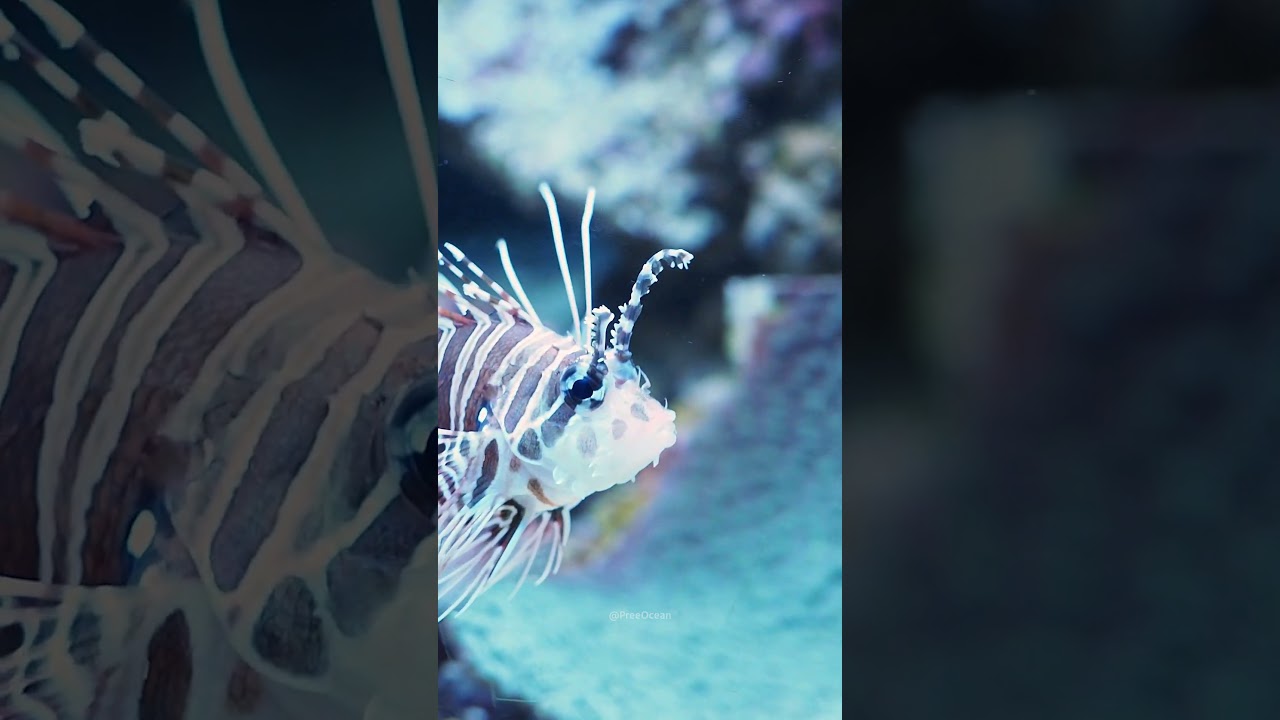
The Pterois volitans exhibits a unique, hovering locomotion pattern. In the footage, the fish displays a deliberate, slow-motion swimming style, utilizing its expansive pectoral fins to stabilize its position in the water column. This movement is not merely for navigation but serves a critical role in its predatory strategy.
By spreading its large fins, the red lionfish creates a visual barrier that corners prey against reef structures. Once the prey is trapped, the fish executes a rapid strike. This feeding event involves the sudden expansion of the buccal cavity, which generates a powerful suction force. The entire process occurs in milliseconds, illustrating the high efficiency of this ambush predator.
Morphological and anatomical adaptations
The morphology of the red lionfish is optimized for both defense and predation. The most striking features are the elongated, feather-like dorsal, pectoral, and pelvic fins. These structures are not only decorative but also house the venomous spines that deter larger marine predators.
The fish also possesses specialized sensory tentacles, or cirri, located above the eyes and near the mouth. These structures detect subtle pressure changes and movements in the surrounding water, allowing the lionfish to track prey in low-light conditions or within complex reef geometries. Its coloration, consisting of bold red, white, and dark brown vertical stripes, provides effective camouflage against the backdrop of coral and rock faces.
Habitat range and benthic ecology
Native to the reefs of the Indo-Pacific, the red lionfish thrives in various marine environments. It is frequently observed in rocky crevices, lagoons, and deep-water reefs. The species is highly adaptable, capable of surviving in a wide range of salinities and temperatures, from 15 to 30 degrees Celsius.
This adaptability is a key factor in its successful colonization of non-native regions. Similar to the complex behaviors seen in black frogfish biology, the red lionfish relies on its environment to facilitate ambush opportunities. It remains stationary for long periods, conserving energy until a suitable target enters its strike zone.
Interspecies relationships and conservation
In its native range, the red lionfish is part of a balanced trophic structure where it is preyed upon by groupers and sharks. However, in the Western Atlantic, the absence of these natural control agents has led to population explosions. The red lionfish consumes native juvenile fish at an unsustainable rate, which threatens the biodiversity of the entire reef ecosystem.
Field biologists monitor these populations to mitigate their impact on local marine life. Understanding the octopus ink defense or other predator-prey dynamics helps researchers evaluate how native species might evolve to recognize the red lionfish as a threat. Current conservation efforts focus on targeted removal programs to restore ecological equilibrium in affected areas.