
Direct answer summary
The Black-and-white Warbler (Mniotilta varia) is a specialized insectivorous songbird that performs systematic bark-gleaning to extract prey. It utilizes a slender, slightly decurved bill to probe bark crevices, allowing it to occupy a distinct ecological niche compared to other foliage-gleaning warblers.
Key Field Takeaways
- Taxonomic Classification: Family Parulidae, Genus Mniotilta, Species Mniotilta varia.
- Foraging Mechanism: Specialized bark-gleaning behavior using a slender, decurved bill to extract hidden arthropods.
- Morphological Adaptation: Robust legs and elongated claws designed for vertical locomotion on tree trunks.
- Conservation Status: Classified as Least Concern by the IUCN, though dependent on mature forest ecosystems.
| Feature | Specification |
|---|---|
| Scientific Name | Mniotilta varia |
| Common Name | Black-and-white Warbler |
| IUCN Status | Least Concern |
| Primary Diet | Insects, spiders, larvae |
| Habitat | Deciduous and mixed forests |
| Key Adaptation | Bark-probing, decurved bill |
Foraging mechanics and behavioral ecology
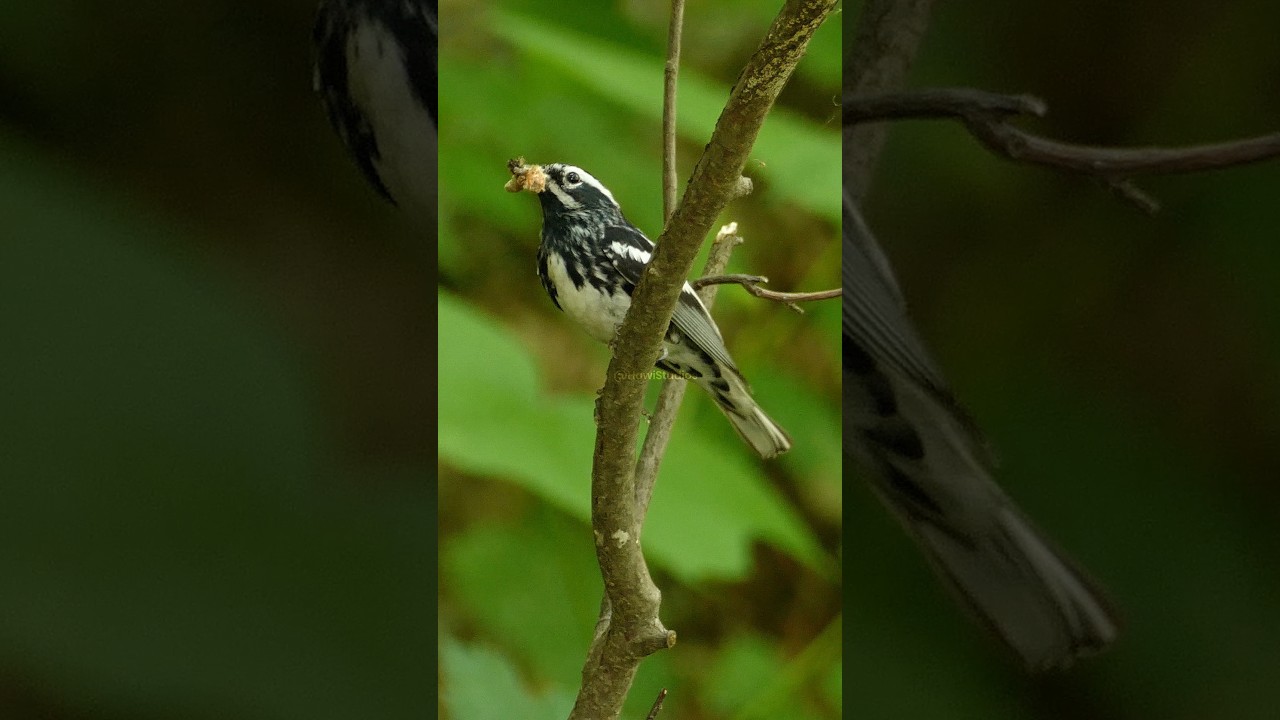
The Black-and-white Warbler exhibits a foraging strategy that diverges significantly from the majority of the Parulidae family. While most warblers focus their energy on foliage-gleaning, this species functions as a trunk-foraging specialist. As observed in the footage, the bird maintains a secure grip on the substrate, using its specialized tarsus and hallux to navigate vertical surfaces with efficiency.
Bark-gleaning specialization
The primary foraging motion involves the bird moving head-first or sideways along branches, probing deep into bark fissures. This behavior minimizes competition with other insectivores that rely on canopy leaves. By focusing on the hidden larval stages of wood-boring insects and spiders, the bird secures a stable food supply within the bark micro-environment.
Morphological and anatomical adaptations
The anatomy of the Black-and-white Warbler is finely tuned for its arboreal lifestyle. The bill is notably longer and more slender than that of related species, providing the necessary reach to extract prey from narrow openings. The plumage serves as effective disruptive coloration, masking the bird against the high-contrast light and shadows found on tree trunks.
Locomotor capabilities
The legs and feet are adapted for gripping, with relatively long toes and sharp, curved claws that provide purchase on rough bark. This physical configuration allows the bird to maintain stability while manipulating prey in its bill, as seen when it captures a larva. This mechanical efficiency is essential for a bird that spends the majority of its active hours in a vertical orientation.
Ecological niche and habitat dynamics
Mniotilta varia occupies a range that spans across North American deciduous and mixed forests. Its survival is closely tied to the availability of mature trees with textured bark, which provide the necessary habitat for its prey base. The species is highly sensitive to habitat fragmentation, as it requires contiguous forest tracts to maintain its specialized foraging routes.
Interspecies relationships
The Black-and-white Warbler occupies a unique trophic role by controlling populations of bark-dwelling insects that might otherwise damage the host trees. For further insights into specialized feeding strategies, one might compare this behavior to the black frogfish biology and ambush feeding mechanics, which also utilizes specific morphological adaptations to exploit a narrow ecological niche. Similarly, the bird’s reliance on specific substrates parallels the moose aquatic foraging tactics, where environmental interaction dictates feeding success. Understanding these niche dynamics is central to avian field biology and the study of forest health.