
Direct answer summary
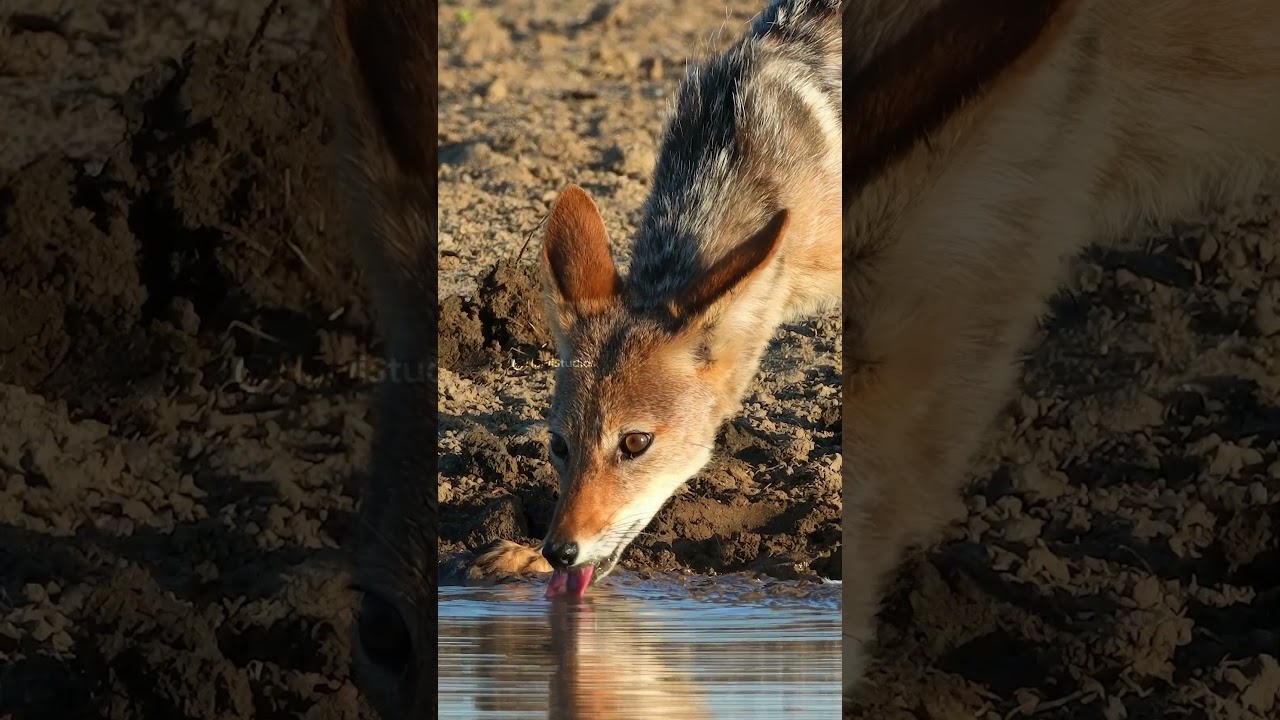
Black-backed jackal drinking behavior relies on a high-frequency lingual lapping mechanism where the tongue forms a backward-facing ladle to lift water through fluid inertia. While lapping, the jackal maintains complete sensory vigilance, keeping its large pinnae upright and eyes open to scan for apex predators at exposed water sources.
Key Field Takeaways
- Taxonomic Classification: Family Canidae, Lupulella mesomelas (formerly Canis mesomelas).
- Fluid Dynamics Mechanism: Laps water at 3 to 4 Hz, pulling a vertical liquid column into the buccal cavity.
- Sensory Vigilance: Maintains continuous 360-degree auditory surveillance using 10 to 12 cm erect pinnae during hydration.
- Conservation & Field Status: Listed as Least Concern by the IUCN, thriving in savannas and arid biomes across Southern and Eastern Africa.
| Taxonomic Metric | Species Field Specification |
|---|---|
| Binomial Name | Lupulella mesomelas |
| Common Names | Black-backed jackal, Silver-backed jackal |
| IUCN Red List Status | Least Concern |
| Average Adult Mass | 6.0 to 10.0 kilograms |
| Lapping Frequency | 3.0 to 4.2 hertz (laps per second) |
| Primary Habitat | Arid savannas, grasslands, and scrub deserts |
| Key Adaptation | Inertia-driven lingual drinking and acute auditory pinnae |
Observational mechanics of black-backed jackal drinking
When a black-backed jackal lowers its snout to an open body of water, it demonstrates the specialized fluid biomechanics common to the family Canidae. Unlike animals with complete cheek structures that create negative pressure to suck liquids, canids possess open cheeks that prevent suction. To compensate, the jackal extends its tongue into the water column and curls the distal tip backward toward its throat, forming a cup-like ladle on the ventral side of the organ.
As the tongue retracts rapidly at a rate between 3 and 4 hertz, it drags liquid upward, generating a vertical fluid column. The jackal closes its jaws over this rising column at the precise millisecond before gravity breaks the surface tension. The close-up footage records this rhythmic lapping motion, showing the rapid movement of the reddish tongue as it contacts the water surface, creating localized surface ripples while maintaining continuous liquid flow into the oral cavity.
Fluid dynamics and lingual motion
The lingual mechanics of Lupulella mesomelas rely on dynamic fluid inertia rather than hydrostatic pressure. Each plunge of the tongue accelerates the liquid upward. The precise timing of jaw closure is regulated by neuromuscular feedback, preventing water loss out the sides of the unsealed lips. The entire process allows the animal to consume sufficient fluid volume within brief, low-exposure timeframes at open water sources.
Morphological adaptations and sensory vigilance
Waterhole environments represent high-threat landscape features in African ecosystems. Predators like lions, leopards, and spotted hyenas frequently ambush prey near water margins. The footage demonstrates how the black-backed jackal maintains total environmental awareness while drinking. Its neck remains bent downward, but its large, erect ears remain raised and angled outward, scanning for high-frequency acoustic signals from the surrounding bush.
The dorsal pelt of the black-backed jackal displays a distinctive silver-and-black saddle extending from the nape of the neck down to the tail. Intermingled black and white guard hairs create a high-contrast pattern that breaks up the animal silhouette under direct sunlight. The lateral sides of the neck, limbs, and face feature rich tawny-red fur, providing effective background matching against ferruginous soils and dry savanna vegetation.
Sensory architecture of the head and ears
The broad, triangular pinnae of the jackal measure roughly 10 to 12 centimeters in height, relative to an overall skull length of 14 to 16 centimeters. These oversized external structures direct faint sounds straight to the tympanic membrane. By keeping the pinnae oriented upward while drinking, the animal detects the rustle of dry grass or the footsteps of an approaching predator long before visual contact occurs.
Hydration dynamics and arid habitat survival
Black-backed jackals inhabit hyper-arid to semi-arid regions across Southern Africa and East Africa. These environments experience high ambient temperatures and severe water scarcity during dry seasons. While jackals drink open water daily when accessible, their metabolic physiological mechanisms allow them to survive in water-scarce zones by extracting moisture directly from their prey items and plant tissues.
When open water sources appear, jackals utilize them efficiently. Hydration events are kept short to limit exposure to terrestrial predators and aquatic threats like the Nile crocodile. During daily drinking bouts, a jackal can replenish up to 5 percent of its body mass in water in just a few minutes, stabilizing its internal osmotic balance in high-temperature environments.
Interspecies interactions at African waterholes
At waterholes, black-backed jackals operate within a complex community of ungulates, birds, and competing carnivores. Jackals share these watering locations with diverse species, including co-occurring savanna birds like the Swainson’s Spurfowl, which also visit the water margin to drink and scan for seeds. The presence of alert avian species provides an added layer of safety, as bird alarm calls signal approaching danger to the jackal.
In addition to birds, jackals frequently cross paths with large herbivores that attract ectoparasite foraging species. Scenes near these water sites often feature a red-billed oxpecker foraging on impala, where the movements of herbivores create disturbances that jackals observe from a distance. Managing risk alongside small mammals like the Eastern Cottontail rabbit in related habitats highlights how mesopredators must balance resource acquisition with threat avoidance.
Trophic role and opportunistic foraging
As opportunistic omnivores and mesopredators, black-backed jackals occupy a vital position in the food web. They scavenge carcasses left behind by apex predators, hunt small rodents, reptiles, and invertebrates, and consume wild fruit species such as wild figs and melon varieties. Waterhole sites serve as drinking spots for jackals and as hunting grounds where they target birds, small mammals, and weak or young ungulates.
Conservation status and ecosystem stability
The IUCN lists Lupulella mesomelas as Least Concern due to its wide distribution, high population numbers, and adaptability to human-modified environments. Despite historical persecution by livestock farmers, black-backed jackals remain resilient across their natural range. Their dietary flexibility and social structure, which consists of monogamous pairs that defend territory jointly, ensure high pup survival rates and stable population dynamics across African reserves and ranchlands.
How do black-backed jackals drink water without suction?
Black-backed jackals use an inertia-driven lingual lapping mechanism. They curl the ventral surface of their tongue backward to scoop liquid upward, catching the accelerating water column with their jaws before gravity pulls it back down.
Why do black-backed jackals remain alert while drinking?
Waterholes represent high-risk predation zones where larger predators like lions, leopards, and Nile crocodiles lurk. Jackals keep their erect pinnae elevated and eyes open to detect subtle auditory and visual cues of approaching danger.
How long can a black-backed jackal survive without drinking water?
While black-backed jackals drink water daily when available, they can survive for extended periods on the moisture absorbed from prey tissues, wild fruits, and succulents in arid environments.
What is the function of the black saddle marking on this jackal species?
The silver-and-black speckled saddle along the back acts as disruptive camouflage in dusty, scrubland vegetation, breaking up the silhouette of the animal when viewed from above or at a distance by larger predators and prey.