
Direct answer summary
The Oriental Garden Lizard (Calotes versicolor) is a highly efficient sit-and-wait predator that utilizes a stationary, vertical-perch hunting strategy. By remaining motionless on elevated substrates, it minimizes detection by prey while maximizing its visual range for spotting small insects within its environment.
Key Field Takeaways
- Taxonomic Classification: Family Agamidae, Genus Calotes, Species Calotes versicolor.
- Primary Behavioral Adaptation: Sit-and-wait predation involving prolonged periods of immobility followed by rapid, explosive strikes at prey.
- Ecological Niche: Primarily arboreal and semi-terrestrial, occupying gardens, forest edges, and urban landscapes across Southeast Asia.
- Morphological Traits: Features a distinct dorsal crest of spines and a highly extensible gular fold for communication and territorial display.
| Feature | Specification |
|---|---|
| Scientific Name | Calotes versicolor |
| Common Name | Oriental Garden Lizard |
| Diet | Insectivorous (ants, beetles, grasshoppers) |
| Habitat | Forest edges, gardens, scrubland |
| Key Adaptation | Sit-and-wait predation |
Hunting mechanics and behavioral observation
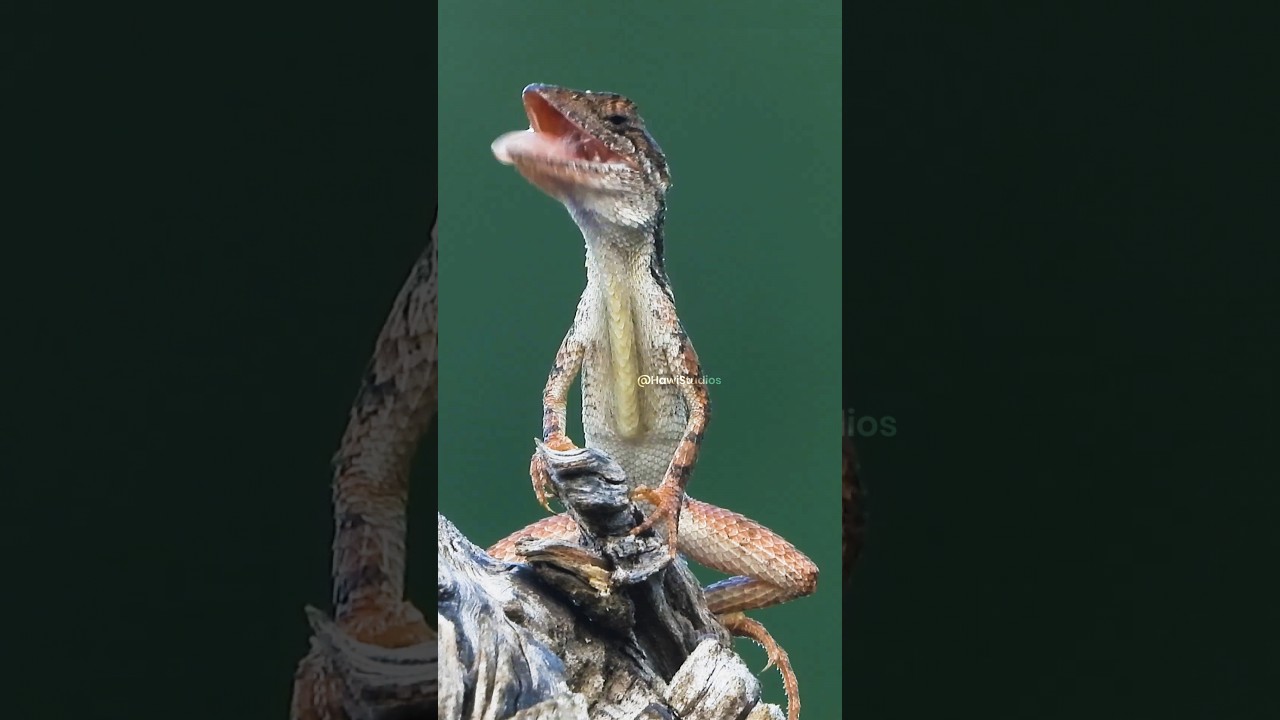
The footage captures an Oriental Garden Lizard in a classic predatory stance. By perching on a weathered log, the individual utilizes height to gain a tactical advantage. This behavior is essential for an insectivore that relies on visual stimuli to trigger a strike.
The lizard maintains a rigid posture, which is a key component of its camouflage and energy-saving strategy. In the wild, this stillness makes the animal nearly invisible against the textured bark of trees. The lizard monitors its immediate environment, waiting for the slight movement of an unsuspecting insect.
The sit-and-wait strategy
This predatory method is common in many agamid lizards. Rather than expending energy through active foraging, Calotes versicolor conserves its metabolic resources. It waits for prey to enter a specific strike zone, usually within a few centimeters of its position, before launching a rapid, tongue-assisted capture.
Morphological adaptations for survival
The anatomy of the Oriental Garden Lizard is perfectly suited for its arboreal lifestyle. The presence of a dorsal crest, visible in the video, acts as a visual signal during territorial disputes and mating displays. The scales are keeled, providing a rough texture that aids in grip when navigating vertical surfaces like tree trunks.
The gular fold, visible along the throat, is another critical anatomical feature. While it is relaxed in this footage, this structure can be expanded to make the lizard appear larger to rivals or predators. This biological equipment is vital for survival in competitive ecosystems where territory defense is constant.
Ecological role and habitat dynamics
Calotes versicolor is a highly adaptable species. It thrives in diverse environments, ranging from dense tropical forests to human-altered landscapes such as urban gardens and parks. Its presence in these areas indicates a high tolerance for environmental variability.
As an insectivore, this lizard plays a role in local population control of invertebrates. Understanding its hunting patterns provides insights into how these reptiles manage energy in fragmented habitats. For those interested in broader animal foraging strategies, comparisons can be drawn to equine grazing mechanics, which demonstrate different approaches to energy acquisition in herbivores.
Conservation and environmental status
The Oriental Garden Lizard is currently classified as Least Concern by the IUCN. Its wide distribution and ability to adapt to human environments ensure its population remains stable. However, habitat degradation remains a threat to local populations, particularly in rapidly urbanizing regions.
Continued observation of these lizards helps researchers understand how small reptiles respond to environmental shifts. By documenting their behavior, we gain a clearer picture of the trophic dynamics within their native ranges. This lizard remains a subject of interest for those studying the evolutionary success of the Agamidae family in changing landscapes.