
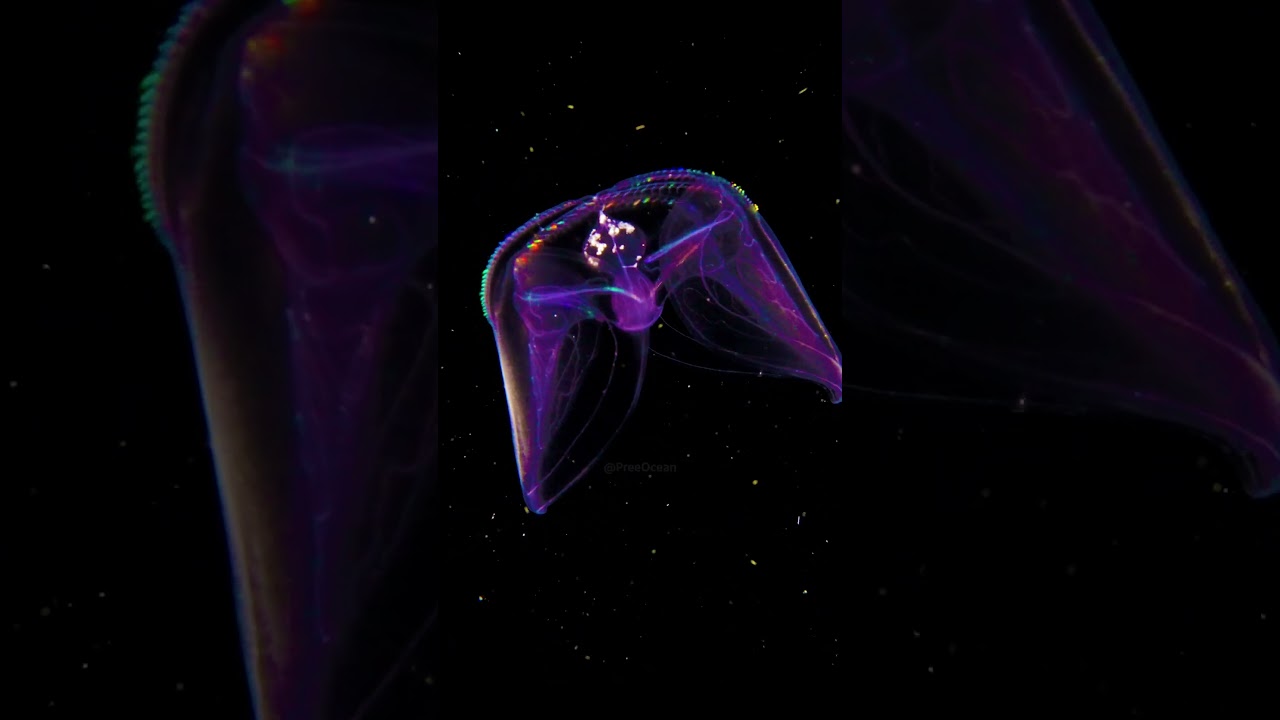
Winged comb jelly propulsion and structural anatomy
Direct answer summary
Winged comb jellies (Ocyropsis maculata) move through open pelagic waters using eight longitudinal rows of cilia called ctenes while flapping two muscular oral lobes for fast propulsion. Light refraction across these beating ciliary plates produces a vivid iridescent rainbow display across their transparent body.
Key Field Takeaways
- Taxonomic Classification: Phylum Ctenophora, Order Lobata, Family Ocyropsidae, Ocyropsis maculata.
- Dual Locomotion System: Uses continuous ciliary beat rows for hovering and muscular lobe clapping for rapid escape surges.
- Prismatic Light Refraction: Scatters light across thousands of microscopic fused cilia, producing dynamic rainbow spectral patterns.
- Ecosystem Role: Specialist pelagic planktivore regulating copepod and micro-crustacean populations in surface and epipelagic ocean zones.
| Taxonomic Parameter | Biological Specification |
|---|---|
| Scientific Name | Ocyropsis maculata |
| Common Name | Winged Comb Jelly |
| Phylum / Order | Ctenophora / Lobata |
| Conservation Status | Not Evaluated (Data Deficient) |
| Primary Diet | Copepods, larval crustaceans, pelagic invertebrates |
| Locomotion Mechanism | Comb row ciliary beating and oral lobe swimming |
| Habitat Zone | Epipelagic tropical and subtropical ocean waters |
Immediate physical observation and behavioral mechanics
In the primary footage, a translucent winged comb jelly suspends itself against a dark, pelagic environment. The organism displays two wide, muscular oral lobes that spread horizontally like delicate wings. These transparent lobes contract and flex in synchronous rhythm, creating subtle water displacement that stabilizes the organism in the water column.
Along the outer contours of the central body, eight distinct vertical lines glow with shifting spectral colors. These lines represent comb rows composed of tightly packed, fused cilia known as ctenes. As these cilia beat sequentially from the aboral pole downward toward the mouth, they diffract ambient light into vibrant bands of red, green, violet, and yellow.
Unlike true jellyfish, which rely exclusively on bell pulsations generated by umbrella-like umbrellas, lobate ctenophores utilize two distinct modes of movement. Slow, precise positioning occurs via continuous ciliary stroking. When sudden movement is required, the creature contracts its expansive oral lobes against one another, forcing water backward and creating a swift jet propulsion surge.
Morphological and anatomical adaptations
The body structure of Ocyropsis maculata consists of over 95 percent water contained within a gelatinous extracellular matrix called mesoglea. This hydrostatic skeleton provides structural rigidity without requiring high metabolic maintenance. The central core houses a simple digestive cavity, which receives food ingested through the central mouth located between the two primary oral lobes.
The defining visual feature of this species is its prismatic light display. The rainbow patterns visible along the body are not generated by biological light production or photoproteins. Instead, the rapid wave-like beating of thousands of microscopic cilia splits incoming ambient light into constituent wavelengths through simple physical diffraction.
To capture prey, the inner surfaces of the oral lobes are lined with specialized adhesive cells called colloblasts. When tiny prey organisms contact these cells, coiled spiral filaments burst outward, releasing a sticky mucus coating that holds the prey until it can be directed toward the mouth. This non-stinging strategy sets ctenophores completely apart from cnidarian jellies.
Habitat range and pelagic ocean ecology
Winged comb jellies inhabit warm tropical and subtropical waters across the Atlantic, Pacific, and Indian Oceans. They primarily occupy the epipelagic zone, ranging from the sunlit surface layer down to depths of roughly 100 meters. Their delicate gelatinous bodies make them highly sensitive to turbulent water currents and rough surface conditions.
Because ctenophores lack a rigid skeletal frame, they rely on neutral buoyancy to maintain their position in the water column. Small adjustments in internal ionic concentration allow the organism to float effortlessly at specific depth strata where prey density is highest. They often aggregate in high concentrations within nutrient-rich oceanic fronts and coastal eddies.
Environmental factors like water temperature, salinity, and light penetration directly influence their spatial distribution. In tropical surface waters, large swarms can form rapidly during seasonal plankton blooms, drastically altering local micro-zooplankton availability over short periods.
Interspecies relationships and trophic dynamics
As active planktivores, winged comb jellies exert significant control over small crustacean populations. Their primary prey consists of calanoid copepods, cladocerans, and tiny invertebrate larvae. By consuming large volumes of micro-zooplankton daily, they compete directly with larval fish for critical food resources in pelagic nurseries.
Despite their delicate build, winged comb jellies are a vital link in the marine food web. They serve as a energy-dense food source for ocean sunfish, sea turtles, and specialized predatory ctenophores such as Beroe species. Unlike prey organisms with hard exoskeletons, soft-bodied jellies offer high water and nutrient absorption for large pelagic predators.
detailed swimming strategies are common across marine species navigating complex pelagic and benthic environments. For example, contrasting locomotory adaptations can be observed in benthic specialists like peacock flounder locomotion or in highly visual marine predators like flamboyant cuttlefish, both of which demonstrate unique physical mechanisms evolved for survival in open water environments.
Conservation status and ecosystem threats
The International Union for Conservation of Nature (IUCN) currently classifies most lobate ctenophore species as Data Deficient or Not Evaluated. Gathering accurate population metrics for fragile marine invertebrates is challenging, as standard sampling nets often destroy delicate mesoglea tissues during collection.
Ocean acidification and rising sea surface temperatures represent long-term concerns for marine plankton networks. Altered pH levels and changing water density layers can disrupt plankton distribution, directly affecting food availability for lobate ctenophores. Plastic micro-pollution also presents a growing hazard, as synthetic particles can ingest directly into their simple gastrovascular cavity.
Monitoring pelagic ctenophore populations provides marine biologists with critical indicators of ocean health. Shifts in comb jelly abundance frequently signal broader changes in sea surface temperatures, nutrient runoff levels, and regional fish stock dynamics.
Frequently Asked Questions
Does a winged comb jelly sting human swimmers?
No, winged comb jellies do not possess stinging cells. Unlike true jellyfish, ctenophores use sticky adhesive cells called colloblasts to catch prey.
How does a winged comb jelly produce rainbow lights?
The dynamic rainbow shimmer is not bioluminescence, but optical light refraction. Millions of microscopic cilia in eight vertical comb rows beat in sequence, splitting ambient light into prismatic spectral colors.
What do winged comb jellies eat in the wild?
They are carnivorous planktivores that feed primarily on small crustaceans, such as copepods, larval fish, and tiny pelagic invertebrates.
How do winged comb jellies propel themselves through water?
They use dual propulsion mechanisms, relying on continuous ciliary beating for slow swimming and powerful muscular flapping of their oral lobes for fast escape movements.