
Direct answer summary
The Greater Racket-tailed Drongo (Dicrurus paradiseus) is a passerine bird belonging to the family Dicruridae, characterized by its glossy black plumage and distinctive elongated tail feathers. It utilizes these specialized appendages for complex social signaling while maintaining high aerial agility for foraging.
Key Field Takeaways
- Taxonomic Classification: Family Dicruridae, Order Passeriformes, Genus Dicrurus.
- Morphological Adaptation: Elongated outer rectrices (tail feathers) with terminal rackets that can exceed 30 centimeters in length.
- Foraging Strategy: Highly efficient aerial insectivore using a sit-and-wait hunting approach to capture prey in flight.
- Ecological Range: Distributed across tropical forests in Southern and Southeast Asia, often found in mid-story canopy layers.
| Feature | Specification |
|---|---|
| Scientific Name | Dicrurus paradiseus |
| Diet | Insects, small vertebrates, nectar |
| Habitat | Tropical and subtropical broadleaf forests |
| Key Adaptation | Elongated tail rackets and vocal mimicry |
| Conservation Status | Least Concern (IUCN) |
Physical observation and behavioral mechanics
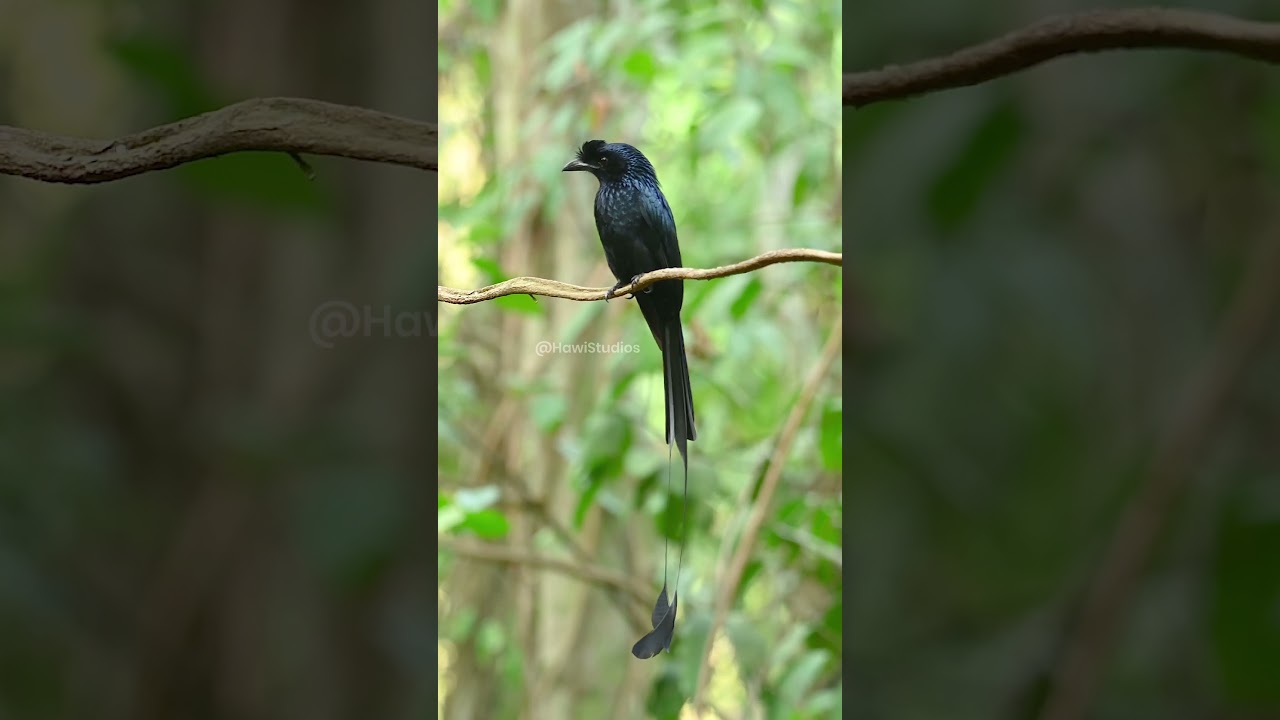
The individual observed in the footage exhibits the typical sedentary behavior of a Greater Racket-tailed Drongo during its rest phase. The bird maintains a steady posture on a thin, flexible vine, utilizing its zygodactyl-like grip to remain stable despite the movement of the substrate. Its plumage displays a high degree of iridescence, reflecting metallic blue and green hues under direct light.
The bird’s frontal crest is clearly visible, consisting of dense, forward-curving feathers that enhance its aggressive facial profile. The most striking anatomical feature, the elongated outer rectrices, hangs vertically beneath the bird. These feathers are remarkably thin for most of their length, terminating in flattened, paddle-like webs that provide a distinct visual marker during flight and courtship displays.
Morphological and anatomical adaptations
The Greater Racket-tailed Drongo possesses a robust, hooked bill designed for grasping and manipulating arthropod prey. This beak structure is essential for handling large, chitinous insects like beetles and mantids. The bird’s eyes are positioned to provide a wide field of view, facilitating the detection of movement in the dense forest understory.
Beyond its visual acuity, the species is recognized for its vocal versatility. It possesses a complex syrinx capable of mimicking a wide range of avian and mammalian sounds. This acoustic adaptation allows the drongo to navigate social interactions within the canopy, often mimicking the alarm calls of other species to clear competitors from a high-quality foraging patch.
Habitat range and forest ecology
This species thrives in the mid-to-upper canopy of tropical evergreen and deciduous forests. It is highly adapted to cluttered environments where maneuverability is a prerequisite for survival. By occupying these structural niches, the Greater Racket-tailed Drongo effectively utilizes the vertical stratification of the forest to monitor insect activity.
Its presence is often associated with stable, mature forest ecosystems. The bird’s reliance on specific tree structures for perching and nesting makes it sensitive to significant habitat fragmentation. For more on how specialized avian species navigate complex environments, one might compare its flight dynamics to the Long-tailed Widowbird flight mechanics and display behavior.
Interspecies relationships and evolutionary significance
The Greater Racket-tailed Drongo plays a significant role in mixed-species foraging flocks. By acting as a sentinel, it alerts other bird species to potential predators, a behavior that often grants it access to insects flushed by the movement of these larger groups. This mutualistic interaction is a key component of its survival strategy in highly competitive forest environments.
The evolution of its elongated tail is a classic example of sexual selection. While the tail may increase drag during high-speed flight, the fitness benefits derived from successful mate attraction outweigh the costs. This balance between aerodynamic efficiency and social signaling is a recurring theme in avian evolution, similar to the specialized feeding mechanisms seen in the Antillean crested hummingbird feeding.