
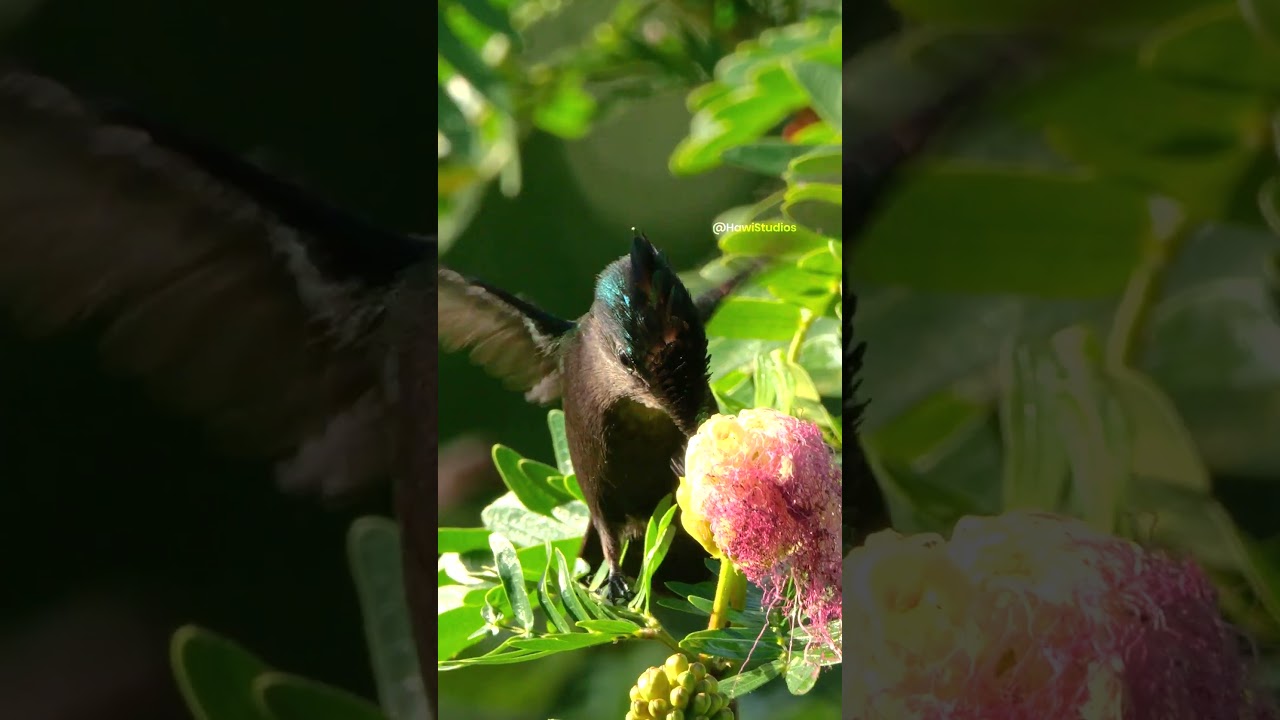
Antillean crested hummingbird feeding kinematics and anatomy
Direct answer summary
The Antillean crested hummingbird (Orthorhyncus cristatus) feeds on floral nectar using ultra-high-frequency wing beats exceeding 50 to 70 Hertz to maintain spatial stabilization while its straight, slender bill probes floral structures. Nectar uptake occurs through rapid lingual extension and fluid trapping mechanics.
Key Field Takeaways
- Taxonomic Classification: Order Apodiformes, Family Trochilidae, Orthorhyncus cristatus.
- Primary Behavioral Adaptation: High-frequency hovering flight coupled with rapid lingual fluid mechanics for efficient nectar harvest.
- Ecological Niche & Range: Endemic across the Lesser Antilles archipelago in coastal scrub, moist mountain forests, and cultivated gardens.
- Conservation & Field Status: Classified as Least Concern on the IUCN Red List with stable island populations.
| Parameter | Field Specification |
|---|---|
| Binomial Nomenclature | Orthorhyncus cristatus |
| Common Name | Antillean crested hummingbird |
| IUCN Red List Status | Least Concern |
| Primary Diet | Nectar (carbohydrates) and small floral arthropods (protein) |
| Geographic Distribution | Lesser Antilles archipelago (Caribbean) |
| Key Physiological Feature | Iridescent emerald crest feathers and specialized rigid wing joints |
Frame-by-frame behavioral analysis of nectar foraging
Hover stabilization and spatial head locking
In the observed video footage, the male Antillean crested hummingbird demonstrates rigid head stabilization while hovering immediately adjacent to a pink inflorescence. The body pitches at a 45-degree angle while the wings move through a horizontal figure-eight trajectory. This specialized movement pattern produces continuous aerodynamic lift on both the forward stroke and backward stroke.
Despite turbulence created by the bird’s high-frequency wingbeats, its head remains stationary relative to the target flower. Visual feedback from the avian ocular system corrects body positioning in real time. This spatial locking enables the hummingbird to insert its bill into small floral openings without striking reproductive structures that could disrupt feeding precision.
Bill insertion and fluid ingestion mechanics
The hummingbird inserts its slender, straight bill directly into the dense stamens of the pink bloom. The lower mandible can flex slightly at the base, permitting tiny shifts in orientation as the tip penetrates the floral tissue. Once the bill reaches the nectar chamber at the base of the corolla, the tongue extends past the bill tip at rates up to 20 cycles per second.
Nectar uptake does not rely on simple suction. The bifurcated tongue features lateral hair-like fringes that expand upon contacting liquid. As the tongue retracts into the bill, elastic fluid trapping pulls nectar into internal grooves, allowing fast carbohydrate ingestion required to fuel high metabolic energy expenditure.
Morphological adaptations and plumagework
Iridescent crest feathers and structural coloration
The most distinctive morphological trait observed in the footage is the bird’s vertical head crest. In male Orthorhyncus cristatus, these short, stiff feathers feature microscopic barbule structures that reflect light in narrow green and turquoise wavelengths. The iridescence appears bright when illuminated at direct angles by sunlight and disappears into dark hues when shifted out of direct alignment.
This directional light reflection acts as a visual signal during territorial defense and courtship displays. By tilting its head toward opponents or prospective mates, the hummingbird projects concentrated flashes of green light without requiring energetic chemical pigments within the feather shaft.
Flight muscle physiology and skeletal modifications
To support hover flight, the hummingbird possesses an enlarged sternal keel that anchors massive pectoralis and supracoracoideus muscles. These two muscle groups account for up to 30 percent of the bird’s total body mass. Unlike most passerines, the shoulder joint allows 180 degrees of axial rotation, while the elbow and wrist joints remain relatively rigid.
This rigid arm structure transforms the wing into a stiff foil, maximizing force efficiency during high-speed wing strokes. The high ratio of fast-glycolytic muscle fibers enables sustained power output without muscular fatigue during long foraging bouts across scattered flowers.
Habitat range and regional ecosystem dynamics
Lesser Antillean distribution and plant choices
The Antillean crested hummingbird is widely distributed throughout the Lesser Antilles, ranging from Puerto Rico and the Virgin Islands south to Grenada. It occupies diverse habitats, including xeric coastal scrublands, moist montane rainforests, urban parklands, and agricultural plantations. Its broad ecological tolerance allows it to exploit both native flora and introduced garden plants.
Flowers with high sucrose concentration, such as species in the family Fabaceae, serve as primary food sources. While collecting nectar, forehead feathers gather pollen grains from flower anthers and transfer them to adjacent blossoms, making this species a key pollinator across Caribbean island ecosystems.
Trophic role and nutritional balance
Although nectar provides immediate carbohydrates for high-frequency flight, it lacks essential amino acids, lipids, and minerals. To fulfill these nutritional demands, the bird hunts small insects and spiders directly from vegetation or captures them during brief mid-air aerial sallies. This omnivorous balance supports egg production, feather development, and muscle repair.
The foraging strategy differs sharply from ground-dwelling seed consumers like common chaffinch foraging or large forest canopy fruit eaters like wreathed hornbill biology. The hummingbird depends entirely on continuous access to high-energy liquid nectar throughout daylight hours to avoid metabolic exhaustion.
Conservation status and ecosystem threats
Population stability and adaptive resilience
The International Union for Conservation of Nature (IUCN) classifies Orthorhyncus cristatus as Least Concern. The species exhibits high adaptability to modified human environments and prospers in manicured gardens containing non-native flowering vegetation. Its small size and high maneuverability lower predation risks from domestic cats and introduced rats.
However, extreme weather events such as intense Caribbean hurricanes present temporary local threats. Severe storms can strip flowering trees of foliage and nectar blossoms, causing short-term population declines until tropical vegetation regenerates. Their high reproductive output and mobility allow rapid recolonization of damaged island sectors.
How fast do Antillean crested hummingbird wings beat during feeding?
Antillean crested hummingbirds maintain wingbeat frequencies between 50 and 70 wingbeats per second while hovering. This high stroke rate generates constant lift on both fore-stroke and back-stroke movements.
What is the primary function of the crest on male Antillean crested hummingbirds?
The metallic green crest serves primarily in sexual selection and intra-species territorial signaling. Reflective structural feather barbs direct light toward rivals or prospective mates.
Where are Antillean crested hummingbirds natively found?
This species is native to islands throughout the Lesser Antilles archipelago in the Caribbean. They inhabit coastal scrublands, tropical secondary forests, and suburban garden environments.
How do hummingbirds pull nectar out of deep floral tubes?
Hummingbirds utilize a bifurcated, grooved tongue that rapidly extends into nectar pools up to 15 to 20 times per second. Surface tension and elastic rebound pull fluid into the lingual grooves without relying purely on capillary action.