
Direct answer summary
Bald eagle vocalization consists of a series of high-pitched, stuttering whistles used primarily for social signaling and territorial defense. Unlike many other raptors, Haliaeetus leucocephalus produces sounds that are relatively weak in volume, often serving to reinforce pair bonds or alert conspecifics to their presence.
Key Field Takeaways
- Taxonomic Classification: Family Accipitridae, Genus Haliaeetus, Species Haliaeetus leucocephalus.
- Primary Behavioral Adaptation: High-frequency vocalization used for mate communication and territorial maintenance.
- Ecological Niche & Range: Apex predator occupying riparian and coastal environments across North America.
- Conservation & Field Status: Currently listed as Least Concern, with populations recovering significantly under the Endangered Species Act.
| Feature | Specification |
|---|---|
| Scientific Name | Haliaeetus leucocephalus |
| Common Name | Bald Eagle |
| IUCN Status | Least Concern |
| Diet | Piscivorous, opportunistic scavenger |
| Habitat | Near large water bodies |
| Key Adaptation | Powerful talons for aquatic prey capture |
Vocalization mechanics in Haliaeetus leucocephalus
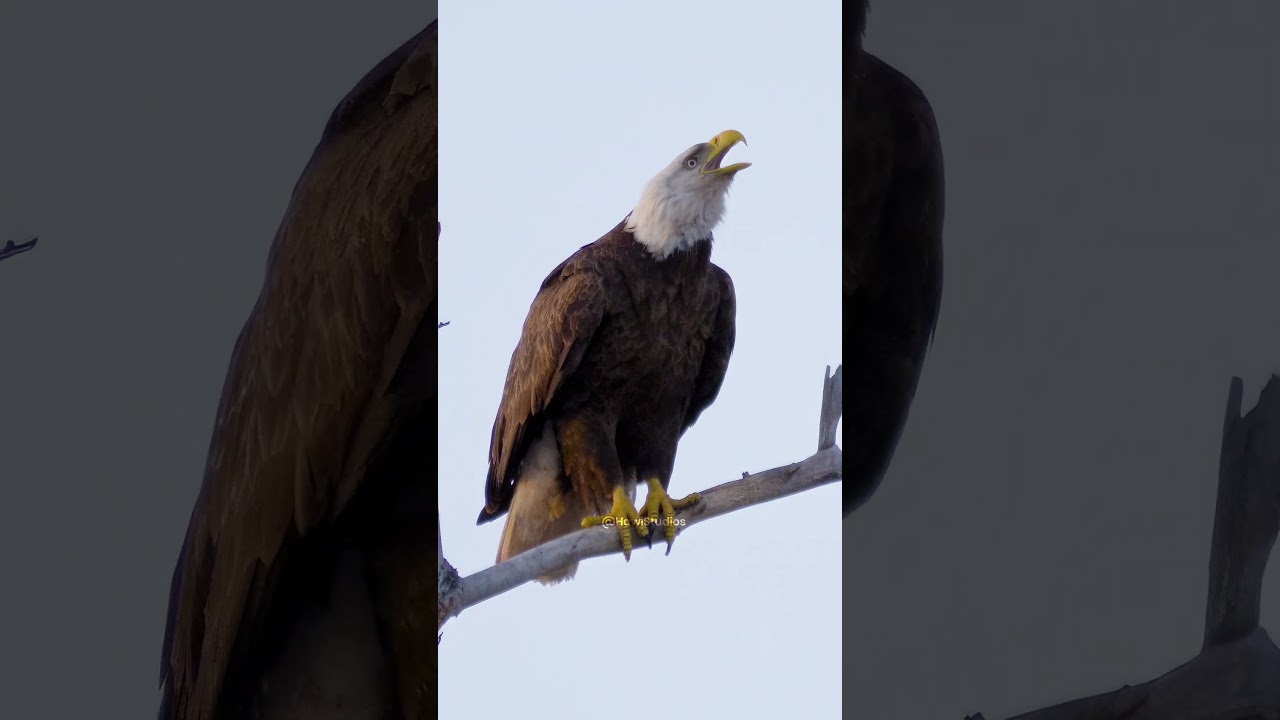
The vocalization observed in the footage highlights the unique morphology of the bald eagle’s respiratory system. While many birds possess complex syrinx structures for elaborate song, the eagle uses its vocal apparatus for sharp, clear whistles. The bird tilts its head backward during the call, which helps in projecting the sound forward and upward, a common behavior in territorial signaling.
Behavioral significance of perching
The eagle’s position on a thin, bare branch provides an unobstructed view of its territory. This vantage point is critical for monitoring both prey movement and the presence of competitors. The grip maintained by the talons is facilitated by the digital flexor tendons, which lock the toes into place, requiring minimal muscular effort to maintain a secure hold while the bird vocalizes.
Morphological adaptations for apex predation
The bald eagle displays classic raptor morphology, including a large, hooked beak designed for tearing flesh and specialized scaly feet with sharp, curved talons. The white head and tail feathers contrast sharply with the dark brown body, serving as a visual signal of maturity. These physical traits are essential for its role as an apex predator in aquatic ecosystems, where it often interacts with other species such as the red-billed oxpecker foraging styles seen in different avian lineages.
Ecosystem dynamics and habitat requirements
Bald eagles require expansive territories near large bodies of water, such as lakes, reservoirs, or coastal areas. Their reliance on these habitats mirrors the specialized requirements of other wildlife, such as the tropical montane stream ecology that supports specific amphibian life cycles. By occupying these niches, the eagle regulates fish populations and scavenges carrion, contributing to the health of the riparian environment.