
Direct answer summary
Southern ground hornbills (Bucorvus leadbeateri) use their sharp, curved bills to capture, crush, and swallow terrestrial prey whole. Their heavy bill tip applies direct point pressure to immobilize small mammals like mice before toss-and-swallow inertial head movements pass the item into the esophagus.
Key Field Takeaways
- Taxonomic Classification: Family Bucorvidae, Genus Bucorvus, Species Bucorvus leadbeateri.
- Primary Behavioral Adaptation: Mandibular point-pressure clamping combined with head-tossing inertial swallowing to ingest live prey without mastication.
- Ecological Niche &, Range: Sub-Saharan grasslands and savannas, maintaining home ranges between 50 and 100 square kilometers.
- Conservation Status: Classified as Vulnerable on the IUCN Red List, threatened by habitat loss and secondary poisoning.
| Field Parameter | Biological Specification |
|---|---|
| Binomial Nomenclature | Bucorvus leadbeateri |
| Common Name | Southern ground hornbill |
| IUCN Conservation Status | Vulnerable |
| Primary Diet | Carnivorous (rodents, snakes, lizards, frogs, tortoises) |
| Natural Habitat | Sub-Saharan savanna, grassland, and open woodland |
| Key Physical Adaptation | Decurved keratin sheath bill and expandable red gular pouch |
Southern ground hornbill prey handling mechanics
Mandibular clamping force and bill tip precision
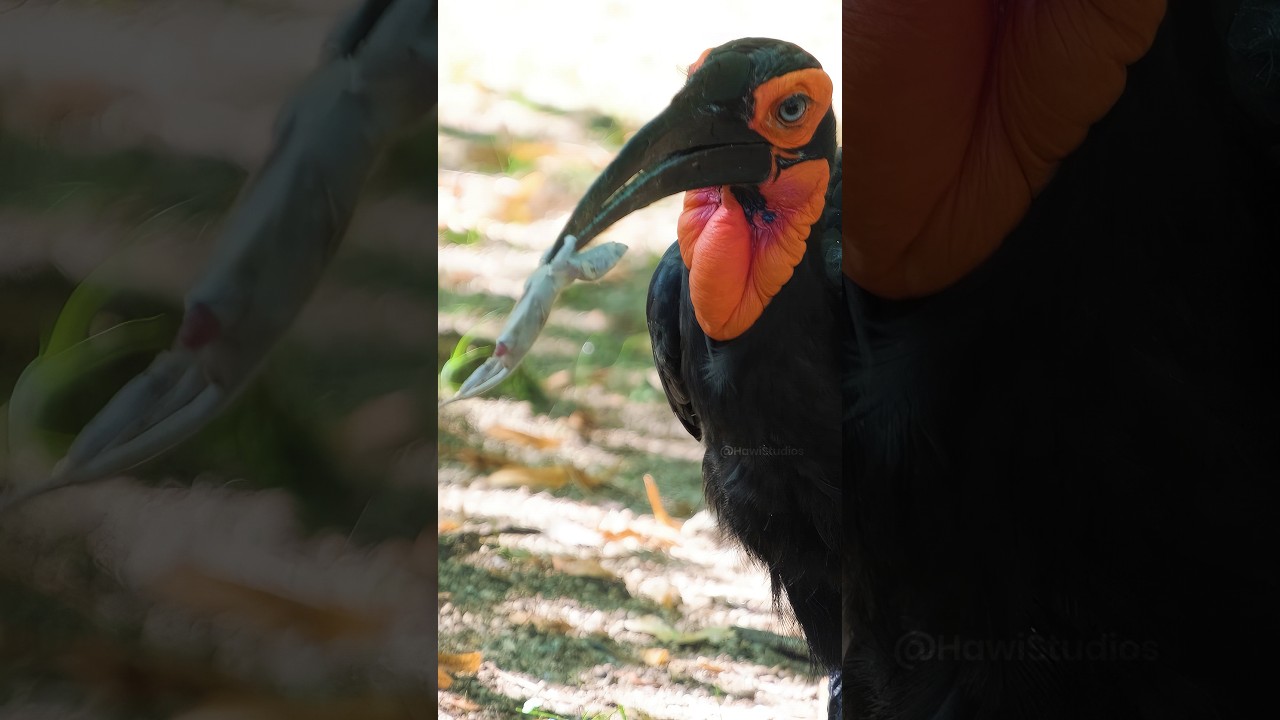
The footage documents an adult Southern ground hornbill (Bucorvus leadbeateri) securing a small gray rodent between the distal ends of its bill. Unlike many raptors that use sharp talons to tear prey, ground hornbills rely entirely on their heavy mandibles to secure live animals. The elongated, curved bill structure acts as a lever, generating concentrated compressive force at the very tip.
As observed in frames 00:00 through 00:04, the bird grips the prey body securely without dropping it. This precise clamping action prevents fast-moving rodents from twisting free or biting the bird’s unfeathered facial skin. The keratin sheath on the bill edge provides strong mechanical resistance during prey immobilization.
Inertial swallowing and head movement mechanics
Avian species lack fleshy lips and flexible tongues capable of chewing food. Southern ground hornbills rely on inertial feeding, a mechanical process where the head snaps backward to toss the item toward the rear of the pharynx. The footage shows subtle upward flicks of the head as the bird repositions the rodent prior to swallowing.
Once the rodent reaches the base of the mouth, powerful throat muscles draw the item past the glottis into the esophagus. This process allows Bucorvus leadbeateri to consume animals up to the size of adult hares or small tortoises without external dismemberment.
Morphological adaptations for terrestrial hunting
Decurved bill structure and cranial reinforcement
The bill of Bucorvus leadbeateri measures between 18 and 22 centimeters in adult specimens. Unlike arboreal hornbill species that possess large hollow casques for acoustic amplification, the Southern ground hornbill has a reduced, reinforced casque at the base of the upper mandible. This structural modification strengthens the skull against mechanical shock when digging into hard soil.
The bill tips remain extremely precise despite their heavy construction. Hornbills can pick up microscopic seeds or small terrestrial invertebrates, yet possess enough rigidity to pry open rotten logs or overturn heavy stones weighing over two kilograms during daily foraging walks.
Facial skin coloration and gular pouch physiology
A distinct visual characteristic seen in the footage is the vivid red skin surrounding the eyes and neck. Adult Southern ground hornbills feature bare facial patches and an expandable inflatable throat pouch, officially known as a gular sac. Male individuals maintain solid red skin, while females display a small patch of deep blue on the lower throat.
This unfeathered skin helps regulate body temperature during long foraging marches across high temperature savannas. The gular sac also functions as a resonance chamber during territorial vocalizations, allowing their deep booming calls to carry over distances exceeding five kilometers.
Savanna foraging ecology and prey detection
Terrestrial walking and substrate probing
Southern ground hornbills spend up to 70 percent of their daylight hours on foot, walking at speeds of 3 to 5 kilometers per hour across open grasslands. Their feet are modified for walking, featuring shortened toes and thickened plantar pads that protect against thorns and sharp rocks. They move systematically in small groups, searching grass roots and ground debris.
Unlike wading birds that rely on aquatic filtering such as mute swan mud foraging mechanics, ground hornbills inspect firm dry ground. They strike at rustling leaves or soil disturbances, catching fleeing prey with rapid forward bill lunges.
Territorial dynamics and interspecies interactions
Cooperative group defense and social structure
Bucorvus leadbeateri lives in obligate cooperative breeding groups consisting of a dominant breeding pair and up to nine helper individuals. Helpers assist in territory defense, nest construction inside hollow tree cavities, and feeding chicks over an extended two year rearing period. Group members coordinate search patterns to flush hidden prey across savanna territory ranges spanning 50 to 100 square kilometers.
When encountering active defensive prey like venomous snakes or fast moving lizards, group members work together. They use wing flares to distract targets, similar to how an oriental garden lizard thermoregulation stance relies on sudden positioning shifts, while the hornbill delivers decisive bill strikes to the head of the prey.
Conservation status and ecosystem threats
Habitat fragmentation and threat mitigation
The IUCN Red List classifies the Southern ground hornbill as Vulnerable across its sub-Saharan distribution, with regional classifications listed as Endangered in South Africa. The species faces population declines due to loss of mature nesting trees, expansion of agricultural land, and accidental secondary poisoning from agricultural baits targeting mammalian carnivores.
Electrocution on utility poles also poses a documented hazard due to their large wingspan reaching up to 1.8 meters. Conservation management teams install artificial nesting boxes and conduct landowner education campaigns to stabilize wild populations.
Secondary savanna ground foragers
Within savanna ecosystems, ground hornbills share ground foraging zones with numerous small creatures. Slow moving invertebrates, such as those exhibiting black land snail locomotion, often fall prey to ground hornbills alongside small mammals and reptiles, forming an integral link in terrestrial nutrient recycling.
Frequently asked questions
What do Southern ground hornbills eat in the wild?
Southern ground hornbills are carnivorous birds that hunt small mammals, snakes, lizards, frogs, tortoises, and large insects. They use their strong decurved bills to dig into soil and crush prey on the ground.
Why do ground hornbills have red skin on their neck?
The bare red skin on their throat and face is a thermal regulation surface and a visual indicator of age and sex. The red gular pouch inflates during vocalizations, allowing their deep calls to travel across long distances.
Can Southern ground hornbills fly?
Yes, Southern ground hornbills can fly, despite spending most of their time walking on the ground. They fly up into high trees to roost at night, escape predators, or travel between distant feeding zones across their large territories.
Why are Southern ground hornbills vulnerable to extinction?
Ground hornbills have low reproduction rates, usually raising only one chick every nine years to maturity. Habitat loss, destruction of nesting hollows, secondary poisoning, and power line collisions severely impact their wild numbers.