
Direct answer summary
Mute swan mud foraging mechanics rely on specialized benthic dabbling and palmate foot stabilization. By bending its 23-vertebra neck into shallow silt, Cygnus olor uses bill lamellae to filter submerged roots, aquatic plants, and invertebrates while webbed feet distribute its heavy body weight across soft mud.
Key Field Takeaways
- Taxonomic Classification: Class Aves, Order Anseriformes, Family Anatidae, Genus Cygnus, Species Cygnus olor.
- Primary Behavioral Adaptation: Benthic probing and lamellar filtering using a 23-vertebra cervical column and serrated bill margins.
- Ecological Niche and Mass: Large herbivorous waterfowl weighing 8.5 to 12 kilograms requiring shallow aquatic substrates under 1 meter deep.
- Locomotor Mechanics: Webbed palmate feet expanding surface contact area to minimize displacement into soft silt deposits.
| Taxonomic Parameter | Biological Specification |
|---|---|
| Binomial Nomenclature | Cygnus olor |
| Common Name | Mute Swan |
| Conservation Status | Least Concern (IUCN Red List) |
| Primary Diet | Submerged aquatic vegetation, roots, macroalgae, benthic invertebrates |
| Habitat Range | Freshwater lakes, shallow ponds, tidal mudflats, slow rivers |
| Key Physical Adaptation | Elongated neck with 23 cervical vertebrae and uropygial waterproofing gland |
Immediate physical observation and behavioral mechanics
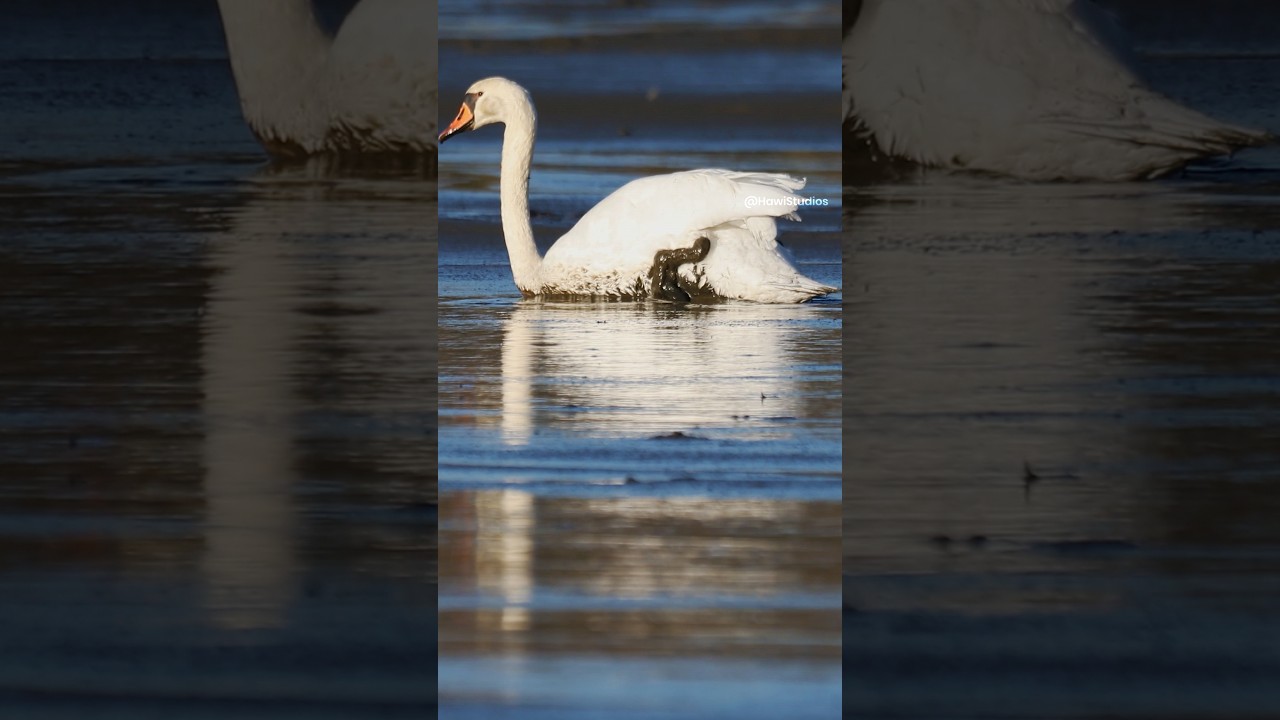
In the observed field footage, an adult mute swan (Cygnus olor) navigates a low-water littoral zone characterized by fine suspended sediment and shallow surface runoff. The specimen exhibits focused benthic searching behavior, bending its flexible neck toward the substrate to sample soft mud. Dark silt clings directly to the ventral contour feathers, indicating prolonged movement through shallow muddy margins where water depth measures only a few centimeters.
The bird executes precise head and neck repositioning while stabilizing its broad torso over soft substrate. Each step involves deliberate placement of large, dark palmate feet. As weight shifts onto each foot, the webbed digital membrane expands across the soft mud surface. This mechanical adjustment distributes body mass across a wider area, preventing deep sinking into fluid benthic sediments.
Benthic filter feeding and bill biomechanics
While moving forward, the swan lowers its head into the muddy water to engage in benthic probing. The bill of Cygnus olor features lateral serrations known as lamellae along the inner margins of the tomia. These comb-like structures function as a mechanical sieve, allowing water and fine liquid mud to flush out while retaining solid organic matter such as plant roots, seeds, and small macroinvertebrates.
This feeding technique requires minimal energy expenditure compared to deep-water diving. By utilizing its long neck, the bird accesses benthic nutrients while keeping its dorsal core above water. Similar specialized feeding strategies can be seen in other avian species, such as Winter Wren nestling development and feeding behavior where precise physical adaptations meet specific ecological demands.
Morphological and anatomical adaptations
The physical structure of Cygnus olor reflects specialized evolution for life in aquatic and semi-aquatic habitats. Adults rank among the heaviest flying birds in North America and Eurasia, with males frequently reaching 11 to 12 kilograms and females averaging 8.5 to 9 kilograms. Supporting this substantial mass on soft ground requires specific anatomical design in the lower limbs and feather structure.
The neck contains 23 cervical vertebrae, more than most other bird groups. This high vertebra count confers exceptional mechanical flexibility, enabling full S-curve flexion and extended downward reach without altering body position. The orange bill, crowned by a pronounced black basal knob in adult males, provides structural rigidity for pulling rooted vegetation from stubborn benthic mud.
Plumage structure and uropygial waterproofing
Despite walking through dark, silty water, the upper dorsal plumage remains dry and clean. Swans maintain this barrier through continuous preening and chemical coating from the uropygial gland located at the base of the tail. This gland secretes a complex mixture of hydrophobic waxes, fatty acids, and lipids.
The bird uses its bill to distribute these uropygial secretions across thousands of contour feathers. The outer vanes form a tight, interlinked barrier over an inner down layer containing thousands of plumulaceous fibers per square centimeter. Air trapped inside this down layer generates static buoyancy and insulates against cold water, shielding skin from muddy moisture.
Habitat range and benthic ecology
Mute swans occupy a diverse range of lowland aquatic ecosystems across Europe, Central Asia, and introduced regions of North America. Preferred habitats include shallow freshwater ponds, eutrophic lakes, sheltered estuarine mudflats, and slow-flowing river banks. These water bodies typically feature abundant submersed aquatic vegetation and soft sediment beds under one meter in depth.
Shallow mudflats represent rich feeding zones due to high organic deposition. Accumulations of dead plant matter, algae, and benthic fauna collect in fine silt layers. When water levels recede during dry periods or low tides, these nutrients concentrate near the surface, allowing swans to systematically clear patches of vegetation.
Sediment disturbance and nutrient cycling
As Cygnus olor walks and dabbles through mud, its large feet and active bill stir up bottom sediments. This physical disturbance suspended organic particles into the water column, altering local turbidity. Unused roots and dislodged seeds float upward, creating micro-foraging opportunities for smaller waterfowl species operating nearby.
This sediment turnover mirrors ecological shifts seen in terrestrial environments, such as those discussed in European Ground Squirrel vigilance and sentinel behavior, where animal activities modify microhabitats and influence surrounding species.
Interspecies relationships and evolutionary significance
Within aquatic ecosystems, mute swans occupy an upper trophic level among herbivorous waterfowl. Their massive size and dominant physical presence allow them to command prime feeding sites along shallow margins. Other waterfowl, including dabbling ducks and coots, often congregate near foraging swans to feed on displaced plant fragments floating to the surface.
Territorial aggression is common during the spring breeding season. Adult cob pairs actively defend nest sites against intruding birds, native waterfowl, and potential ground predators. Their large size, powerful humerus bone structure, and strong wing strokes serve as effective physical deterrents against threats along shoreline nesting zones.
Thermal strategy across varied seasons
Mute swans exhibit high tolerance for variable seasonal conditions. During cold winter periods, when shallow pond edges freeze or turn into ice-laden mud, their counter-current heat exchange system in the legs minimizes metabolic heat loss. Warm arterial blood traveling down the tarsometatarsus transfers heat directly to cooler venous blood returning from the unfeathered feet.
This vascular mechanism prevents tissue freezing while walking across frozen mud or cold water. Similar survival mechanisms are evident in extreme high-altitude species, as highlighted in analysis of alpine wildlife adaptations in cold ecosystems where structural traits shield animals from harsh conditions.
Conservation status and environmental threats
The IUCN Red List classifies Cygnus olor as Least Concern due to widespread distribution and stable global population trends. In native European ranges, legal protection and habitat restoration have supported strong recovery over recent decades. However, in non-native introduced ranges, dense populations can alter native aquatic plant communities through heavy grazing pressure.
Primary threats to local populations include ingestion of lead fishing sinkers, collision with overhead power cables, water pollution, and habitat loss from urban wetland drainage. Ingestion of discarded lead tackle leads to neuromuscular paralysis and digestive disruption, posing a persistent threat to birds foraging deep in shallow bottom mud.
Frequently Asked Questions
Why do mute swans forage in shallow muddy water?
Mute swans forage in shallow muddy water to reach submerged aquatic vegetation, roots, tubers, and small benthic invertebrates. Their long necks allow them to reach substrates up to one meter deep without fully submerging their bodies.
How do swans stay warm and dry when covered in wet mud?
Swans maintain waterproofing and thermal insulation through dense down feather layers and regular preening with secretions from the uropygial gland. This lipid-rich wax coats outer contour feathers, preventing muddy water from reaching the skin.
What feet structure helps mute swans walk on soft silt?
Mute swans possess large palmate feet with broad interdigital webbing between three anterior toes. This structural surface area distributes body mass across loose mud, preventing deep sinking during shallow wading.
How much food does an adult mute swan consume daily?
An adult mute swan consumes approximately three to four kilograms of aquatic vegetation per day. This high intake fuels their heavy body mass, which ranges from 8.5 to 12 kilograms in healthy adults.