
Direct answer summary
The Winter Wren (Troglodytes hiemalis) nestling exhibits a highly specialized begging behavior characterized by wide-gaping, which facilitates efficient food transfer from the parent. This rapid growth phase is supported by the parent’s intensive foraging of small, protein-rich invertebrates.
Key Field Takeaways
- Taxonomic Classification: Family Troglodytidae, Genus Troglodytes, Species hiemalis.
- Primary Behavioral Adaptation: High-frequency begging response with high-contrast yellow gape to trigger parental feeding.
- Ecological Niche & Range: Primarily inhabits dense, damp coniferous forests and riparian zones across North America.
- Conservation & Field Status: Generally stable populations, though sensitive to the loss of old-growth forest understory and nesting sites.
| Feature | Specification |
|---|---|
| Scientific Name | Troglodytes hiemalis |
| Common Name | Winter Wren |
| IUCN Status | Least Concern |
| Primary Diet | Invertebrates (spiders, insects) |
| Habitat | Coniferous forest understory |
| Adaptation | Complex, high-pitched song and cryptic nesting |
Immediate physical observation and behavioral mechanics
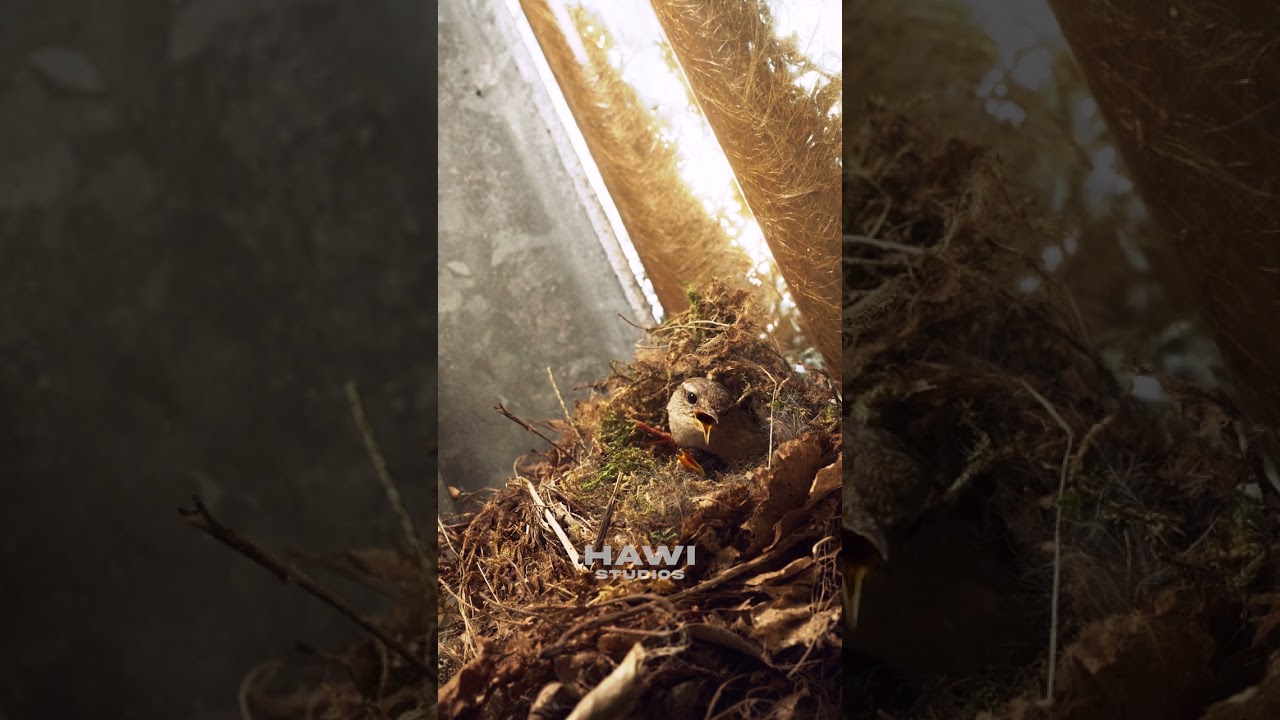
In the documented footage, the Winter Wren nestling demonstrates the classic begging posture of a passerine chick. The bird maintains a crouched position within the cup of the nest, which is lined with moss and fine rootlets. Upon sensing movement or sound, the chick automatically triggers a gape response, extending its neck and opening its mouth to reveal a vivid yellow lining.
This visual stimulus acts as a critical signal for the adult Winter Wren. The bright color of the gape is a target for the parent, ensuring that food delivery is precise and rapid. This behavior is essential for minimizing the time the parent spends at the nest, thereby reducing the risk of attracting predators to the site.
Morphological and anatomical adaptations
The Winter Wren is a small, compact bird, typically measuring 8 to 11 centimeters in length. Its anatomy is perfectly suited for navigating the dense, complex understory of coniferous forests. The short, rounded wings allow for quick, agile flight over short distances, while the stiff, short tail is often held in a cocked position, a hallmark of the Troglodytidae family.
The bill of the Winter Wren is thin and slightly decurved, an evolutionary adaptation for probing into crevices, bark, and mossy substrates to extract insects. This specialized foraging tool is critical for survival in environments where prey is often hidden deep within decaying wood or dense vegetation. For further context on nestling development, see European serin nestling feeding mechanics and biology.
Habitat range and terrestrial ecology
Winter Wrens are primarily associated with cool, moist coniferous forests. They prefer areas with significant downed woody debris, mossy logs, and tangled roots, which provide both nesting sites and abundant foraging opportunities. Their distribution spans across much of North America, where they occupy a niche as an active, ground-dwelling insectivore.
The species relies on the presence of high-quality understory cover to protect its young from aerial and terrestrial predators. By nesting in sheltered areas like mossy banks or tree cavities, the Winter Wren mitigates the risks associated with ground-level exposure. This habitat selection is a key component of their reproductive success and overall population stability.
Interspecies relationships and evolutionary significance
As an insectivorous species, the Winter Wren plays a role in regulating populations of small invertebrates within the forest ecosystem. Their foraging activity helps control the density of various forest-floor arthropods, contributing to the health of the local habitat. The species faces competition from other small passerines, but its unique ability to forage in dense, low-light environments provides a distinct ecological advantage.
Evolutionarily, the Winter Wren represents a highly successful adaptation to temperate forest life. Their complex vocalizations and secretive nesting habits are strategies that have allowed them to thrive across varied, often harsh, environmental conditions. For comparison with other avian adaptations, see Emerald Dove biology.