
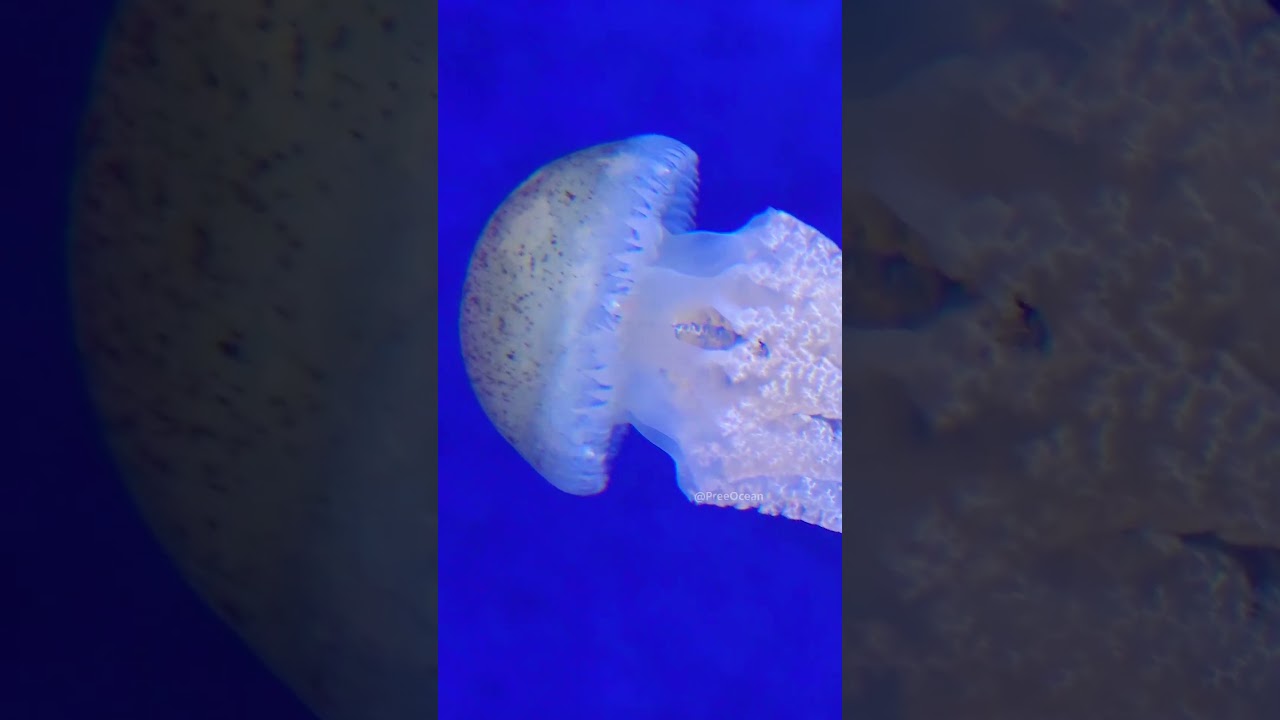
Direct answer summary
The white-spotted jellyfish (Phyllorhiza punctata) propels itself through pelagic waters via rhythmic subumbrellar muscular contractions at frequencies of 0.5 to 1.2 Hz. This hydro-propulsive motion creates fluid vortices that draw micro-zooplankton into its oral pores while offering structural protection to juvenile teleost fish seeking commensal shelter.
Key Field Takeaways
- Taxonomic Classification: Class Scyphozoa, Order Rhizostomeae, Family Rhizostomatidae, Phyllorhiza punctata.
- Propulsion Mechanics: Subumbrellar coronale muscle contractions operating at 0.5 to 1.2 pulses per second.
- Ecological Niche & Range: Native to the Western Pacific and Indo-Pacific oceans, inhabiting coastal estuaries and surface zones down to depths of 30 meters.
- Interspecies Mutualism: Provides spatial micro-refuge for juvenile teleost fish against larger open-water predators.
| Biological Property | Field Observation & Metric |
|---|---|
| Binomial Nomenclature | Phyllorhiza punctata |
| Common Name | White-spotted jellyfish, Australian spotted jellyfish |
| IUCN Conservation Status | Not Evaluated (Invasive in Atlantic Ocean) |
| Bell Diameter Range | 30 to 50 centimeters |
| Pulsation Frequency | 0.5 to 1.2 Hz (contractions per second) |
| Primary Diet | Micro-zooplankton, copepods, bivalve larvae, fish eggs |
| Native Distribution | Tropical Western Pacific and Indo-Pacific marine waters |
Frame-by-frame biological analysis of spotted jellyfish locomotion
In the primary footage, a mature specimen of Phyllorhiza punctata demonstrates clear hydro-propulsive movement in an open marine environment. The bell contracts in a synchronized sequence, narrowing the subumbrellar cavity and ejecting a stream of water backwards to generate forward thrust.
This contracting phase occurs rapidly, lasting less than half a second per stroke. The elastic tissue of the gelatinous bell, composed of a collagen-rich matrix called mesoglea, recoils automatically during the relaxation phase. This passive recoil re-expands the bell, refilling the subumbrellar cavity without extra metabolic effort.
Subumbrellar muscular contraction mechanics
The movement depends on a network of circular muscle fibers situated along the lower margin of the bell, known as coronale muscles. These muscle sheets receive electrical signals from nerve nets distributed around the bell rim. When these muscles flex, they squeeze the perimeter inward, decreasing the internal volume of the subumbrellar cavity.
During contractions, the bell margin curves inward to form a nozzle shape. This shape concentrates the expelled water jet, maximizing push while reducing energetic waste. The steady rhythm of these pulses allows the jellyfish to maintain vertical stability in water currents.
Vortex generation and fluid displacement
Each propulsion cycle generates paired toroidal vortices along the edge of the bell. The starting vortex forms as water is forced out during contraction, while a second stopping vortex develops as the bell expands during recovery. These circulating water patterns push the animal forward through the water column.
These vortex currents also pull surrounding water toward the oral arms underneath the bell. This continuous flow of water delivers microscopic planktonic prey directly to the feeding structures, merging movement and feeding into one efficient physical process.
Morphological and sensory adaptations of scyphozoans
The physical structure of Phyllorhiza punctata features a wide dome-shaped umbrella speckled with white crystalloid spots. These white inclusions are aggregations of reflective cells set within the gelatinous bell tissue, helping break up the animal’s silhouette in sunlit surface waters.
Unlike jellyfish in the order Semaeostomeae, members of Rhizostomeae lack long trailing marginal tentacles around the perimeter of the bell. Instead, their feeding structures are concentrated in eight thick, highly branched oral arms suspended beneath the central disc.
Oral arm architecture and ostia filtration
The oral arms of Phyllorhiza punctata consist of dense, cauliflower-like masses of tissue equipped with thousands of tiny mouth pores called ostia. These ostia replace the single central mouth found in simpler jellyfish species, creating a broad filtration system.
Each oral arm ends in long, translucent ribbon-like appendages that float below the main body. Microscopic stinging cells called nematocysts line these appendages, discharging microscopic barbed threads on contact to immobilize tiny planktonic prey before transferring them into the internal digestive canals.
Rhopalia and statocyst sensory systems
Along the outer edge of the bell sit specialized sensory structures known as rhopalia. Each rhopalium contains a statocyst, which is a gravity-sensing organ filled with calcium carbonate crystals, alongside primitive light-sensing pigment pits called ocelli.
These sensory nodes allow Phyllorhiza punctata to orient itself relative to gravity and light gradients. The rhopalia direct rhythmic contractions across the nerve net, helping the medusa swim toward light-filled surface waters where its symbiotic algae can perform photosynthesis.
Commensal relationships between juvenile fish and jellyfish
The footage documents a clear commensal interaction between the jellyfish and a small juvenile teleost fish swimming close to the oral arms. The juvenile fish navigates safely between the fleshy folds, staying near the jellyfish as it moves through open water.
This dynamic offers clear spatial benefits for the juvenile fish. In open water, small fish face constant predation from larger hunting species, making the stinging arms of a scyphozoan an effective floating shelter.
Hydrodynamic shelter inside oral arm clusters
By staying inside the subumbrellar cavity and oral arm cluster, the juvenile fish reduces the swimming effort needed to traverse open water. The fluid vortices generated by the contracting bell create low-pressure zones that pull the small fish forward along with the jellyfish.
The physical presence of the jellyfish acts as a body shield against larger predators, which avoid the stinging cells of the oral arms. The small fish stays positioned between the central arms, moving in step with every pulse of the bell.
Nematocyst evasion mechanisms in juvenile teleosts
Juvenile fish avoid jellyfish stings through rapid swimming adjustments and a specialized outer mucus layer. This thick mucus coating lacks the specific glycoproteins that trigger nematocyst discharge, letting the fish touch the oral arms without setting off the stingers.
This protective strategy allows young fish to mature safely in pelagic environments until they grow large enough to leave the host. Similar spatial shelter behaviors appear in other marine animals, such as the algae octopus camouflage techniques observed in shallow coastal environments.
Ecosystem impacts and trophic dynamics
As large filter feeders, populations of Phyllorhiza punctata filter vast amounts of ocean water every day. An adult specimen can process over 50,000 liters of seawater daily, removing substantial amounts of micro-zooplankton, copepods, and larval fish from the local food web.
When jellyfish populations swell into dense blooms, their intense filter-feeding can deplete food sources for commercially important fish species. This ecological pressure alters plankton availability and reshapes energy movement through coastal pelagic ecosystems.
Filter-feeding volume and plankton depletion
The microscopic ostia openings on the oral arms capture plankton between 10 and 100 micrometers in size. Driven by regular bell contractions, water passes continuously across these pores, trapping organisms in internal mucosal ribbons.
This unselective intake impacts lower trophic levels by reducing populations of copepods and invertebrate larvae. Similar continuous feeding mechanics occur across distinct taxa, such as the specialized precision seen in Carabus ullrichii feeding mechanics within terrestrial leaf litter habitats.
Environmental distribution and population dynamics
Phyllorhiza punctata is native to the warm tropical waters of the Western Pacific and Indo-Pacific regions, including the coastal waters of northern Australia. However, shipping trade has carried the species far beyond its original range into the Gulf of Mexico, the Caribbean Sea, and the South Atlantic Ocean.
In introduced regions, the absence of natural predators and warm water temperatures foster massive population surges. These swarms disrupt local fisheries, clog intake pipes on coastal industrial infrastructure, and alter localized nutrient cycles.
Distribution across warm marine ecosystems
The success of Phyllorhiza punctata relies on its two-stage life cycle, alternating between a free-swimming medusa phase and a settled benthic polyp phase. Polyps attach to hard submerged surfaces, budding off new medusae whenever seawater temperatures rise.
This flexible life strategy enables rapid colonization of coastal estuaries, harbors, and shallow bays. Just as coastal birds rely on precise environmental conditions, demonstrated in River Tern plunge diving behavior, this scyphozoan relies on specific temperature and salinity levels to trigger mass reproduction.
Frequently asked biological questions
How does the white-spotted jellyfish contract its bell for propulsion?
The white-spotted jellyfish uses specialized subumbrellar ring muscles to contract its mesoglea bell at frequencies between 0.5 and 1.2 Hz. This contraction forces water backward, driving the jellyfish forward via jet propulsion.
Why do juvenile fish swim inside jellyfish oral arms?
Juvenile teleost fish seek shelter within the oral arms of jellyfish to protect themselves from open-water predators. The dense umbrella of stinging tentacles provides a spatial barrier while the juvenile fish remain immune or agile enough to avoid contact with toxic cells.
What do white-spotted jellyfish eat?
White-spotted jellyfish are filter feeders that consume microscopic zooplankton, copepods, invertebrate larvae, and fish eggs. They draw prey into thousands of tiny mouth openings called ostia located along their eight oral arms.
Is Phyllorhiza punctata dangerous to humans?
The sting of the white-spotted jellyfish is mild and non-lethal to humans. Its nematocysts are adapted for capturing tiny planktonic organisms, producing negligible skin reactions in swimmers.