
Direct answer summary
Stray dog beach behavior reflects a combination of energy conservation and sensory surveillance. The domestic dog (Canis lupus familiaris) positions itself on open shingle shores to maintain direct lines of sight, capture airborne scents via prevailing wind currents, and monitor anthropogenic resources while remaining ready to move immediately.
Key Field Takeaways
- Taxonomic Classification: Mammalia, Carnivora, Canidae, Canis lupus familiaris.
- Primary Sensory Adaptation: Dual-pathway nasal airflow paired with mobile pinnae for omnidirectional environmental scanning.
- Ecological Habitat: Coastal shingle beaches, urban shorelines, and disturbed intertidal boundary zones.
- Alert Physiology: Sternal resting posture elevated above loose gravel, minimizing heat exchange while maintaining instant locomotion capability.
| Taxonomic Parameter | Biological Specification |
|---|---|
| Binomial Name | Canis lupus familiaris |
| Common Name | Domestic dog (Free-ranging / Stray) |
| IUCN Status | Domesticated / Not Evaluated (Global population over 900 million) |
| Dietary Classification | Opportunistic Omnivore / Scavenger |
| Olfactory Receptor Count | 200 million to 300 million receptors |
| Auditory Frequency Range | 67 Hz to 45,000 Hz |
Immediate physical observation and posture mechanics
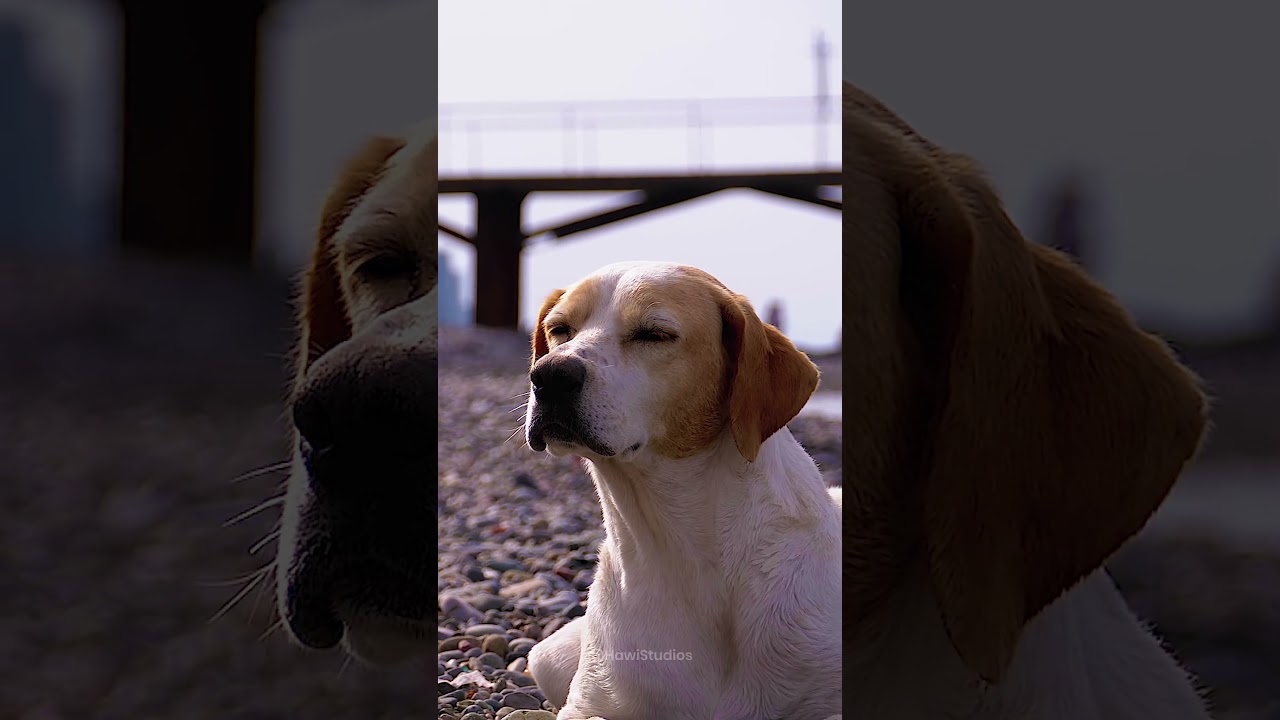
The subject observed on the pebble shore exhibits classic alert resting posture typical of free-ranging Canis lupus familiaris. The body is settled on loose shingle, with the weight distributed evenly across the haunches and forelimbs to ensure stability on uneven substrate.
Subtle muscle tone across the neck and shoulders indicates that the animal is not in deep sleep. Instead, the head remains elevated approximately 30 to 40 centimeters above ground level, positioning the sensory organs above ambient surface heat and ground clutter.
The ocular area shows slight contraction of the orbicularis oculi muscle, a physiological response to high solar radiation reflecting off water and light-colored gravel. Despite the glare, periodic micro-movements of the eyes demonstrate continuous peripheral tracking across the open horizon.
Morphological and anatomical sensory adaptations
Free-ranging dogs rely heavily on specialized anatomical structures to monitor dynamic coastal environments. The drop-ear morphology seen in this individual retains significant mobility, turning independently toward subtle low-frequency acoustic signals generated by wave action or human movement.
The canine olfactory apparatus features up to 300 million specialized sensory neurons inside the nasal cavity. Cold, moist nasal skin traps airborne chemical molecules, which are swept inward during specialized sniffing bursts that do not disrupt regular pulmonary ventilation.
This dual airflow mechanism enables the dog to sample airborne scent plumes blown off the marine environment or nearby coastal paths. Similar sensory tracking mechanics are studied in coastal predators where atmospheric currents dictate foraging efficiency, as seen in polar bear olfactory vigilance research.
Coastal habitat dynamics and substrate interactions
Coastal beach zones present unique mechanical and microclimatic challenges for terrestrial mammals. Loose pebble shingle requires continuous footpad adjustments, as small stones shift under the weight of the animal during movement.
By sitting quietly on the gravel, the dog minimizes physical exertion while benefiting from the thermal inertia of sun-warmed stones. The open topography of a beach eliminates blind spots, giving free-ranging animals early warning of approaching territorial rivals, humans, or potential food sources.
Coastal shorelines also serve as linear movement corridors where intertidal debris accumulates. Similar shore movement patterns exist among specialized coastal species, such as observed during hermit crab beach locomotion along sandy intertidal zones.
Ecological role and urban edge dynamics
Free-ranging domestic dogs constitute an integrated component of coastal and urban edge ecosystems worldwide. These animals function primarily as opportunistic scavengers, feeding on discarded human refuse, stranded marine life, and small prey organisms.
Their presence on beaches highlights the overlap between human coastal infrastructure and semi-independent animal populations. Vigilance behavior allows these dogs to navigate complex human interactions, securing energy rich resources while avoiding potential conflicts.
Why do stray dogs often congregate along coastal beaches?
Free-ranging dogs frequent beach zones due to high resource availability, including discarded human food, washed-up organic matter, and sheltered resting spots under coastal infrastructure. Coastal shorelines also offer unobstructed visual lines of sight for monitoring potential threats and scavenged food opportunities.
How do dogs process olfactory cues in windy coastal environments?
Canine nasal morphology features separate airflow pathways for respiration and olfaction, allowing continuous scent sampling. On windy beaches, dogs orient their muzzle into prevailing air currents to capture airborne volatile chemical compounds coming from tide lines or human activity.
What posture indicates alert resting in free-ranging dogs?
An upright seated posture with the forelimbs extended, spine erect, and head elevated allows the animal to conserve physical energy while keeping its eyes and ears raised above ground-level obstructions. This position permits instantaneous transition into flight or investigation.
How do bright sunlight and coastal wind affect canine eye tracking?
Canine eyes feature a high density of rod photoreceptors suited for motion detection. In bright sunlight, the nictitating membrane and pupillary constriction protect the retina, while subtle eye squinting reduces glare without impairing peripheral movement detection across open shores.