
Direct answer summary
Caterpillar locomotion mechanics rely on hydrostatic fluid pressure combined with rhythmic peristaltic waves that travel from the posterior to the anterior segments. Specialized microscopic hooks called crochets on the abdominal prolegs grip textured surfaces, allowing the insect to ascend vertical structures against gravity.
Key Field Takeaways
- Hydrostatic Skeleton Drive: Internal fluid pressure transfers energy along soft abdominal segments without rigid bone leverage.
- Crochet Micro-Grip System: Sclerotized curved hooks on abdominal prolegs generate mechanical friction on vertical concrete substrates.
- Visceral-Somatic Decoupling: The digestive tract glides independently forward inside the body cavity before external segments step.
- Cryptic Bark Mimicry: Mottled grey-brown cuticle pigmentation provides disruptive camouflage against stone and woody debris.
| Taxonomic Class | Common Name | Conservation Status | Primary Diet | Habitat Range | Locomotive Adaptation |
|---|---|---|---|---|---|
| Insecta: Lepidoptera | Cryptic Moth Caterpillar | Least Concern / Unassessed | Herbivorous Foliage & Detritus | Terrestrial Woodlands & Urban Structures | Hydrostatic Peristalsis & Crochet Prolegs |
Immediate physical observation and behavioral mechanics
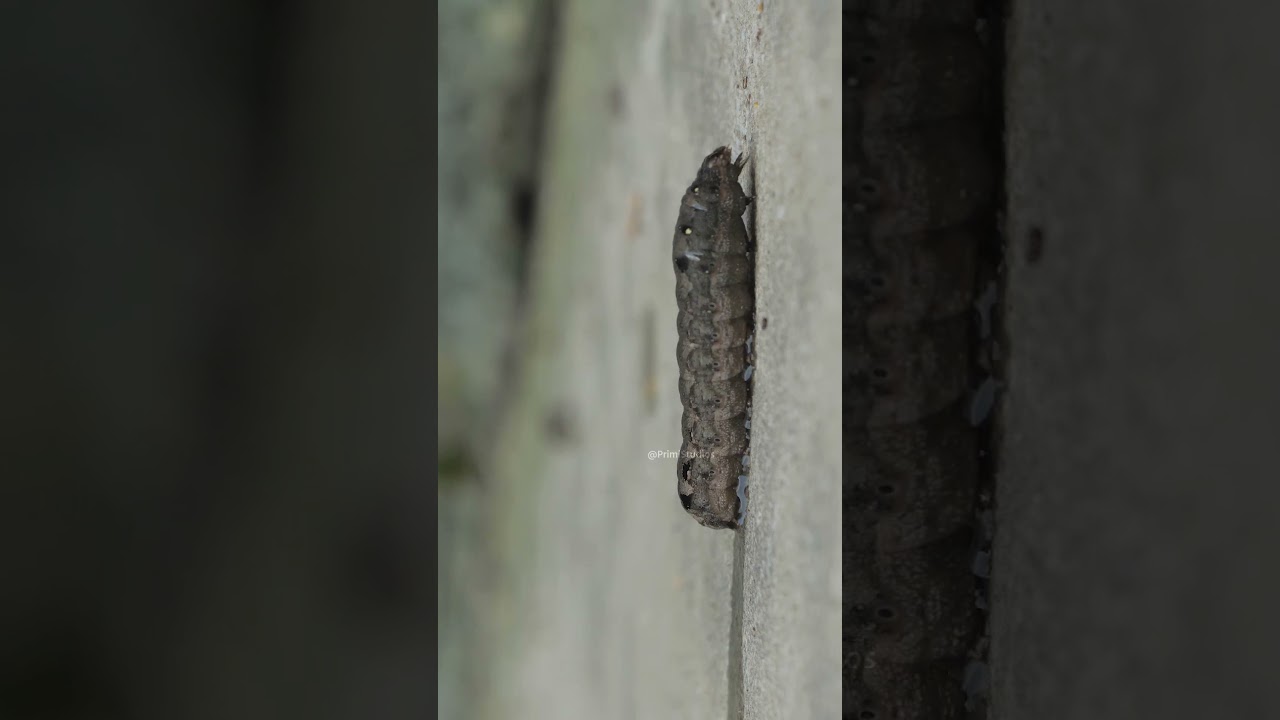
The primary video footage documents a moth larva ascending a coarse vertical substrate. The motion begins at the posterior abdominal segments. A contraction wave lifts the rearmost terminal prolegs off the surface, drawing the tail segment forward toward the mid-body. This localized shortening increases internal fluid pressure within the hemocoel.
As the peristaltic wave progresses sequentially through segments A3 to A6, the abdominal prolegs release their grip in order. Each proleg pair shifts forward by several millimeters before re-attaching. The anterior thoracic legs then extend to secure a new anchoring point on the concrete face, pulling the head capsule upward in a fluid continuation of the wave cycle.
This climbing routine demonstrates remarkable stability on vertical planes. By alternating firm attachment points between the posterior prolegs and the anterior true legs, the insect maintains continuous contact points against gravity. The movement highlights how soft-bodied organisms generate directed traction without rigid jointed appendages.
Morphological and anatomical adaptations
Hydrostatic skeleton mechanics
Unlike adult arthropods with hard exocuticles, the larval stage relies on a flexible body wall filled with pressurized hemolymph. Muscle contractions press against this inelastic fluid chamber. When transverse muscles contract, individual body segments elongate, when longitudinal muscles contract, those segments shorten and expand outward.
Proleg anatomy and crochet structure
The larva features three pairs of sclerotized thoracic legs near the head capsule and four pairs of fleshy abdominal prolegs, plus one terminal anal pair. The distal ends of these prolegs bear tiny curved chitinous hooks called crochets. These microscopic hooks interlock with microscopic rugosities on bark and concrete, providing friction against vertical slip.
Disruptive camouflage and cuticle texture
The dorsal and lateral surfaces exhibit a dull grey and charcoal coloration with irregular dark spots. This visual patterning breaks up the body outline on granite, bark, and masonry. The rough texture of the cuticle further diffuses light, preventing glints that could attract avian predators searching vertical surfaces.
Habitat range and terrestrial ecology
Lepidopteran larvae occupy diverse terrestrial microhabitats ranging from deciduous forest canopies to suburban masonry walls. Vertical climbing behavior is essential during late instar development when larvae seek pupation sites. Leaving low-lying host plants reduces exposure to ground-dwelling predators such as the Carabus ullrichii feeding mechanics observed in ground beetles.
On exposed vertical walls, larvae face thermal radiation and drying winds. The thick cuticular layer prevents rapid water loss, while nocturnal or crepuscular travel minimizes exposure to daytime solar stress. Navigating urban concrete mimics natural tree trunk climbs where caterpillars search for sheltered bark crevices or high pupation niches.
Interspecies relationships and evolutionary significance
Soft-bodied caterpillars represent a vital energetic node in terrestrial food webs. They convert plant biomass into nutrient-dense protein consumed by birds, small mammals, and predatory arthropods like the European fire ant. To survive high predation pressure, caterpillars have evolved specialized physiological defenses, cryptic coloration, and rapid vertical escape movements.
From an evolutionary perspective, the soft hydrostatic body design allows caterpillars to maneuver through dense foliage and narrow bark crevices that rigid bodies cannot navigate. Decoupling internal organ movement from the muscular body wall reduces energetic expenditure during peristaltic crawling, making vertical dispersion highly efficient.
Conservation status and environmental threats
Most generalist moth caterpillars maintain stable populations across native and modified environments. However, localized populations face threats from broad-spectrum chemical pesticides, habitat fragmentation, and artificial light pollution at night. Artificial illumination disorients adult moths, altering egg-laying site selection and shifting caterpillar distributions into urban microhabitats.
Protecting natural foliage corridors and reducing synthetic pesticide runoff in mixed agricultural and suburban zones preserves critical larval food sources. Maintaining intact leaf litter and mature tree bark provides essential overwintering habitats necessary for completing the full lepidopteran life cycle.
How do caterpillars climb vertical concrete walls without slipping?
Caterpillars use fleshy abdominal prolegs equipped with tiny chitinous hooks known as crochets. These crochets hook into small surface imperfections on vertical concrete, creating mechanical friction that holds the insect in place against gravity.
What is a hydrostatic skeleton in caterpillars?
A hydrostatic skeleton is a body structure supported by pressurized fluid contained within a flexible muscular wall. By contracting longitudinal and transverse muscles against internal fluid pressure, caterpillars change shape and propel themselves forward without rigid bones.
Why do caterpillars leave their host plants to climb vertical surfaces?
Mature caterpillars often climb vertical trunks, rocks, or structures to find protected crevices for pupation. Moving away from feeding sites reduces the risk of being targeted by foliage-searching predators and parasites.
What is the difference between thoracic legs and abdominal prolegs?
Thoracic legs are true jointed appendages near the head that persist into adulthood. Abdominal prolegs are unjointed, fleshy, temporary structures equipped with crochets that assist in larval locomotion and disappear during metamorphosis.