
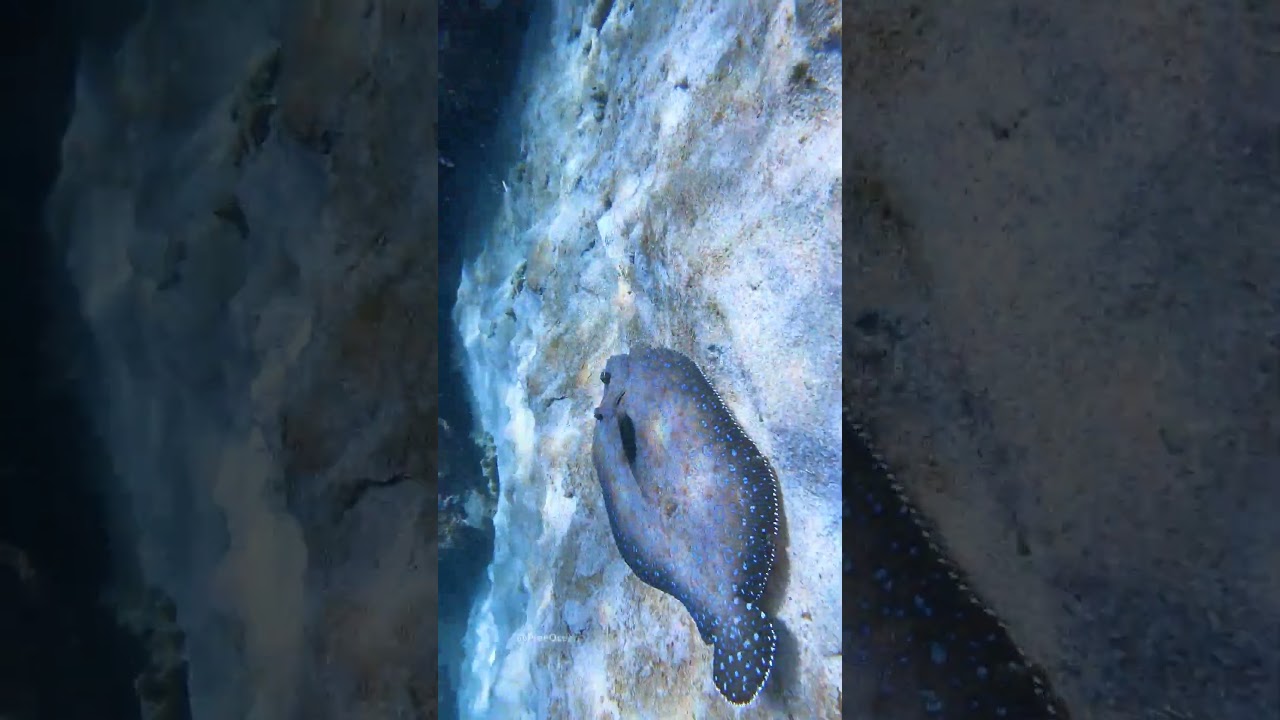
Locomotion mechanics of the peacock flounder
Direct answer summary
Peacock flounder locomotion relies on synchronized, continuous wave-like undulations of the continuous dorsal and anal marginal fins. Lacking an adult swim bladder, Bothus mancus maintains negative buoyancy, generating forward propulsion millimeters above benthic substrates while preserving low turbulence and acoustic neutrality.
Key Field Takeaways
- Taxonomic Classification: Family Bothidae, Bothus mancus (Lefteye flounder).
- Primary Locomotor Mechanism: Sciophilous undulation of elongated dorsal and anal fins.
- Hydrodynamic Advantage: Ground-effect fluid dynamics reduce energy cost during horizontal reef transport.
- Camouflage Speed: Neural chromatophore reorganization achieved in 8 to 15 seconds.
| Metric | Biological Specification |
|---|---|
| Binomial Name | Bothus mancus |
| Common Name | Peacock Flounder / Flowery Flounder |
| Conservation Status | Least Concern (IUCN) |
| Depth Range | 1 to 150 meters |
| Primary Diet | Small benthic fish, decapod crustaceans, mysids |
| Key Adaptation | Cranial asymmetry, rapid chromatophore shifts, ribbon fin swimming |
Benthic undulation and marginal fin swimming
The peacock flounder (Bothus mancus) demonstrates a highly specialized form of aquatic propulsion engineered for life on two-dimensional benthic planes. In the footage, the flatfish glides across a shallow marine substrate with its flattened body held horizontal to the reef floor. Rather than relying on powerful lateral tail sweeps characteristic of fusiform teleosts, the flounder uses continuous metachronal waves passing along its dorsal and anal fins.
These elongated marginal fins extend along nearly the entire length of the fish. By rippling these fins from anterior to posterior, the fish produces steady forward thrust while creating minimal displacement in the water column. This hydrodynamic method allows the flounder to move directly over fine sand, macroalgae, and rocky surfaces without disturbing sediment that could alert potential prey or predators.
Maintaining an elevation of less than two centimeters off the seabed enables the flounder to exploit ground-effect fluid dynamics. Water trapped beneath the wide, flattened lower surface creates a cushion of high pressure, enhancing lift efficiency. Because adult flatfishes absorb their swim bladders during metamorphosis, negative buoyancy keeps them naturally resting on the bottom without spending muscular energy to remain submerged.
Chromatophore regulation and adaptive camouflage
Visual observation of the upper surface reveals a dense, complex pattern of brown, tan, and cream mottling interspersed with bright turquoise ringed spots, known as ocelli. These blue rings give Bothus mancus its common name. The skin functions as an active dynamic concealment system rather than a static camouflage pattern.
Dermal structures in flatfishes contain three distinct layered cell types: melanophores (black and brown pigments), xanthophores (yellow pigments), and iridophores (reflective structural crystals). Visual input gathered by the dorsally positioned eyes is processed through the central nervous system, sending motor signals directly to muscular units controlling chromatophore expansion and contraction.
When moving across heterogenous substrate types, such as transitioning from bare sand to coral rubble covered in turf algae, the flounder alters pigment distribution across its skin. Full chromatic and pattern adaptation can take place in as little as 8 to 15 seconds. This continuous adjustment disrupts the outline of the animal, rendering it virtually invisible when motionless against benthic backgrounds.
Ocular migration and lefteye asymmetry
Flatfishes belong to the order Pleuronectiformes, characterized by complete cranial asymmetry in adulthood. Larval peacock flounders hatch with symmetrical bodies and swim upright in the pelagic plankton layer. As larval development progresses into post-embryonic metamorphosis, a dramatic anatomical shift occurs: the right eye migrates across the dorsal midline of the head to settle on the left side.
In the family Bothidae, known as lefteye flounders, individuals lie on their right side (eyeless or blind side), which remains unpigmented and pale. The left side (eyed side) faces upward toward the open water column. Both eyes sit on raised muscular stalks, operating independently with 360-degree rotational freedom. This ocular arrangement allows the flounder to scan for incoming threats and prey while remaining completely flat against the reef floor.
The internal skeleton undergoes significant restructuring during this phase. The olfactory tracts, frontal cranial bones, and jaw musculature shift laterally. These anatomical alterations optimize the flounder for ambush hunting and surface-matching concealment, turning a standard teleost body plan into an effective flat bottom-dweller.
Foraging mechanics and benthic prey strikes
Peacock flounders are specialized visual ambush hunters that occupy intermediate trophic levels within Indo-Pacific coral reef food webs. Their diet consists primarily of small benthic fishes, such as gobies and blennies, alongside penaeid shrimp and small crabs. By relying on total visual integration with the surrounding substrate, the flounder remains motionless until target prey strays within a critical strike zone of 5 to 10 centimeters.
The strike mechanism involves a brief explosive burst of force powered by rapid contraction of the axial musculature. While routine movement relies on marginal fin undulation, escape responses and prey capture utilize the broad caudal fin. The flounder lifts its anterior disk slightly, opens its asymmetrical jaws, and creates strong negative buccal pressure to draw prey into its mouth within milliseconds.
Understanding these benthic feeding mechanisms complements broader marine predator-prey dynamics across tropical reefs. Similar predatory and symbiotic adaptations occur across diverse benthic taxa, such as the spatial strategies documented in snake eel cleaner shrimp mutualism where bottom-dwelling species utilize precise structural microhabitats for foraging and maintenance. Furthermore, sensory adaptation principles observed in marine substrates parallel terrestrial species in tropical montane stream ecology where body transparency and visual concealment govern survival.
How do peacock flounders swim without swim bladders?
Peacock flounders lose their functional swim bladders during larval metamorphosis, causing them to be naturally negatively buoyant. They generate forward motion by undulating their continuous dorsal and anal marginal fins along their body edges, floating just above the substrate using ground-effect hydrodynamics.
Why do both eyes sit on the left side of the peacock flounder?
During larval transformation, the right eye migrates over the dorsal skull ridge to join the left eye on the left side of the body. As lefteye flounders (Bothidae), this asymmetry allows them to lie flat on their right side while keeping both eyes pointed toward the water column to detect prey and predators.
How fast can a peacock flounder change its skin coloration?
A peacock flounder can adjust its skin coloration, brightness, and surface pattern in 8 to 15 seconds. Visual cues processed by the brain activate dermal chromatophores and iridophores to match the textures of surrounding sand, rock, or gravel.
What do peacock flounders eat in their natural habitat?
They feed primarily on small substrate-associated teleost fishes, including gobies, blennies, and cardinalfishes, as well as decapod crustaceans like shrimp and small crabs. They remain concealed against the bottom until prey approaches, capturing it with an explosive jaw strike.