
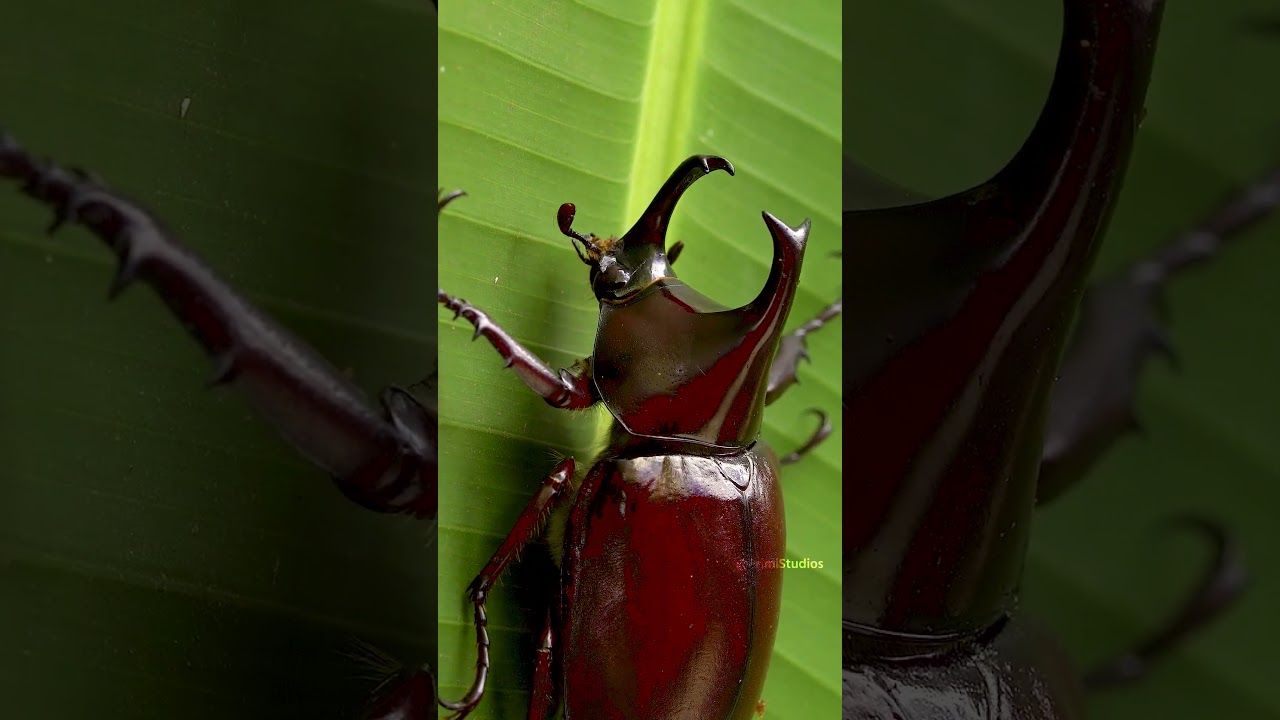
Anatomy and head horn morphology of the male rhinoceros beetle
Direct answer summary
Rhinoceros beetle horns function primarily as specialized biological levers used by males during combat over mating territory and sap feeding sites. These curved cuticular extensions allow males to pincer, lift, and dislodge rivals from narrow tree branches without causing fatal puncture wounds to their heavily armored competitors.
Key field takeaways
- Taxonomic Classification: Subfamily Dynastinae, Family Scarabaeidae, Order Coleoptera.
- Biomechanical Advantage: Horn leverage allows adult males to lift objects up to 850 times their body mass.
- Habitat & Distribution: Primary tropical rainforests, agricultural palm groves, and humid woodland canopies across Southeast Asia.
- Conservation Status: Classified as Least Concern, though local populations face threats from forest clearing and pesticide exposure.
| Taxonomic Parameter | Biological Data |
|---|---|
| Binomial Nomenclature | Xylotrupes gideon |
| Common Name | Asian Rhinoceros Beetle |
| Adult Body Length | 40 to 70 millimeters |
| Adult Mass | 5 to 10 grams |
| Primary Adult Diet | Tree sap, decaying plant fruit, floral nectar |
| Primary Larval Substrate | Decaying hardwood timber and leaf litter |
Physical visual breakdown and structural adaptations
In the observed video footage, the male Asian rhinoceros beetle displays a dark reddish-brown sclerotized cuticle polished to a high sheen. The head features two distinct horn projections: a long, lower cephalic horn that curves gently upward with a bifurcated tip, and a stout thoracic horn projecting forward from the pronotum. These dual cuticular structures form a natural clamp or pincer, operated by powerful thoracic flexor muscles that drive the movement of the beetle head relative to its chest.
The beetle maintains a secure hold on the smooth epidermis of the banana leaf using specialized tarsi. Each tarsus terminates in paired, sharp tarsal claws that hook directly into microscopic leaf grooves. Along the lower leg segments, short cuticular spines provide additional traction against broad tropical foliage. Active antennal club movement visible near the base of the eyes indicates continuous olfactory scanning for volatile chemical cues produced by ripe fruit and conspecific signaling pheromones.
Evolutionary purpose of sexual dimorphism and male combat
Sexual dimorphism in dynastine beetles is among the most pronounced in the insect order Coleoptera. Male rhinoceros beetles invest substantial energy during the pupal stage into growing oversized chitinous horns, whereas female beetles remain hornless with compact, spade-like head structures. This physical divergence corresponds directly to differing ecological roles between sexes.
Males establish territorial dominance on high-value feeding sites, such as bark wounds oozing sugar-rich sap. When two rival males meet on a vertical trunk, they lock their lower cephalic horns beneath the body of the opponent. By extending their forelegs and flexing the thorax upward, the attacking beetle uses mechanical leverage to pry the competitor off the bark substrate. The rounded, bifurcated tips of the horn minimize lethal punctures, ensuring that fights result in displacement rather than fatal injury.
Ecological niche and canopy habitat dynamics
Rhinoceros beetles serve essential ecological functions across tropical forest layers. Adult beetles spend daytime hours concealed under dense foliage or beneath loose bark, emerging at night to feed on sap flows and soft fruits. During female oviposition, adults bore into decaying forest timber, breaking down fibrous cellulose and accelerating nutrient cycling across the forest floor. Females deposit eggs directly into damp, rotting logs, where the resulting C-shaped grubs feed for several months, consuming up to several grams of decomposing wood per day.
The health of wild dynastine populations relies on high forest humidity and standing dead timber. In regions characterized by humid climate patterns and tropical montane stream ecology, damp wood substrates remain moist year round, providing ideal microclimates for grub development. Preserving mature tree stands and unmanaged forest debris ensures stable breeding sites for these large scarab beetles across tropical ecosystems.
What is the primary function of a rhinoceros beetle horn?
Male rhinoceros beetles use their large head and thoracic horns as hydraulic levers during battles with rival males. These contests take place on tree branches and sap sites, where beetles attempt to lift and throw competitors off feeding zones.
How much weight can a rhinoceros beetle carry?
A rhinoceros beetle can support up to 850 times its own weight on its back. This force production stems from dense thoracic muscle fibers and a heavy, reinforced chitinous exoskeleton.
Do female rhinoceros beetles have horns?
Female rhinoceros beetles lack the prominent head and thoracic horns found on males. Females feature small, streamlined bodies adapted for burrowing into decaying wood to lay eggs rather than fighting for territory.