
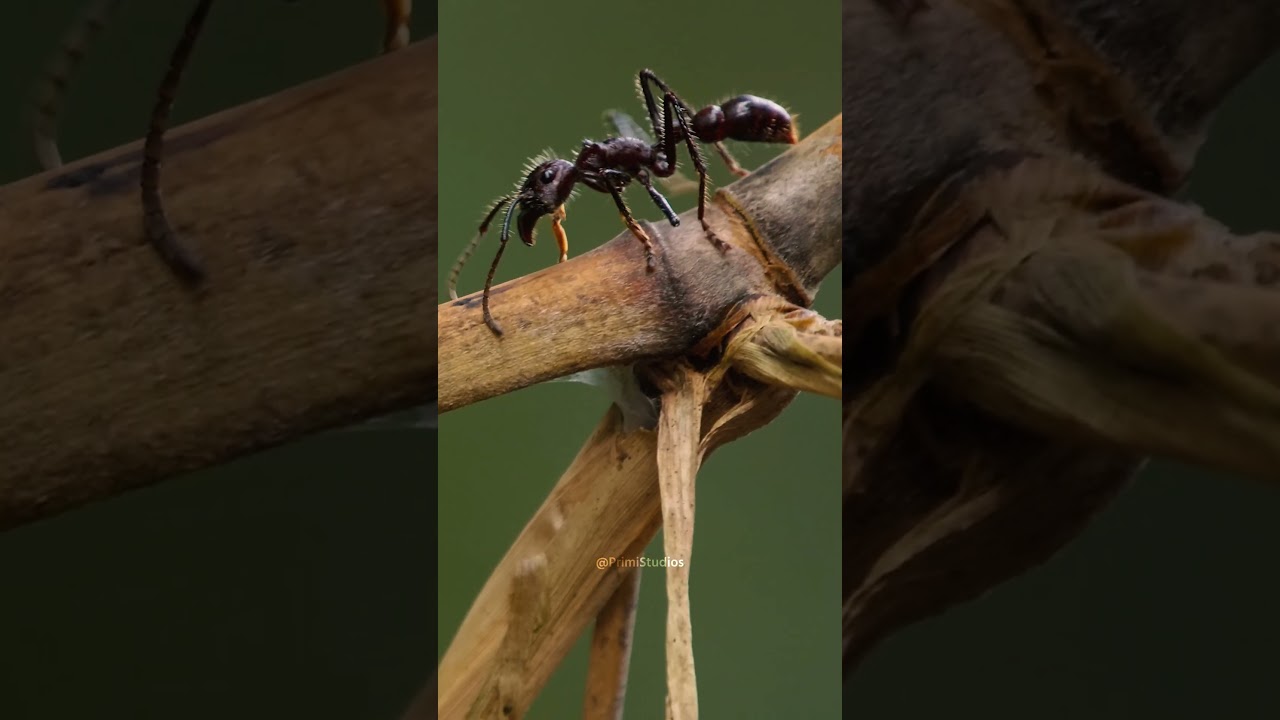
Bullet ant substrate navigation mechanics
Direct answer summary
Bullet ants (Paraponera clavata) navigate narrow tree branches using alternating tripod gait movement and continuous antennal contact. Their tarsal claws grip rough bark while paired antennae scan 180 degrees ahead to map physical obstacles and chemical trails across rainforest canopies.
Key Field Takeaways
- Taxonomic Classification: Family Formicidae, Subfamily Paraponerinae, Paraponera clavata.
- Locomotor Mechanics: Alternating tripod leg placement supported by specialized tarsal claws for vertical stem gripping.
- Sensory Architecture: Elongate 12-segmented antennae executing rapid lateral sweeps to detect surface topography and chemical cues.
- Defensive Morphology: Powerful falcate mandibles paired with an abdominal sting organ that secretes poneratoxin.
| Parameter | Specification |
|---|---|
| Binomial Nomenclature | Paraponera clavata |
| Common Names | Bullet Ant, 24-Hour Ant, Hormiga Veinticuatro |
| IUCN Status | Not Evaluated (Locally Abundant) |
| Primary Diet | Extrafloral nectar, tree sap, small arthropods |
| Habitat Range | Lowland Neotropical Rainforests (Canopy to Understory) |
| Key Adaptation | Poneratoxin-bearing sting organ and tarsal adhesion claws |
Arboreal gait and physical traction on narrow twigs
The worker Paraponera clavata demonstrates structural stability while traversing weathered woody branches. Measuring between 18 and 30 millimeters in total body length, this species relies on a reinforced chitinous exoskeleton to stabilize its center of mass over narrow substrates.
During movement, the insect executes an alternating tripod gait. The front and hind legs on one side move synchronously with the middle leg on the opposite side, keeping three points of contact on the stem at all times. Tarsal claws at the tips of the legs latch onto fine bark crevices, preventing slippage during inclined climbing.
Mandibular position and balancing during movement
As the ant traverses the dry stem, it holds its heavy sclerotized head parallel to the line of motion. The robust mandibles remain slightly open, ready to grasp potential prey or defend against threats. This head orientation maintains static equilibrium as the long gaster extends rearward.
Antennal scanning and spatial orientation
Direct inspection of the movement pattern reveals continuous antennal activity. The worker extends its elbowed antennae forward, sweeping them in alternating arcs across the substrate surface. These sensory structures continuously touch the bark ahead of the front tarsi.
Each antenna houses high concentrations of sensilla trichodea and sensilla basiconica. These microscopic olfactory and tactile receptors detect structural drop-offs, texture changes, and volatile chemical markers deposited by nestmates. By continuously probing the pathway, the ant adjusts its footing prior to placing weight on distal leg segments.
Arboreal foraging ecology and predatory adaptations
Bullet ants occupy an important predatory and nectar-gathering niche in Neotropical forests. Workers forage individually throughout the forest understory and subcanopy strata, climbing from ground level up to heights exceeding 30 meters.
In addition to hunting live invertebrates, workers collect liquid carbohydrates from extrafloral nectaries and plant exudates. Their physical adaptations allow them to transport heavy liquid droplets or prey items along narrow branches back to the subterranean or tree-base nest entrance.
Substrate navigation capabilities are vital across diverse tropical environments, such as those found near tropical montane stream ecology where dense vegetation creates dense interconnected aerial highways.
Interspecies comparisons and biomechanical efficiency
The heavy muscular skeleton of Paraponera clavata contrasts with lighter arboreal species. While some insects rely on specialized head weapons for territory defense, like the structures documented in rhinoceros beetle horn function research, the bullet ant relies on a combined system of mandibles and its abdominal sting apparatus.
In terrestrial and low-canopy interactions, bullet ants rarely engage in passive mutualisms seen in smaller rainforest organisms, such as snake eel cleaner shrimp mutualism. Instead, bullet ants maintain solitary foraging paths, relying on individual power and neurotoxic defenses to deter larger predators.
How fast can a bullet ant move along branches?
A worker bullet ant typically crawls at speeds between 2 and 5 centimeters per second along arboreal pathways. This moderate pace allows the insect to continuously scan the substrate with its antennae while maintaining secure tarsal grips.
Why do bullet ants walk with open mandibles?
Keeping mandibles partially open allows bullet ants to instantly strike prey or clamp onto surfaces if threatened. This posture also shifts a portion of their mass forward, assisting with balance on narrow twigs.
How do bullet ants prevent falling from high canopy branches?
Bullet ants utilize curved tarsal claws on all six legs alongside specialized adhesive pads called arolia. These structures generate mechanical friction against rough bark surfaces, securing firm attachment even on vertical or upside-down inclines.