
Direct answer summary
Snake eels engage in mutualistic cleaning behaviors with small caridean shrimp to remove marine ectoparasites, necrotic tissue, and mucus from their facial skin. The eel remains stationary in sandy benthic sediment, suppressing predatory reflexes while the shrimp feeds on organic matter.
Key field takeaways
- Taxonomic Classification: Family Ophichthidae (snake eels) and Order Decapoda (cleaner shrimp).
- Primary Behavioral Adaptation: Suppression of predatory feeding reflexes during interspecies mutualistic cleaning.
- Ecological Niche & Range: Benthic soft-sediment environments in tropical marine ecosystems.
- Conservation Status: Least Concern according to global marine red list evaluations.
Morphological adaptations and cleaning mechanics
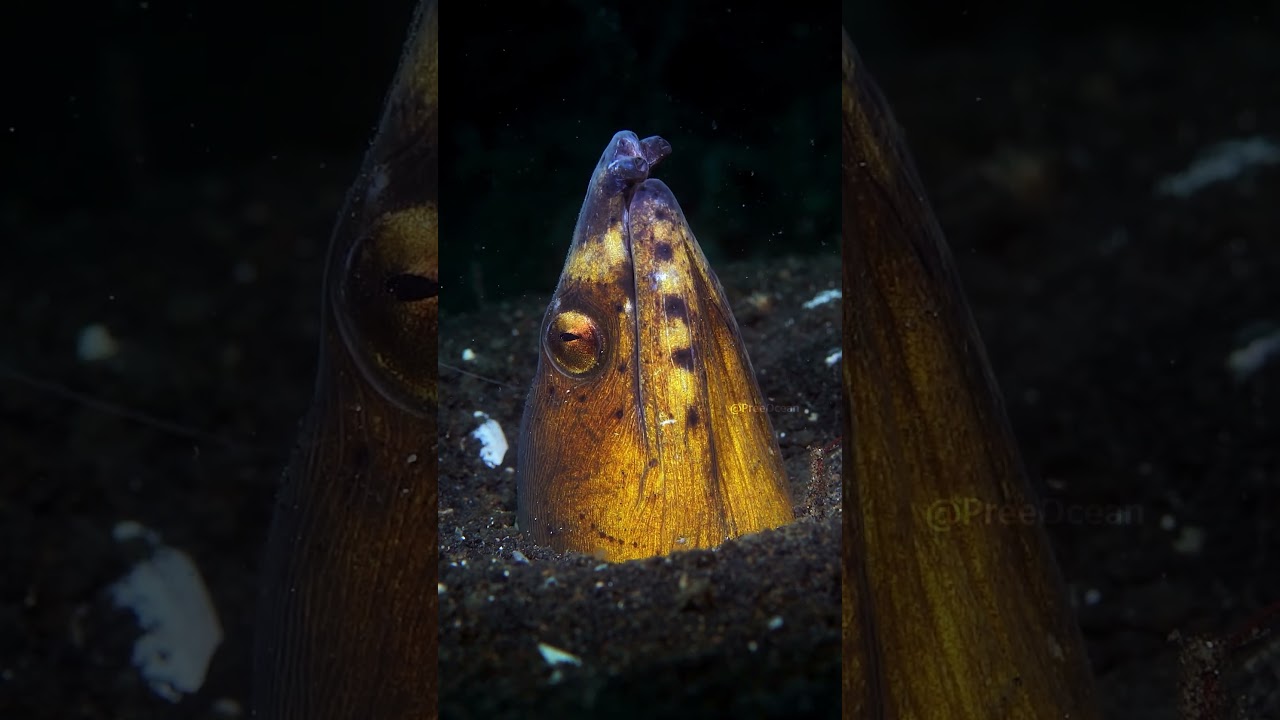
In the video footage, a snake eel head protrudes vertically from fine, dark volcanic sediment. The animal exhibits a bright yellow epidermal coloration interrupted by dark cranial blotches and small anterior nostril tubes extending forward above the upper jaw. A translucent cleaner shrimp, belonging to the genus Ancylomenes, walks across the eel’s head, using tiny chelae to pick away small organic particles and ectoparasites situated near the eye and nasal tubes.
| Taxonomic Specification | Species & Environmental Field Details |
|---|---|
| Binomial Name | Ophichthidae family / Ancylomenes species |
| Common Names | Snake eel and cleaner shrimp |
| IUCN Status | Least Concern |
| Primary Diet | Small benthic invertebrates, fish, and organic debris |
| Habitat Depth | Subtidal sandy substrate (1 to 50 meters) |
| Key Adaptation | Burrowing tail tip and interspecies signal recognition |
Sensory posture and reflex suppression
The snake eel maintains a rigid posture, elevating its head approximately 5 to 8 centimeters above the sandy floor while keeping its body buried. This orientation exposes its sensory organs and skin folds to the cleaner shrimp. Despite being a carnivore capable of snapping down on small crustaceans, the eel holds its mouth steady and retrains its strike impulses, permitting the shrimp to clean around sensitive structures like the eye ring and nostrils.
Evolutionary benefits of interspecies cleaning mutualism
Mutualistic interactions on benthic soft bottoms provide survival benefits to both organisms. Snake eels lack limbs or grooming structures, making them susceptible to parasitic copepods, isopods, and bacterial buildup on their skin. The shrimp provides parasite removal, reducing skin lesion risks and energetic costs associated with immune defenses.
Nutritional exchange for cleaner organisms
For the cleaner shrimp, the eel provides a stable food source rich in proteins and lipids found in parasitic organisms and sloughed dermal cells. By establishing a safe foraging zone directly on host organisms, the shrimp gains protection from other small predators that avoid approaching a predatory snake eel.
Benthic habitat dynamics and environmental context
Soft sediment habitats provide limited cover, forcing sand-dwelling organisms to rely on behavioral specialization. Snake eels utilize pointed tail tips to dig backward into loose substrate, leaving only their eyes and nostrils exposed to monitor prey and cleaner organisms. Similar fine-scale microhabitats can be observed across other aquatic environments, such as tropical montane stream ecology where specialized micro-niches support delicate fauna.
Understanding cuticular and epidermal structures across varied animal lineages shows how specialized body surfaces interact with local environments. Complex anatomical structures across diverse species, such as those analyzed in studies on rhinoceros beetle horn function, demonstrate the wide array of physical adaptations organisms develop for survival.