
Direct answer summary
The King Vulture (Sarcoramphus papa) is a large New World vulture distinguished by its vibrant, bare head and neck, which are crucial for hygiene during carrion feeding and for thermoregulation. This species possesses a powerful, hooked beak uniquely adapted for tearing tough hides and consuming diverse decaying animal matter across tropical lowland forests.
Key Field Takeaways
- Taxonomic Classification: The King Vulture belongs to the Order Cathartiformes, Family Cathartidae, and Genus Sarcoramphus.
- Primary Behavioral Adaptation: This species exhibits dominant scavenging behavior at carcasses, often displacing smaller vulture species due to its larger size, ranging from 2.7 to 4.7 kilograms.
- Ecological Niche & Range: King Vultures are vital detritivores in tropical lowland forests and savannas, distributed from southern Mexico to northern Argentina, typically below 1,500 meters elevation.
- Conservation & Field Status: Classified as Least Concern by the IUCN, the population trend is decreasing, primarily due to habitat loss and indirect poisoning.
| Characteristic | Detail |
|---|---|
| Binomial Nomenclature | Sarcoramphus papa |
| Common Names | King Vulture, Royal Vulture |
| IUCN Conservation Status | Least Concern (Population decreasing) |
| Primary Diet &, Foraging Apparatus | Carrion, large, hooked beak and strong talons for tearing flesh |
| Natural Habitat &, Elevation Range | Tropical lowland forests, savannas, typically below 1,500 meters |
| Key Anatomical/Physiological Adaptation | Highly acidic stomach (pH ~1) for pathogen destruction, bare, brightly colored head for hygiene and signaling |
Physical observation and behavioral mechanics
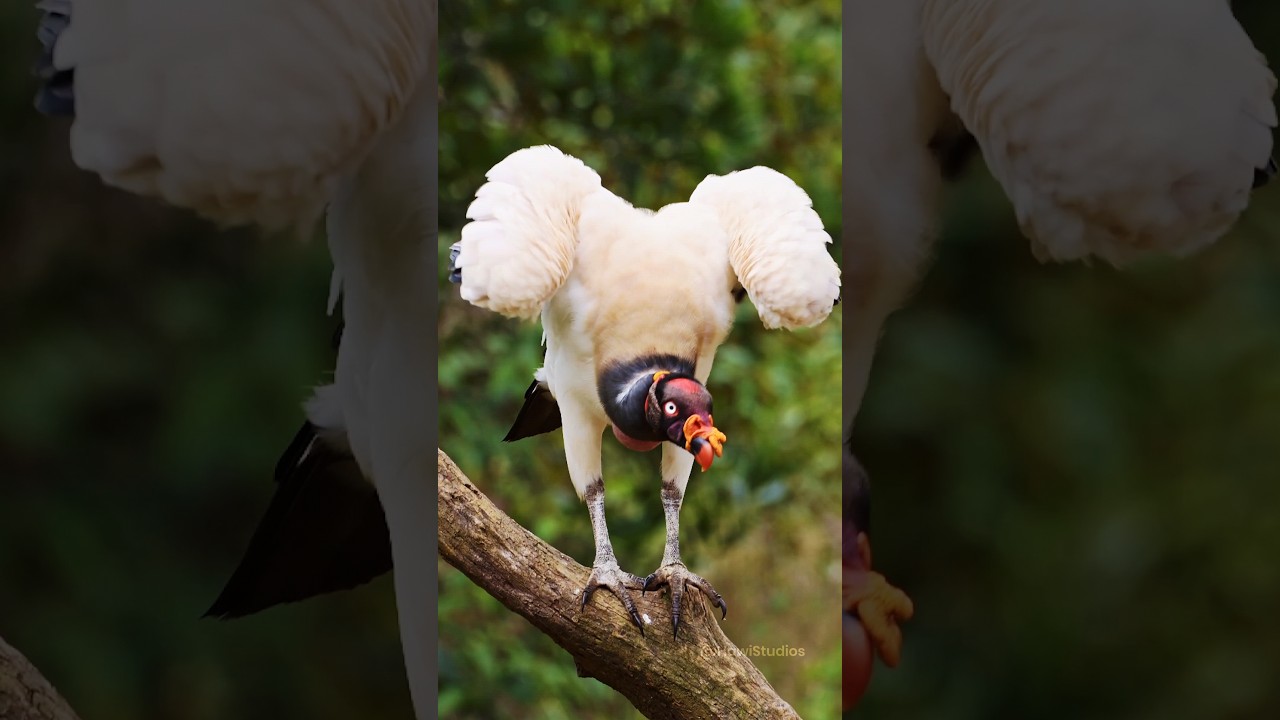
The video footage captures a King Vulture (Sarcoramphus papa) perched firmly on a substantial horizontal tree branch. At the onset (0:00-0:01), the bird slightly spreads its broad wings, indicating a postural adjustment or preparation for movement. This initial action highlights its large wingspan, which can reach up to 2 meters, crucial for soaring.
The vulture then settles, lowering its head and adopting a vigilant, forward-leaning stance (0:02-0:07). This posture, with its dark eyes intently focused, suggests an awareness of its surroundings, a common behavior for scavengers scanning for carrion or potential threats. The robust talons are visibly gripping the rough bark, demonstrating powerful perching capabilities.
As the sequence progresses (0:08-0:14), the King Vulture slowly lifts and turns its head, allowing a full view of its distinctive facial features. The prominent, unfeathered head and neck display a striking palette of red, orange, yellow, and purplish-black. A large, pale pink gular sac, a fleshy pouch on its throat, is also clearly visible, which can be indicative of recent feeding or thermoregulatory activity.
Morphological and anatomical adaptations
The King Vulture exhibits several specialized morphological adaptations for its scavenging lifestyle. Its head and neck are entirely bare of feathers, a critical adaptation that prevents feathers from becoming soiled with blood and tissue when the bird feeds deep inside carcasses. This bare skin is also easier to clean and plays a role in thermoregulation, allowing the bird to dissipate excess heat in its tropical environment.
The vibrant coloration of its head, including shades of red, orange, yellow, and black, is unique among New World vultures and may serve as a visual signal for social communication or to indicate health and dominance. A prominent, fleshy orange caruncle adorns the base of its powerful, hooked beak. This beak, with its sharp, curved upper mandible, is exceptionally strong, designed to tear through the tough hides and muscle of large animal carcasses.
Its plumage is predominantly creamy white, contrasting sharply with its black flight feathers and a distinctive grey-black ruff around its neck. The large, dark eyes, often with a reddish sclera, provide excellent long-distance vision, essential for spotting carrion from high altitudes. While its talons are strong for perching, they are not as powerfully raptorial as those of predatory birds, reflecting its role as a scavenger rather than a hunter.
Habitat range and terrestrial ecology
The King Vulture is native to the tropical lowlands of Central and South America, with a vast geographical distribution stretching from southern Mexico to northern Argentina. It primarily inhabits undisturbed tropical rainforests, but can also be found in savannas, grasslands, and gallery forests, often near rivers or open areas where food sources might be more readily available.
This species typically resides at elevations below 1,500 meters, though it can occasionally be observed at higher altitudes. Its ecological role as a scavenger is indispensable, by consuming decaying animal matter, the King Vulture prevents the buildup of carcasses, thereby limiting the spread of diseases and facilitating nutrient cycling within its ecosystem. Its broad wings allow it to soar efficiently on thermals, covering vast territories in search of food.
Interspecies relationships and evolutionary significance
The King Vulture occupies a dominant position within the scavenging hierarchy of its habitat. Due to its larger size and powerful beak, it often arrives at a carcass and displaces smaller vulture species, such as the Black Vulture (Coragyps atratus) and the Turkey Vulture (Cathartes aura). This dominance allows it to be the first to open tough hides, thereby creating access for other scavengers that lack the strength to penetrate the carcass themselves.
This facilitating role underscores its importance in the broader detritivore community. Unlike some other New World vultures, the King Vulture relies more on its keen eyesight for locating carrion, sometimes following the more olfactorily-gifted Turkey Vultures. Its digestive system is a marvel of evolutionary adaptation, featuring an extremely acidic stomach (pH ~1) capable of neutralizing harmful bacteria and toxins found in putrid meat, a trait shared with other specialized scavengers like the Lappet-Faced Vulture. This adaptation is crucial for its survival and ecological function.
The King Vulture’s specialized diet contrasts with the molluscivorous diet of species like the Caiman Lizard, highlighting the diverse feeding strategies in different ecological niches. Its presence signifies a healthy ecosystem capable of supporting large vertebrates and the subsequent decomposition processes.
Conservation status and ecosystem threats
The International Union for Conservation of Nature (IUCN) currently classifies the King Vulture as a species of Least Concern. Despite this, its population trend is noted as decreasing, indicating ongoing threats to its long-term survival. The primary danger to King Vultures is habitat destruction, driven by extensive deforestation for agricultural expansion, logging, and infrastructure development across Central and South America. The fragmentation of their forest habitats reduces available foraging grounds and nesting sites.
Indirect poisoning also poses a significant threat. Vultures can ingest lead bullet fragments from carcasses of animals hunted by humans, leading to lead poisoning. Additionally, the use of pesticides and other chemicals in agricultural areas can contaminate their food sources, causing secondary poisoning. Conservation efforts focus on protecting large tracts of undisturbed forest and raising awareness about the ecological importance of scavengers. Monitoring population trends and mitigating human-wildlife conflict are crucial for ensuring the continued presence of this magnificent bird in its natural range.
Why does the King Vulture have such a colorful head?
The King Vulture’s bare, brightly colored head and neck serve multiple biological functions. The lack of feathers aids in hygiene, preventing bacterial buildup when feeding deep inside carcasses, and also assists in thermoregulation by allowing heat dissipation. The vibrant coloration may also play a role in social signaling and display among individuals.
What is the primary diet of a King Vulture?
King Vultures are obligate scavengers, meaning their primary diet consists almost exclusively of carrion. They feed on the carcasses of medium to large-sized animals found in their tropical forest habitats. Their powerful, hooked beaks are adapted for tearing tough hides and accessing internal organs.
Where do King Vultures typically live?
King Vultures inhabit tropical lowland forests, savannas, and grasslands across Central and South America. Their range extends from southern Mexico, through Central America, and down to northern Argentina. They are typically found at elevations below 1,500 meters, often near rivers or open clearings where carrion may be more accessible.
How does the King Vulture impact its ecosystem?
The King Vulture plays a crucial ecological role as a natural clean-up crew. By consuming carrion, it helps prevent the spread of diseases and recycles nutrients back into the ecosystem. Its large size and powerful beak also allow it to open tough carcasses, making food accessible for smaller scavengers that lack the strength to do so.