
Direct answer summary
Rugose land hermit crab (Coenobita rugosus) beach locomotion relies on the synchronized movement of the second and third pairs of walking legs (pereiopods) to drag a protective gastropod shell across loose sand. The crab stabilizes its soft abdomen inside the spiral columella using modified uropods while propelling its mass forward at speeds between 1 and 3 centimeters per second.
Key Field Takeaways
- Taxonomic Classification: Class Malacostraca, Order Decapoda, Family Coenobitidae, Coenobita rugosus.
- Locomotion Mechanics: Alternating tripod gait utilizing the second and third pereiopods to generate propulsive thrust on sandy substrate.
- Shell Maintenance: Hauls empty gastropod shells weighing up to 120 percent of their total soft-tissue body mass.
- Conservation & Habitat: Tropical intertidal coastlines and sandy shorelines across the Indo-Pacific region.
| Taxonomic Metric | Biological Field Specification |
|---|---|
| Binomial Name | Coenobita rugosus |
| Common Name | Rugose land hermit crab |
| IUCN Status | Not Evaluated (Locally Abundant) |
| Primary Diet | Opportunistic scavenger (algae, detritus, plant matter, carrion) |
| Habitat Range | Supralittoral sandy beaches and coastal tropical dunes |
| Carapace Length | 10 to 30 millimeters |
| Locomotion Mechanism | Pereiopod push-pull haulage with modified uropod anchoring |
Observation of hermit crab beach locomotion mechanics
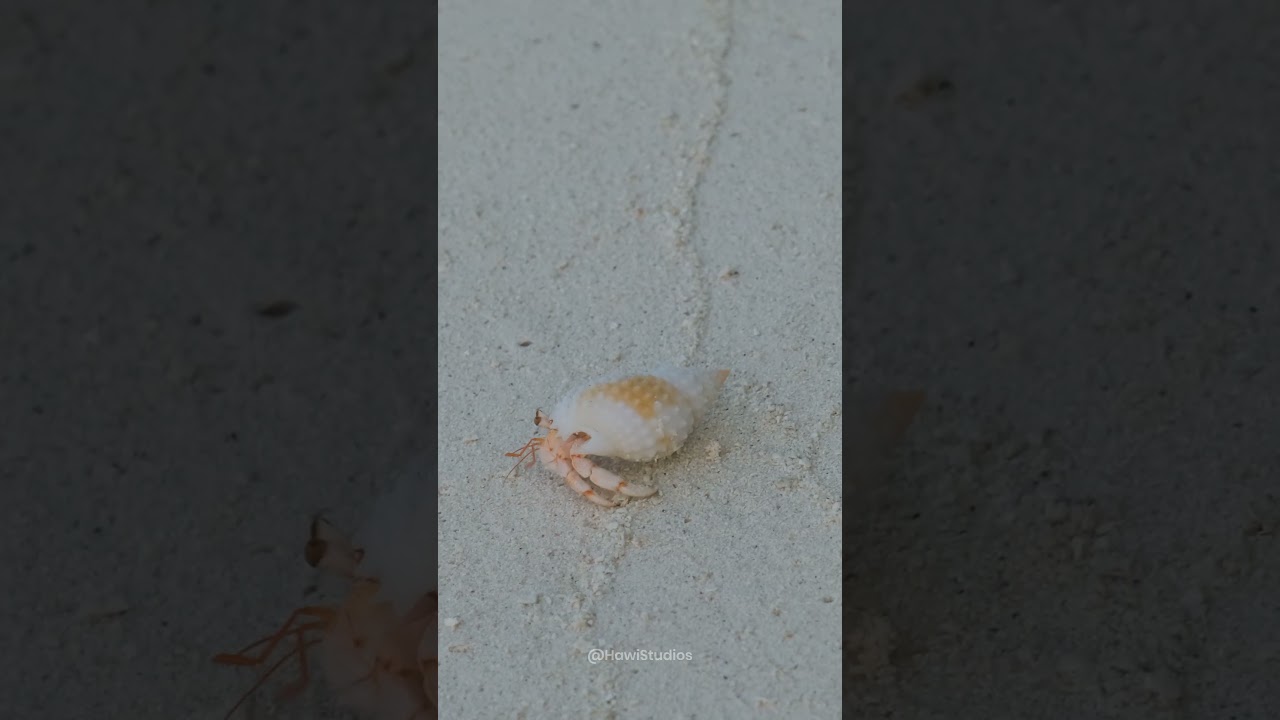
The rugose land hermit crab navigates loose sandy environments using a specialized decapod gait. In the primary footage, Coenobita rugosus steps across fine coralline sand, reaching forward with its second and third pairs of walking legs (pereiopods). These jointed limbs flex and plant into the shifting substrate, generating traction to haul the attached gastropod shell.
As the rugose land hermit crab advances, the first pair of appendages (chelipeds) provides balance and counterweight. The left cheliped is significantly larger than the right, functioning as a defensive door (operculum) when the crab retreats into its shell. During forward movement, this asymmetric claw stays slightly raised above the sand to prevent unnecessary drag.
Morphological adaptations for carrying gastropod shells
Unlike true crabs, land hermit crabs possess an uncalcified, soft pleon (abdomen) that spirals downward to match the internal coil of gastropod shells. Modified asymmetrical appendages at the tip of the abdomen, known as uropods, press tightly against the central column (columella) of the shell. This muscular anchoring prevents ocean currents or mechanical force from dislodging the crab from its enclosure.
The exoskeleton of the cephalothorax measures between 10 and 30 millimeters long in adult specimens. Because the shell adds substantial dead weight, the pereiopod muscles are built for high torque rather than speed. This anatomy allows Coenobita rugosus to carry shells that weigh up to 120 percent of its own wet body mass across uneven beach topography.
Sensory navigation and environmental detection
While moving across the beach, the rugose land hermit crab constantly gathers sensory input from its surrounding environment. Two prominent stalked compound eyes rise above the anterior carapace, granting a elevated field of view over sand grains. These visual structures detect overhead movements from potential avian or reptilian predators.
Simultaneously, two pairs of sensory antennae actively sample the surrounding air and ground surface. The short inner antennules flicker rapidly in a process called flicking, which detects chemical cues related to food sources, salinity levels, and humidity. The long outer antennae sweep the ground ahead to detect physical obstacles and micro-relief in the sand dune structure.
Foraging behavior and beach ecosystem interactions
Rugose land hermit crabs fill a vital ecological role as opportunistic scavengers along tropical shorelines. They forage along the high tide drift line, consuming decaying plant matter, washed-up algae, fallen fruits, and animal carrion. By processing organic detritus, these decapods accelerate nutrient recycling across tropical coastal ecosystems.
In marine intertidal environments, benthic adaptations vary widely among invertebrate species. While Coenobita rugosus walks along the open dry sand, sublittoral species rely on subterranean concealment strategies, similar to mechanisms documented in Zebra Squid burrowing behavior and benthic adaptations. Benthic predators on adjacent reef flats, such as those analyzed in black frogfish biology and benthic mechanics, exploit camouflage to capture mobile crustaceans that enter shallow waters.
Coastal conservation challenges and micro-habitat threats
Despite being locally abundant, rugose land hermit crab populations face growing threats from coastal human activities. Plastic pollution on tropical beaches poses a severe danger, as land hermit crabs frequently enter discarded plastic bottles or caps searching for shelter. Once trapped inside smooth plastic containers, the crabs cannot climb out and succumb to high temperature stress.
Additionally, human removal of empty gastropod shells from beaches deprives growing hermit crabs of future shelters. Without a steady supply of natural shells, crab populations experience reduced growth rates and increased exposure to desiccation. Soft-bodied marine organisms employ alternative survival methods, such as soft body chemical releases observed in octopus ink defense biological mechanics, whereas land hermit crabs remain entirely dependent on physical calcium carbonate structures for protection.
How does a hermit crab move while carrying a shell?
A rugose land hermit crab uses its second and third pairs of walking legs (pereiopods) to grip and push off the sandy surface in an alternating gait. The soft abdomen remains hooked inside the gastropod shell via modified uropods, allowing the crab to haul heavy shell mass without losing its grip.
Why do land hermit crabs need gastropod shells?
Land hermit crabs possess an uncalcified, soft abdomen (pleon) vulnerable to physical injury, predators, and desiccation. Borrowing empty gastropod shells provides a portable micro-habitat that retains internal moisture and physical defense.
How fast can a rugose land hermit crab walk on beach sand?
On open beach sand, a rugose land hermit crab travels at speeds between 1 and 3 centimeters per second. Velocity varies based on sand grain size, slope steepness, and the relative mass of the shell.
How do hermit crabs find bigger shells when they grow?
Hermit crabs participate in social vacancy chains. Multiple crabs gather near an empty gastropod shell, lining up according to body size so each crab can step up to the next larger size class sequentially.