
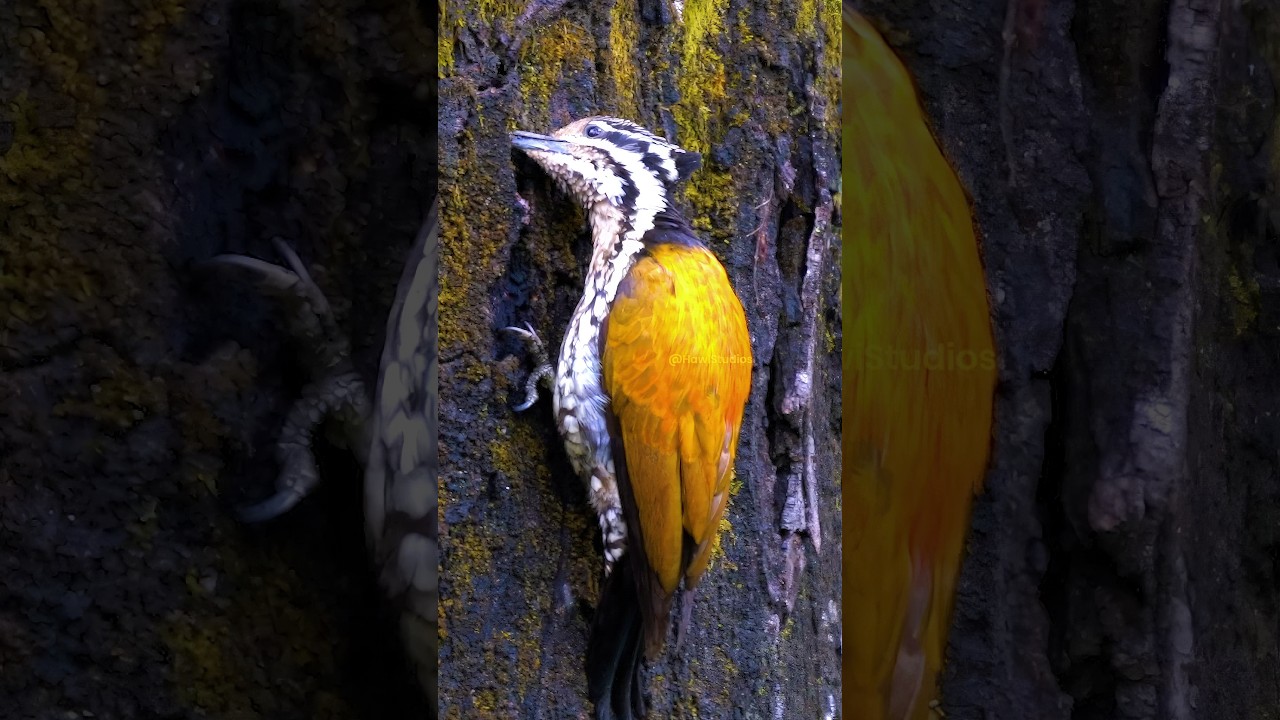
Direct answer summary
The Himalayan flameback (Dinopium shorii) uses a specialized biological kit comprising a chisel-like bill, zygodactyl feet, and stiffened rectrices to extract subterranean forest insects. By bracing its rigid tail against vertical bark, the bird delivers localized mechanical blows to uncover hidden wood-boring larvae.
Key Field Takeaways
- Taxonomic Classification: Class Aves, Order Piciformes, Family Picidae, Dinopium shorii.
- Primary Behavioral Adaptation: Zygodactyl toe arrangement paired with rigid tail feather bracing for vertical bark scaling.
- Ecological Niche &, Range: Subtropical moist broadleaf forests across the Himalayan foothills at elevations up to 1,500 meters.
- Conservation &, Field Status: Categorized as Least Concern on the IUCN Red List of Threatened Species with stable localized populations.
| Field Metric | Biological Specification |
|---|---|
| Binomial Nomenclature | Dinopium shorii |
| Common Names | Himalayan flameback, Himalayan goldenback |
| IUCN Conservation Status | Least Concern (LC) |
| Primary Diet &, Apparatus | Insectivorous (ants, beetle larvae), chisel bill and barbed hyoid tongue |
| Natural Habitat Elevation | Foothill and hill broadleaf forests, 200 to 1,500 meters |
| Key Adaptation | Spongy shock-absorbing skull bone paired with a tripod tail brace system |
Visual breakdown of bark foraging mechanics
The visual footage reveals the exact mechanical sequence used by the Himalayan flameback (Dinopium shorii) while foraging on vertical timber. Perched on a moss encrusted tree trunk, the bird anchors its weight using specialized claws while driving its upper mandible directly into bark crevices. Between 00:00 and 00:05, the bird executes precise side to side head movements, adjusting its beak insertion angle by 15 to 30 degrees to reach subterranean insect channels.
At 00:06, the individual rotates its torso upward, revealing its full dorsal color pattern. The movement shows how the bird relies on its stiffened tail feathers as a central support column. This structural tripod reduces muscle fatigue in the lower limbs, allowing the avian predator to deliver high energy percussive taps without slipping off wet moss or crumbling bark layers.
Skeletal and anatomical adaptations for vertical climbing
Vertical bark navigation requires distinct skeletal modifications unique to the family Picidae. The Himalayan flameback possesses zygodactyl feet, an arrangement where the second and third digits face forward, while the first and fourth digits point backward. This physical configuration allows the toes to wrap securely around uneven tree bark, distributing body mass across four independent anchor points.
Tail feather bracing mechanics
The central tail feathers, known as rectrices, feature broad, thick shafts that resist bending under compressive loads. When the bird presses its tail against the tree trunk, these rigid feathers create an external bracing system. This structural support counteracts the force of gravity, enabling the bird to maintain stability while hammering into dense timber.
Cranial impact absorption
Repeated beak impacts generate substantial forces that could injure brain tissue in unadapted vertebrates. To prevent cranial injury, the Himalayan flameback features spongy trabecular bone in the frontal area of the skull. This porous bone matrix dampens kinetic energy, while the hyoid apparatus wraps entirely around the skull to function as a mechanical shock absorber during active percussive drilling.
Plumage morphology and visual species identification
The visual characteristics of Dinopium shorii allow field researchers to separate it from sympatric species such as the black rumped flameback. The overall dorsal surface features bright golden yellow feathering across the mantle and wings. At 00:07 of the recording, a sudden wing shift highlights a distinct crimson lower back and rump patch, confirming its specific identity.
The head region displays a classic black and white striped pattern extending from the lores across the neck. Males bear a vivid crimson crown and crest, whereas females present a black crown covered in small white oval spots. The throat area contains a thin, broken center stripe that helps field ornithologists differentiate this species from larger Chrysocolaptes woodpeckers.
Habitat dynamics and forest canopy ecology
The Himalayan flameback thrives primarily in mature moist deciduous and broadleaf forests along the southern slopes of the Himalayas. Its geographical range spans across northern India, Nepal, Bhutan, and parts of Myanmar at altitudes from 200 to 1,500 meters above sea level. Forest tracts rich in mature trees offer ample deadwood cavities necessary for both insect foraging and annual nest construction.
These birds play an essential functional role in forest health by regulating populations of wood-boring beetles and carpenter ants. By excavating bark cavities to find prey, the species exposes hidden insect colonies to other smaller forest birds. The abandoned nest cavities created by the flameback later serve as nesting sites for secondary cavity-nesting species throughout the canopy ecosystem.
Conservation standing and avian ecosystem connections
Current field assessments by the International Union for Conservation of Nature classify the Himalayan flameback as Least Concern. Despite localized habitat fragmentation caused by timber harvesting and agricultural expansion, regional populations remain broadly distributed across protected reserves. Maintaining old growth trees with intact deadwood sections remains vital for preserving regional avian biodiversity.
In these forest ecosystems, the flameback shares space with diverse avian species that rely on similar vegetation layers. For instance, understanding Indian Peafowl biology provides perspective on lower forest floor interactions, while studies on Rose-ringed Parakeet foraging highlight how secondary cavity occupants utilize old woodpecker nest sites. Additionally, monitoring Thick-billed Green-Pigeon feeding behaviors illustrates how fruit-eating birds interact with the same canopy structures surveyed by insectivorous woodpeckers.