
Direct answer summary
European praying mantis (Mantis religiosa) feeding mechanics rely on lightning-fast raptorial forelegs that lock prey in place within 30 to 50 milliseconds. Lacking venom, the mantis uses chewing mandibles to break down the chitinous exoskeleton while spined tibiae prevent escape.
Key Field Takeaways
- Taxonomic Classification: Class Insecta, Order Mantodea, Family Mantidae, Mantis religiosa.
- Strike Velocity &, Mechanics: Foreleg extension occurs within 30 to 50 milliseconds using specialized barbed joints.
- Sensory Adaptation: Compound eyes with fovea-like resolution regions permit precise depth perception up to 50 centimeters away.
- Conservation Status: Classified as Least Concern with stable populations across grasslands and agricultural systems.
| Biological Property | Field Specification |
|---|---|
| Binomial Nomenclature | Mantis religiosa |
| Common Name | European praying mantis |
| Conservation Status | Least Concern (IUCN Red List) |
| Primary Feeding Apparatus | Spined raptorial forelegs and chewing mandibles |
| Natural Habitat Zone | Temperate grasslands, scrublands, and agricultural fields |
| Key Adaptation | 180-degree neck rotation and binocular stereoscopic vision |
Immediate physical observation and behavioral mechanics
Frame by frame analysis of the predatory hold
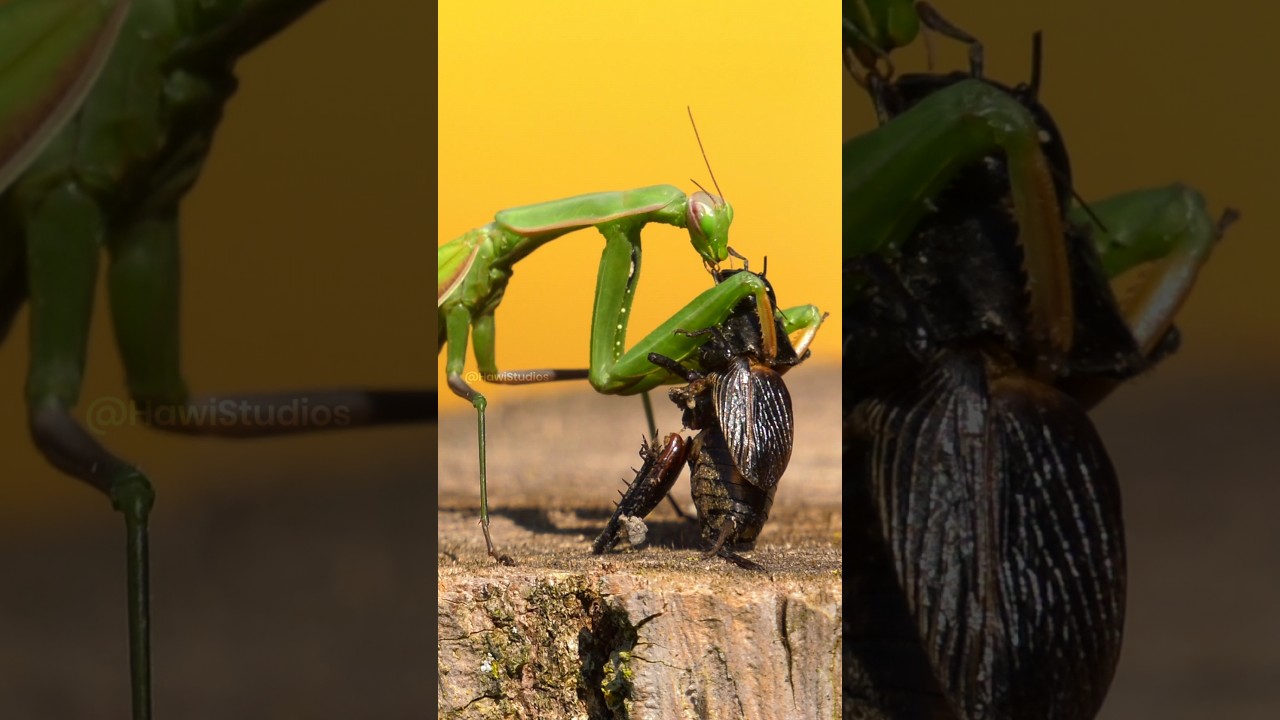
The primary footage displays a bright green adult European praying mantis positioned on a dry wooden substrate. The mantis holds a field cricket (Gryllus campestris) secured between its primary raptorial forelegs. The powerful femora and tibiae flex at acute angles, locking the outer shell of the cricket against rows of cuticular spines. The mantis anchors its body with four elongated walking legs while elevating its anterior thorax to maintain leverage over the thrashing prey.
As the prey struggles, the mantis maintains an unwavering grip near the prothorax of the cricket. The lower tibiae exert constant mechanical pressure against the soft abdominal segment joints. This physical immobilisation prevents the cricket from engaging its strong hind legs to jump away. The mantis uses its flexible neck joint to orient its head directly downwards toward the dorsal region of the captured insect.
Mandible engagement and exoskeleton breakdown
The mantis uses sharp mandibles to chew through the outer head plates of the cricket. The chewing action relies on lateral movement of paired maxillae and mandibles that crush sclerotized protein layers. Drops of digestive secretions enter the puncture site, softening dense tissue layers as the mouthparts slice into muscle fibers. The mantis systematically consumes the soft internal organs before grinding through thicker sclerotized leg joints.
Because mantises lack chemical venom or stings, the prey remains alive during the initial phases of feeding. Continuous mechanical chewing disrupts central nervous system function within minutes. The mantis pauses periodically to adjust its foreleg positioning, ensuring that balance remains centered over its hind legs while transferring weight across the wooden surface.
Morphological and anatomical adaptations
Raptorial foreleg architecture and locking mechanism
The forelegs of Mantis religiosa represent specialized predatory appendages evolved from typical insect walking legs. The femur features two prominent rows of ventral spines matched by complementary grooves along the tibia. When the tibia snaps backward against the femur, these rigid spines interlock like a trap, trapping soft tissues of prey items between rigid chitinous teeth.
This mechanical clamping force does not require continuous muscle contraction once closed. The spatial arrangement of the leg flexor muscles allows high static pressure with minimal energy output. Similar structural principles occur across specialized arthropod predators, including aquatic species studied in arrow crab foraging mechanics.
Compound vision and cranial rotation mechanics
Praying mantises are unique among insects in possessing true stereoscopic depth perception achieved through forward-facing compound eyes. Each eye contains up to 10,000 individual ommatidia arranged to create an overlapping visual field. A high-density zone near the center of the visual organ functions like a vertebrate fovea, allowing clear spatial resolution for calculating distance to moving targets.
The head connects to the prothorax via a soft cervical membrane that enables 180 degrees of lateral movement. This cranial flexibility allows the mantis to track fast-moving insects without altering its body posture or rustling nearby foliage. Consequently, ambient camouflage remains intact until the moment of foreleg deployment.
Habitat range and terrestrial ecology
Vegetation structure and microclimate preferences
Mantis religiosa inhabits sunny, open terrestrial habitats across southern Europe, temperate Asia, northern Africa, and introduced areas of North America. Preferred sites include tall grasslands, shrubby meadows, crop margins, and old field environments. These areas provide vertical plant stalks that support camouflage tactics and offer elevated hunting perches.
Temperature exerts a direct effect on mantis activity levels and metabolic efficiency. Optimal hunting efficiency occurs between 25 and 35 degrees Celsius. In cooler conditions, nerve impulse conduction slows down, extending strike duration and decreasing capture accuracy on mobile prey species.
Microhabitat hunting strategies
As an ambush predator, the mantis rests motionless on stems or wooden surfaces for long periods. Green or brown cuticular coloration matches surrounding vegetation, obscuring the insect from both potential prey and avian predators. The mantis waits until an unsuspecting insect enters a strike zone measured at approximately two-thirds of its foreleg length.
Once a target enters this proximity radius, tiny adjustment movements position the body axis toward the victim. The mantis shifts its weight onto its middle and hind legs while drawing its raptorial arms back toward the chest. This posture stores elastic potential energy in thoracic tendons before rapid muscle contraction triggers the strike.
Interspecies relationships and evolutionary significance
Role in invertebrate trophic networks
Praying mantises function as high-level invertebrate predators within grassland ecosystems. By preying on abundant herbivorous insects like crickets, grasshoppers, and caterpillars, mantises assist in regulating insect populations. Their feeding activities reduce plant tissue damage across agricultural borders and native plant communities.
In turn, mantises serve as vital protein sources for larger terrestrial vertebrates, including songbirds, lizards, and small mammals. Specialized terrestrial foraging strategies seen in small mammals are documented in Eurasian red squirrel foraging studies. Furthermore, social insects like ants interact with mantises, occasionally scavenging leftover insect carcasses discarded by feeding mantises, as detailed in research on leaf-cutter ant foraging mechanics.
Selective pressure on prey defense adaptations
The intense predatory pressure exerted by mantises has driven counter-adaptations in orthopteran prey species. Many field crickets have evolved sensitive cercal hairs capable of detecting micro air currents generated by an approaching foreleg strike. Early detection allows crickets to initiate defensive jumping movements within milliseconds.
Additionally, sound-producing structures in crickets serve dual functions for mate attraction and territorial signaling, but high-frequency vibrations can inadvertently expose their position to nearby mantises. This evolutionary back-and-forth shapes sensory biology across both predator and prey lineages in shared grassland ecosystems.
Conservation status and ecosystem threats
Habitat fragmentation and agricultural impacts
Mantis religiosa holds an evaluation of Least Concern on the IUCN Red List of Threatened Species due to its wide distribution and broad ecological tolerance. However, localized population declines occur in regions affected by intense industrial agriculture. Broad-spectrum chemical insecticides reduce overall prey availability while directly poisoning non-target predatory insects.
Habitats characterized by frequent mechanical mowing remove essential egg deposition sites known as oothecae. Female mantises attach these foamy egg cases to sturdy plant stems during late autumn. Protecting unmown vegetation buffer strips along agricultural fields provides critical winter refuges for overwintering egg masses.
Technical specifications and taxonomic detail
How fast is a praying mantis strike when capturing prey?
A praying mantis strikes in approximately 30 to 50 milliseconds. Specialized raptorial forelegs extend and snap shut around prey faster than a human eye blinks.
How do praying mantises process their prey after capture?
Praying mantises do not possess venom or digestive stings. They hold captured insects using barbed tibiae and chew directly into exoskeleton tissue using powerful slicing mandibles.
Can a praying mantis turn its head completely around?
Yes, praying mantises possess a specialized neck joint that allows up to 180 degrees of lateral head rotation. This mobility enables full visual tracking without body repositioning.
What primary prey do European praying mantises target?
European praying mantises eat grasshoppers, crickets, flies, moths, and other terrestrial arthropods, occasionally consuming small vertebrates if full body size permits.