
Direct answer summary
Greek tortoise feeding adaptations center on a toothless, sharp keratin sheath known as a rhamphotheca that shears fibrous vegetation at ground level. Supported by heavily scaled, columnar forelimbs for anchor leverage, Testudo graeca grazes on clover and grass with precise downward head strikes to process tough plant matter efficiently.
Key Field Takeaways
- Taxonomic Classification: Class Reptilia, Order Testudines, Family Testudinidae, Testudo graeca.
- Primary Behavioral Adaptation: Low-altitude grazing utilizing a sharp keratinized rhamphotheca to shear stem fibers close to the root base.
- Ecological Niche & Range: Native to Southern Europe, North Africa, and Southwest Asia across Mediterranean scrubland and semi-arid pastures.
- Conservation Status: Classified as Vulnerable on the IUCN Red List due to habitat destruction and historic collection.
| Biological Attribute | Observed Specification |
|---|---|
| Binomial Name | Testudo graeca |
| Common Name | Greek tortoise (Spur-thighed tortoise) |
| IUCN Conservation Status | Vulnerable |
| Primary Diet | Herbivorous (broadleaf forbs, wild grasses, clover, succulents) |
| Average Carapace Length | 15 to 25 cm |
| Adult Body Mass | 1.0 to 3.0 kg |
| Foraging Mechanism | Jaw closure via keratinized rhamphotheca shear edges |
Grazing biomechanics and head movement in Greek tortoises
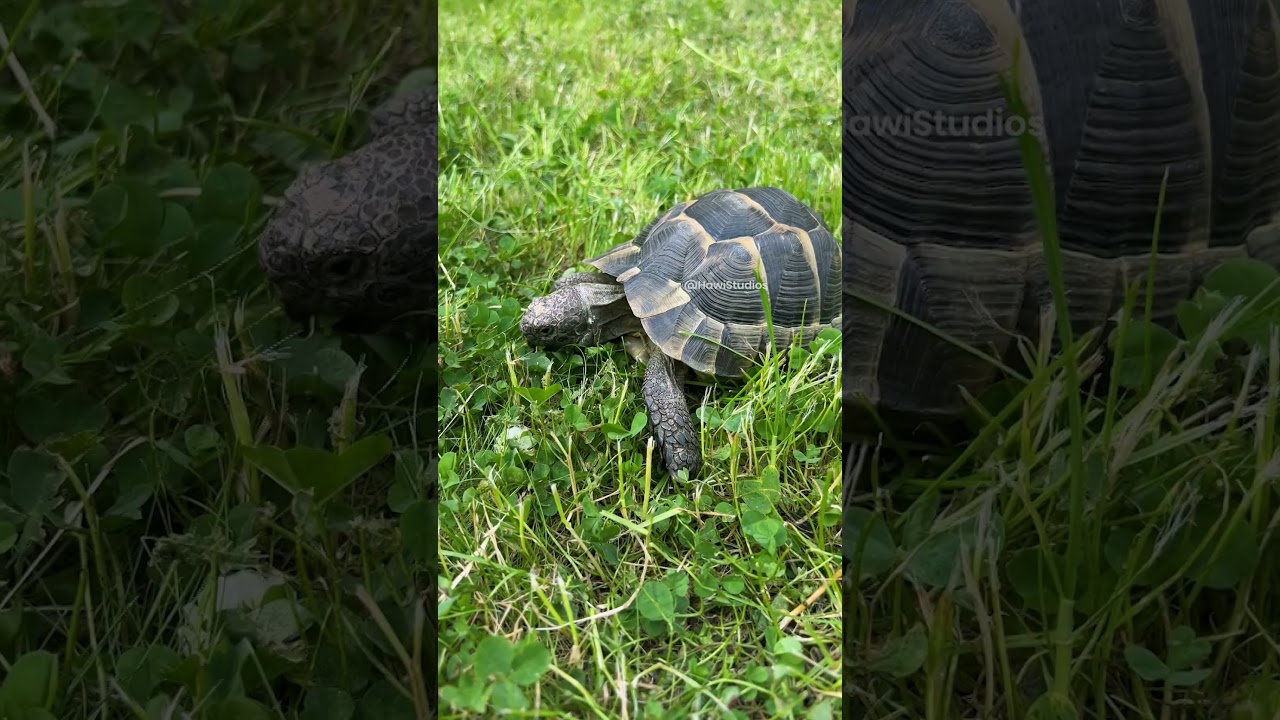
Observational footage shows the Greek tortoise (Testudo graeca) navigating a patch of turf grass mixed with clover (Trifolium repens). The feeding sequence begins when the reptile extends its flexible cervical vertebrae, thrusting its head forward and downward toward target leaves. The movement is controlled, bringing the snout within millimeters of the foliage before jaw engagement occurs.
Because tortoises possess rigid shells, head movement supplies all front-end positioning during grazing. The head tilts slightly sideways or downward depending on the angle of the target stem. Once aligned, the jaws open wide, surrounding the plant tissue before closing forcefully to sever the leaf blade.
Forelimb anchor mechanics during plant shearing
As Testudo graeca bites into vegetation, its forelimbs remain firmly planted in the substrate. The forelimbs feature large, overlapping epidermal scales and broad claw structures that grip the soil. This stance prevents the tortoise from slipping forward when pulling back against resilient grass fibers.
The combination of forward jaw pressure and backward cervical tension allows the animal to tear off stubborn plant parts. This physical anchoring mechanism compensates for the lack of flexible lips or mobile cheek structures found in mammalian grazers.
Cranial morphology and toothless digestive processing
Members of the family Testudinidae lack dentition entirely. Instead, the upper and lower jaw bones are capped by a continuous horn sheath called the rhamphotheca. The inner edges of this sheath feature sharp margins that act like scissors when the lower jaw retracts against the upper jaw.
When grazing on low vegetation, the sharp rim of the rhamphotheca cuts through cell walls and stem fibers. The broad roof of the mouth helps push severed material toward the pharynx. A short, thick muscular tongue then aids in swallowing the unchewed plant fragments whole.
Digestion of high-fiber plant materials
Because plant matter is swallowed in relatively large pieces, initial physical breakdown relies on jaw action rather than oral mastication. Post-ingestion processing occurs in the enlarged hindgut. Specialized symbiotic microflora degrade tough cellulose and hemicellulose into absorbable short-chain fatty acids over an extended transit time that can last several days.
Terrestrial locomotion and shell structure on grasslands
The movement shown in the footage highlights the interaction between terrestrial locomotion and shell geometry. The carapace of Testudo graeca displays a high dome composed of fused bony plates covered by keratinized scutes. Dark brown and yellow patterns on each scute break up the animal’s outline against mixed ground cover.
Locomotion across uneven lawn terrain uses a classic quadrupedal diagonal-gait walk. Opposite forelimbs and hindlimbs move in coordinated sequence, keeping the center of mass stable inside the support footprint formed by three grounded feet.
Limb design and ground clearance
The forelimbs of the Greek tortoise are flattened and spade-like, adapted for pushing aside dense stems and digging burrows. The hindlimbs are columnar and elephantine, designed to bear the heavy weight of the shell and internal organs. Ground clearance remains low, allowing the lower shell, or plastron, to slide past tall blades of grass while maintaining momentum.
Mediterranean habitat dynamics and thermal foraging windows
In native Mediterranean ecosystems, Testudo graeca inhabits dry scrublands, coastal dunes, and open pastures. Feeding activity correlates strongly with environmental temperatures. As ectothermic reptiles, their core metabolic rate depends on external heat sources to maintain optimal body temperatures between 26 and 32 degrees Celsius.
Foraging typically occurs during morning and late afternoon hours when ambient temperatures permit active movement without risking lethal overheating. Similar environmental temperature requirements influence behavioral pacing in other terrestrial species, such as oriental garden lizard thermoregulation strategy in open terrain.
Ground level resource competition and herbivory
By consuming low-lying broadleaf weeds and clover, the Greek tortoise occupies a specific herbivorous niche at ground level. Other small invertebrates share this space, utilizing distinct sensory mechanisms, as seen in black land snail locomotion across damp soil. Grazing by tortoises helps clear dense leaf cover, creating micro-gaps that allow seeds to germinate.
Ecosystem roles, threats, and conservation priorities
As primary consumers, Greek tortoises influence plant distribution through seed dispersal. Undigested seeds pass through the digestive tract intact and are deposited across different zones in nutrient-rich fecal matter, promoting plant diversity in dry environments.
Despite their ecological importance, populations of Testudo graeca face pressure from habitat destruction, urban development, agricultural expansion, and wild collection for the pet trade. Protecting continuous tracts of Mediterranean habitat remains vital for preserving naturally foraging wild populations.
How do Greek tortoises bite grass without teeth?
Greek tortoises possess a razor-sharp keratin beak known as a rhamphotheca. This horn-like structure covers the upper and lower jaws, allowing the reptile to slice through fibrous plant tissues using simple lever mechanics.
What is the primary natural diet of Testudo graeca?
In the wild, Testudo graeca feeds primarily on herbaceous vegetation, including wild grasses, clover, dandelion greens, succulents, and broadleaf forbs rich in calcium and crude fiber.
Why do Greek tortoises lower their heads so close to the turf while moving?
Lowering the head brings the eyes and nasal cavities close to ground level, enabling the tortoise to inspect potential food items using visual cues and olfactory receptors before biting.
What role do the forelimbs play during terrestrial grazing?
The heavily scaled forelimbs act as anchors against the soil, providing leverage while the head pulls upward to snap off fibrous vegetation held in the jaws.