
Direct answer summary
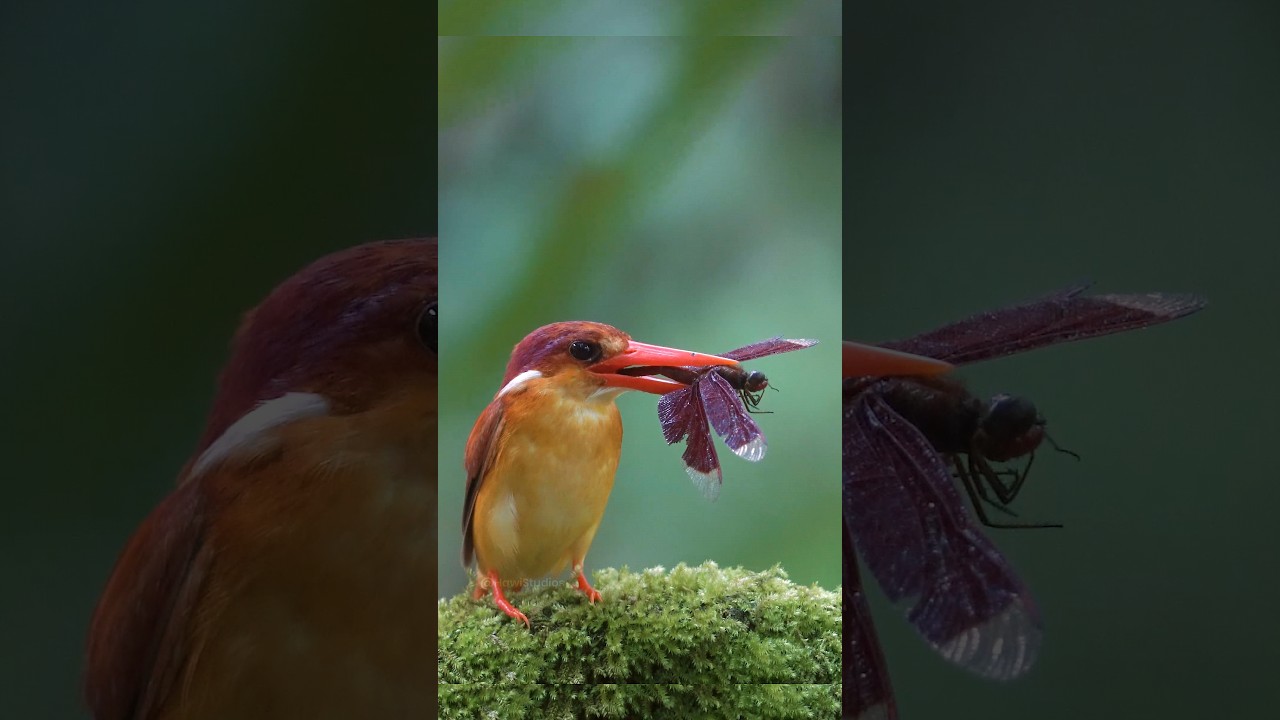
The rufous-backed kingfisher (Ceyx erithaca) captures aquatic and terrestrial invertebrates using high-speed sallying strikes, repositioning captured prey within its long bill. Through precise mandibular adjustments, the bird disarms stiff wings and fractures rigid chitinous exoskeletons on wooden perches prior to head-first ingestion.
Key Field Takeaways
- Taxonomic Classification: Order Coraciiformes, Family Alcedinidae, Ceyx erithaca.
- Primary Behavioral Adaptation: Precise mandibular rotation and perch-battering tactics to neutralize large odonate prey.
- Ecological Niche & Range: Shaded lowland rainforest streams across South and Southeast Asia below 1,000 meters elevation.
- Conservation Status: Currently classified as Near Threatened by the IUCN due to lowland forest conversion.
| Attribute | Specification |
|---|---|
| Scientific Binomial | Ceyx erithaca |
| Common Names | Rufous-backed kingfisher, Oriental dwarf kingfisher |
| IUCN Status | Near Threatened |
| Body Length | 13 to 14 centimeters |
| Average Body Mass | 14 to 20 grams |
| Primary Diet | Odonates (dragonflies), orthopterans, spiders, small amphibians |
| Habitat Elevation Range | Lowland evergreen forest streams under 1,000 meters |
Mandibular manipulation and prey handling mechanics
The observational footage captures a rufous-backed kingfisher (Ceyx erithaca) perched on a moss-covered branch while holding a large red dragonfly belonging to the order Odonata. The bird maintains a firm grip across the thorax of the insect, using the full length of its red rhamphotheca to prevent escape. Capturing winged invertebrates requires immediate control over muscle groups that drive flight organs, which the bird achieves by pinning the thorax tightly.
Frame sequence of insect positioning
During the sequence, the rufous-backed kingfisher executes a series of brief mandibular relaxations paired with rapid head movements. This action shifts the position of the dragonfly within the bill without releasing control. The bird rotates the insect from a lateral orientation toward an aligned head-first position. Similar specialized prey handling mechanics occur in other forest avian species, such as observed in grey butcherbird vocal mechanics research regarding perch-based prey manipulation.
Chitin crushing and wing disarming tactics
Dragonfly wings consist of rigid chitin veins that present structural obstruction during deglutition. The video highlights how the rufous-backed kingfisher squeezes its lower and upper mandible to crush the base of the wings. In field conditions, individuals frequently strike captured prey repeatedly against woody perches to fracture exoskeleton plates and disable remaining muscle reflexes prior to swallowing.
Anatomical features for insectivorous hunting
The morphology of Ceyx erithaca exhibits extreme adaptation for precision sallying predation in dense understory foliage. Measuring 13 to 14 centimeters in length and weighing between 14 and 20 grams, the bird possesses a high power-to-weight ratio. Its bright rufous mantle, yellow-orange underparts, and coral-red bill provide functional advantages in shaded forest environments where light filtering is highly variable.
Rhamphotheca structure and leverage points
The bill of the rufous-backed kingfisher is long, dagger-shaped, and laterally compressed. The sharp edges of the tomia allow the bird to exert focused mechanical force on hard insect cuticles. Unlike aquatic diving kingfishers that feature deeper bill keels for fish capture, this species possesses a slimmer profile optimized for grabbing terrestrial arthropods, small frogs, and stream-dwelling invertebrates.
Visual field and stereoscopic targeting
Extensive binocular overlap gives the rufous-backed kingfisher accurate depth perception required to track fast-moving insects through dense vegetation. High densities of photoreceptor cells within the retina process fast movement, allowing the bird to strike flying dragonflies mid-air or snatch them from low-hanging leaves. Retinal visual adaptations in forest birds parallel sensory structures analyzed in large-billed crow ocular mechanics studies.
Tropical understory habitat and foraging niche
The rufous-backed kingfisher occupies shaded primary and mature secondary lowland evergreen forests across Southeast Asia and the Indian subcontinent. It targets microhabitats adjacent to small forest streams, swampy hollows, and trickling rivulets where moisture levels support abundant insect populations. Dense canopy cover buffers ambient temperature fluctuations, maintaining suitable foraging microclimates.
Perch-and-wait hunting strategies near forest streams
Foraging relies on low-perch scanning tactics. The bird selects mossy roots or low branches between 0.5 and 2 meters above the ground, remaining stationary while scanning foliage and water surfaces. Once prey is localized, the bird executes a rapid sally flight, taking the target in mid-air or off vegetation before returning to the perch to process the catch. Similar perch-based surveillance patterns appear across forest fauna, as documented in Eurasian red squirrel foraging observations.
Microhabitat selection and territory defense
Breeding pairs maintain linear territories along stream channels, defending feeding zones against conspecifics using high-pitched vocal calls. The presence of moss-covered perches, as shown in the footage, provides secure footing and moisture conservation for the bird while it processes high-energy invertebrate prey items.
Trophic role and insect predation dynamics
As a mid-tier predator in tropical understory food webs, the rufous-backed kingfisher regulates local populations of odonates, orthopterans, and small terrestrial vertebrates. High metabolic demands require the bird to consume multiple large insect prey items daily, converting arthropod biomass into avian energy across stream corridors.
Impact of dragonfly consumption on aquatic food webs
Dragonflies represent significant energy packages due to their dense thoracic muscle tissue. By consuming adult dragonflies, the rufous-backed kingfisher links aquatic nymph production with terrestrial avian energetic pathways. This predatory pressure influences insect density near stream margins, stabilizing arthropod community structures.
Interspecies prey competition and foraging efficiency
Within its forest niche, the rufous-backed kingfisher competes with sympatric flycatchers, babblers, and larger kingfisher species. Its small size allows it to exploit dense, low-vegetation zones unsuited for larger birds, maximizing prey capture efficiency per unit of energy expended during flight sallies.
Conservation status and environmental pressures
The International Union for Conservation of Nature (IUCN) classifies the rufous-backed kingfisher as Near Threatened. Primary survival challenges stem from wide-scale clearing of lowland rainforest habitats for agricultural expansion, timber harvesting, and infrastructure development. Stream degradation and loss of canopy cover directly reduce aquatic insect emergence rates, limiting essential food sources for breeding populations.
Vulnerability of lowland tropical forest corridors
Because the species relies on intact understory microclimates under 1,000 meters elevation, forest fragmentation isolates local populations. Protecting riparian buffer zones along lowland streams remains fundamental to ensuring habitat connectivity and preserving essential nesting sites in earthen riverbanks.
Frequently Asked Questions
What does the rufous-backed kingfisher eat?
The rufous-backed kingfisher feeds primarily on terrestrial and aquatic invertebrates including dragonflies, grasshoppers, mantises, spiders, and small crabs, along with small frogs and lizards.
How large is the rufous-backed kingfisher?
The rufous-backed kingfisher is a small avian species measuring between 13 and 14 centimeters in total body length and weighing approximately 14 to 20 grams.
Where does the rufous-backed kingfisher live?
This species inhabits dense tropical lowland forests and stream corridors across South and Southeast Asia, typically below 1,000 meters in elevation.
Why do kingfishers shift prey in their beak before eating?
Kingfishers adjust captured prey head-first to compress tough exoskeletons, disarm flapping wings, and ensure smooth passage down the esophagus without injury.