
Direct answer summary
American bison (Bison bison) survive extreme winter blizzards by facing directly into prevailing winds to present their thickest fur coat, dense forehead wool, and massive shoulder hump to the storm. This behavioral orientation, paired with a dual-layer woolly coat, prevents body heat loss in temperatures below minus 30 degrees Celsius.
Key Field Takeaways
- Taxonomic Classification: Mammalia, Artiodactyla, Bovidae, Bison bison.
- Thermal Adaptations: High-density inner wool undercoat covered by coarse guard hairs that stop surface snow melting.
- Foraging Mechanics: Extended dorsal thoracic spines support powerful cervical muscles used for side-to-side head snow sweeping.
- Behavioral Response: Low-profile stance oriented into oncoming winds minimizes heat loss across thinner flank pelt regions.
| Taxonomic Metric | Field Biological Detail |
|---|---|
| Binomial Name | Bison bison |
| Common Name | American bison |
| IUCN Status | Near Threatened |
| Primary Diet | C3 and C4 graminoids, sedges, and woody forage |
| Habitat Range | North American plains, meadows, and cold boreal woodlands |
| Thermoregulatory Adaptation | Dual-layer insulation with low metabolic baseline down to -30 degrees C |
Frame-by-frame stance analysis in sub-zero winter storms
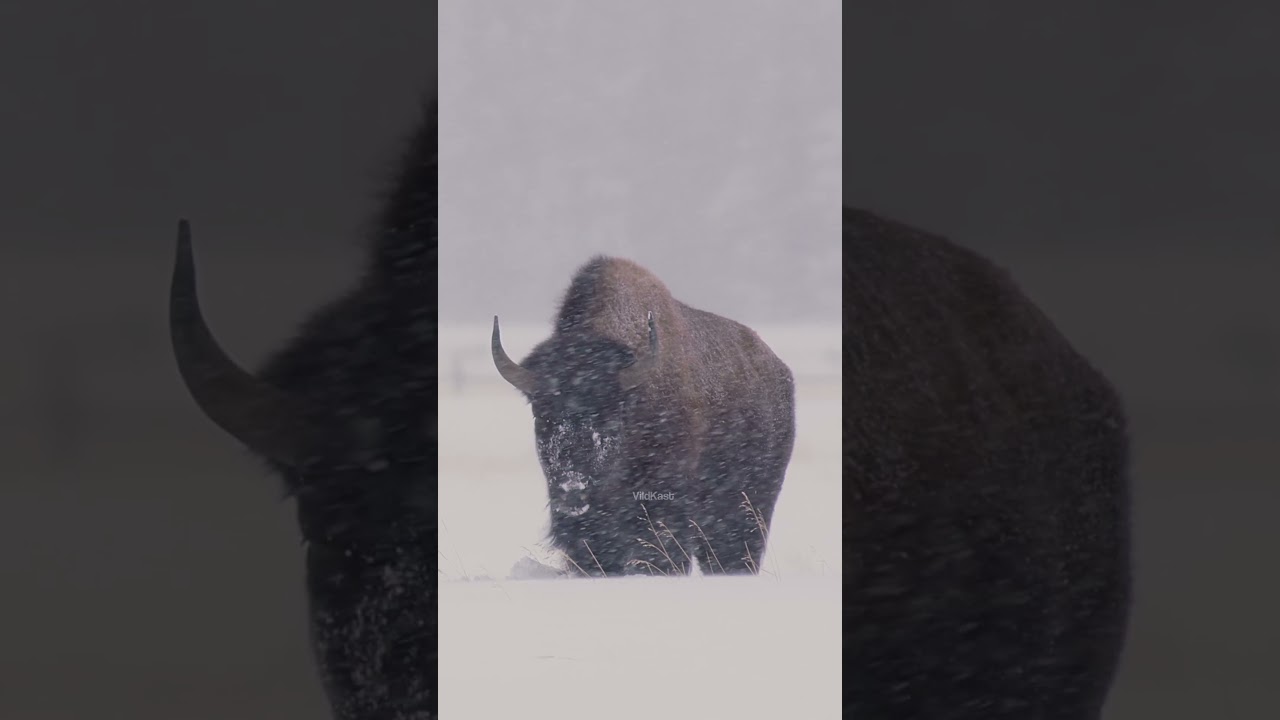
In the observed field footage, an adult male American bison stands completely stationary in an open plain during an active blizzard. The environmental conditions feature fast windblown snow particles moving horizontally across the frame. Rather than turning away from the wind, the ungulate positions its broad cranium and thick thoracic hump facing into the gale.
This directional orientation is a specialized behavioral adaptation observed in northern bovid species. The thickest area of the bison hide and hair density covers the head, neck, and shoulder regions. By presenting this fortified frontal silhouette to the oncoming snow, the animal shields its rear flanks and abdominal cavity, which carry shorter pelage and lose thermal energy faster.
During the entire sequence, the broad hooves remain planted firmly in deep snow. The lowered skull angle reduces overall body draft profile, preventing high-velocity winter gusts from lifting the protective fur layers away from the skin surface.
Dense fur insulation and thermoregulatory mechanics
The biological capacity of Bison bison to withstand arctic winter storms relies on structural hair specialization. The pelage features two main layers: a dense, highly crimped inner wool coat next to the dermis, and an outer mantle of coarse guard hairs. The inner layer traps static air pockets, creating a non-conductive barrier against low ambient air temperatures.
As recorded in the footage, snow collects directly on top of the dark hair around the forehead and shoulder hump without melting. This lack of surface melting confirms exceptionally low thermal conduction through the coat. If body heat escaped through the skin and pelt, the frozen moisture would turn to liquid water and freeze into solid ice near the dermis, stripping away insulating properties.
Furthermore, adult bison possess a metabolic baseline that remains stable across broad thermal windows. They do not need to elevate metabolic heat production until ambient air temperatures drop significantly below minus 30 degrees Celsius, conserving vital energy reserves during lean winter months.
Cranial muscle architecture and snow-sweeping foraging
Surviving prolonged blizzard conditions requires access to underlying graminoid vegetation beneath packed snow layers. Bison use their broad head structure as a mechanical tool to plow through heavy drifts. The enlarged shoulder hump consists of elongated neural spines extending from the thoracic vertebrae, serving as anchor points for massive neck muscles.
These dorsal muscles, including the trapezius and rhomboideus groups, power wide lateral swinging motions of the head. The bison lowers its muzzle into frozen snowpacks and sways its cranium back and forth to clear feeding trenches. This sweeping mechanism allows the herbivore to reach buried grasses that smaller ungulates cannot uncover.
In deep snow conditions, this clearing strategy demands substantial energy expenditure. Consequently, bison minimize non-essential movement during active storms, as shown in the footage where the individual remains motionless to conserve caloric reserves until wind velocities decrease.
Group herd dynamics and facing into arctic blizzards
While the video highlights a solitary individual, bison herd social structures also adjust during severe weather events. Unlike domestic cattle, which typically turn their backs to incoming storms and drift downwind into hazards like fences or ravines, bison move directly toward windward fronts. This collective movement allows herds to move through winter storms efficiently rather than being driven across unfamiliar terrain.
In large herd structures, mature adults often take positions on the outer windward perimeter. Younger calves and smaller sub-adults remain in the center of the mass, benefiting from the windbreak created by the heavy frontal profile of mature bulls and cows. This spatial grouping lowers thermal stress across the entire population unit.
Once the blizzard subsides, the herd uses established snow-trench paths to travel between grazing zones and sheltered river valleys. Their broad hooves distribute body weight effectively across packed snow crusts, facilitating group movement through challenging winter landscapes.
Adjacent winter survival strategies in boreal ecosystems
Winter adaptations across temperate and boreal environments vary significantly between mammalian and avian taxa. While large ungulates like bison rely on mass thermal inertia and thick pelage, smaller terrestrial species utilize different anatomical strategies. For example, comparing North American ungulate responses with mule deer vigilance mechanics illustrates how distinct body scales influence winter microhabitat selection and predator avoidance strategies.
Predatory mammals in cold zones also adapt their hunting tactics to deep snow cover. Observing red fox hunting behavior demonstrates how smaller carnivores execute specialized leaps to penetrate icy snow crusts to capture subnivean rodents. Meanwhile, arboreal mammals like the tree-dwelling rodent documented in Eurasian red squirrel foraging rely on seed stashes and tree canopy shelter to navigate harsh seasonal drops in ambient temperature.
Frequently Asked Questions
How do bison stay warm in freezing blizzards?
American bison possess a dense double-layered pelage consisting of a thick, woolly undercoat beneath long, coarse guard hairs. This pelt provides structural thermal insulation so efficient that snow accumulates on top of the outer coat without melting from body heat.
Why do bison turn to face directly into winter storms?
Bison turn toward incoming blizzards because their front shoulders, neck, and chest are protected by the thickest fur, hide, and skeletal muscle. Facing into the wind reduces body surface exposure and prevents icy wind from penetrating the thinner coat on their rear quarters.
How do bison locate grass under deep winter snow?
Bison use massive neck and shoulder muscles attached to prolonged thoracic neural spines to sweep their broad heads side to side like a snowplow. This mechanical motion clears heavy snowpacks to reveal underlying grasses and sedges.
What temperature range can an adult bison tolerate?
Adult American bison tolerate ambient temperatures below minus 30 degrees Celsius without increasing their basal metabolic rate. Their low surface-area-to-volume ratio and insulating pelt minimize heat loss in extreme arctic environments.